Sales
A proposed workflow for sales. Revised 17 September 2026. The roles below are design options, not claims that these agents are deployed or that multiple agents are necessary.
The business opportunity
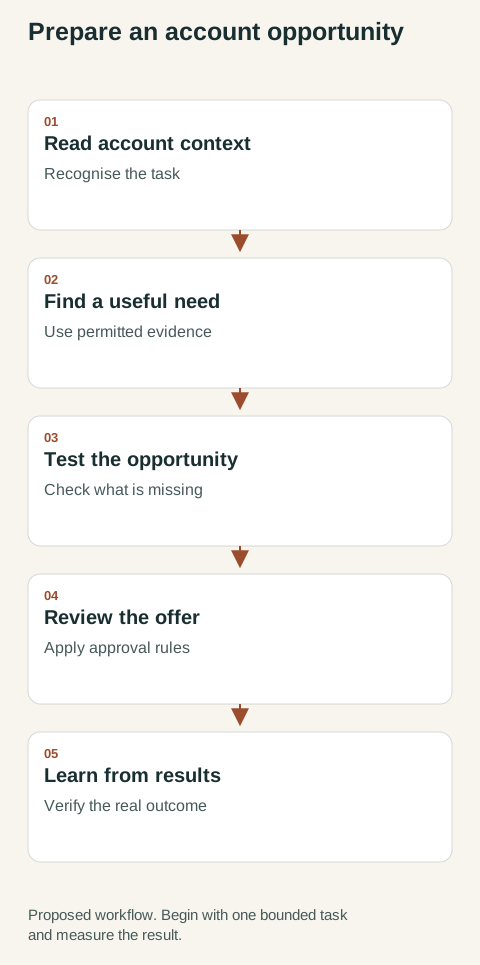
An account manager wants to identify where an existing customer might benefit from another service. The evidence spans contracts, product use, service issues, and previous commitments.
Start with the simplest useful solution
Compare the agent with cRM reports, renewal alerts, and a structured account review. Use the same representative cases and count human review, errors, integration, and ongoing operation. Add an agent only where choosing what to investigate or handling varied evidence improves the result.
Proposed responsibilities
- Agent
- Account research agent
- What it does
- Assembles account context from CRM, news, product usage and past interactions with provenance
- Autonomy and learning position
- A2, L1
- Notes
- The unglamorous winner. Solitary work, measurable, contained
- Agent
- CRM hygiene agent
- What it does
- Proposes and applies structured updates from call notes and email
- Autonomy and learning position
- A3 on structured fields, A2 on narrative, L1
- Notes
- Where the administrative time actually goes
- Agent
- Inbound qualification agent
- What it does
- Engages inbound enquiries, qualifies against stated criteria, routes
- Autonomy and learning position
- A3, L2
- Notes
- Customer-facing. Inherits the entire customer-service control set
- Agent
- Forecast analysis agent
- What it does
- Explains pipeline movement against history, flags inconsistency
- Autonomy and learning position
- A2, L2
- Notes
- Explains; the manager forecasts
Start with one agent and ordinary tools. Separate a responsibility only when it needs different permissions, independent review, or its own operating schedule. The autonomy and learning positions are starting choices to test, not certification levels.
How the architecture supports the task
Tool gateway (direct: CRM gravity is strongest here, and agents reach records through wrapped governed APIs), knowledge and memory (direct), evaluation and release (direct), identity and policy (direct for the inbound agent, which sits in the customer-facing lane), human oversight, observability and audit trail, runtime (supporting).
Controls and human decisions
Use permitted account data. Have the account owner approve claims, pricing, and external contact.
Give every tool call a task identity, a limited permission scope, and a recorded result. Before a write, check that the source record has not changed. Stop when required evidence is unavailable, the task budget is reached, or a proposal exceeds the authorised scope.
A useful investigation loop
Observe the exception, identify the missing fact, request that evidence, and check whether it changes the proposed action. Repeat only while there is a concrete unanswered question. End with a reviewed proposal, a confirmed result, or an explicit request for human help.
Economics and measures
Measure qualified opportunities, conversion, margin, customer retention, and preparation time against a comparable baseline.
Agree the baseline with the process owner. Count value only after the outcome is confirmed. Compare the value of recovered time and improved outcomes with the full cost of tools, models, evidence preparation, supervision, and correction.
Limits to test
An observed pattern is a lead to investigate. It does not establish customer intent or permission to contact someone.
Evaluate ordinary cases, uncommon failures, conflicting evidence, and recovery after an interrupted action before expanding authority.
External reading
The workflow above is the guide's proposal. These sources support the general investigation and risk-management methods; they do not validate the proposed business result.
- ReAct: reasoning and acting with language models, 2022. Research basis for alternating reasoning and tool use.
- NIST AI Risk Management Framework, 2023. General framework for managing AI risks.
Sources reviewed 17 September 2026.
Cite this page
Written by Murali Sid, Founder and AI Systems Architect, last updated 15 October 2026. Licensed CC BY-SA 4.0, so quote it freely with attribution.
Murali Sid (2026). Sales. Agentic Architecture Skills. https://www.agenticarchitectureskills.com/library/blueprints/departments/salesMachine-readable version of this page: /library/blueprints/departments/sales.md
HR and people
A proposed workflow for hr and people. Revised 17 September 2026. The roles below are design options, not claims that these agents are deployed or that multiple agents are necessary.
Marketing
A proposed workflow for marketing. Revised 17 September 2026. The roles below are design options, not claims that these agents are deployed or that multiple agents are necessary.