Adapters and supervised fine-tuning
How training on examples changes a model, what LoRA and QLoRA are, what it cannot teach, and what it breaks.
Instructions, context and tools are tuned, and the agent still gets the format or behaviour wrong. When does training the model on examples help, and what does it break? This is the first change that touches the model itself. You show it a few thousand examples of the task done well. Its weights shift towards answers in that shape. It is the right tool for consistent behaviour, and for moving work to a smaller, cheaper model. It is the wrong tool for teaching facts. It also has a side effect: models forget things they used to do well. This is one of the model-change options on the intelligence ladder.
What training on examples does
A model is a very large set of numbers called weights. Generating text means those weights turn your input into odds for each possible next token. A token is a word or part of a word.
Supervised fine-tuning shows the model an input and the output you wanted. It measures how far the model is from producing that output. Then it nudges every relevant weight slightly in the direction that closes the gap. Repeat over thousands of pairs, and the model's default behaviour moves towards the pattern the pairs share.
Two facts about fine-tuning follow from that mechanism.
It learns the pattern, not the content. The training rewards outputs shaped like your examples. If your examples are good answers about your product catalogue, the shape includes fluent, confident catalogue answers. It does not include the catalogue. A few thousand pairs cannot carry a million facts, and nothing in the process stores them. So a fine-tuned model can answer questions about your business in a perfect house style and get the details wrong. You taught it the style and the confidence, without the substance.
It moves weights that were doing other jobs. The weights being nudged are the same ones that hold general skill. Push them hard enough towards your task, and they drift away from things the model could do before. That is called catastrophic forgetting. It comes from the mechanism itself, not from sloppy work.
Full fine-tuning, LoRA and QLoRA
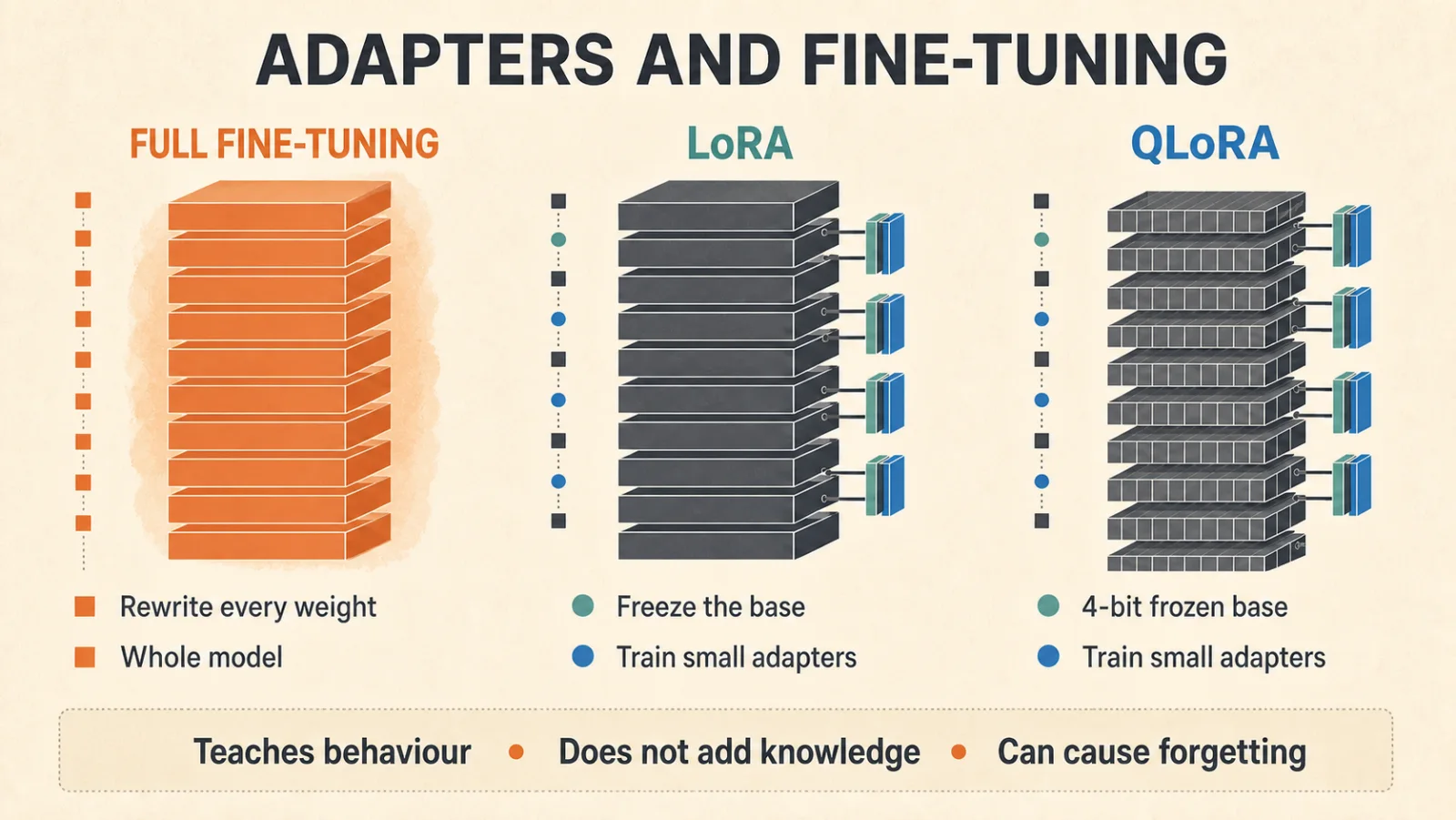
Full fine-tuning updates all the weights. It has the most power to change behaviour and needs the most computing. The output is a whole model you must store and host.
LoRA starts from an observation. A fine-tune changes a large table of weights. That change can usually be approximated by two much smaller tables multiplied together. This is what "low-rank" means. So LoRA freezes the large table and trains the two small ones alongside it. Their product is added when the model runs. The number of weights trained drops by orders of magnitude. The result is an adapter of megabytes, not a model of gigabytes. Adapters can be swapped per task over one shared base model. That is their most useful property in operation: one hosted model, many behaviours.
QLoRA adds one more move. The frozen base model is compressed to 4-bit precision during training. That cuts the memory needed far enough to adapt a large model on a single serious GPU. The adapter itself trains at normal precision. Quality is close to LoRA, on a fraction of the hardware.
One belief needs correcting because it drives bad decisions. Adapters do not prevent forgetting. Touching fewer weights sounds safer. The published finding is that LoRA does not protect the model's general skill. If forgetting matters for your use, measure it. The repair is on distillation.
foundation · comparison
Three ways to train on examples
Same mechanism, different footprint. None of the three stores facts, and none prevents forgetting.
Full fine-tuning
- Every weight updates
- Artifact: a whole model
- Multi-GPU training
- Maximum drift, maximum cost
LoRA
- Two small matrices per layer
- Artifact: megabyte adapter
- Base model stays frozen
- Swap adapters per task
QLoRA
- LoRA over a 4-bit base
- Artifact: megabyte adapter
- One serious GPU
- Near-LoRA quality, less memory
Diagram description: Comparison of full fine-tuning, LoRA and QLoRA across what trains, the artifact produced, and the hardware needed. The comparison contains 3 groups: Full fine-tuning, containing Every weight updates, Artifact: a whole model, Multi-GPU training, Maximum drift, maximum cost; LoRA, containing Two small matrices per layer, Artifact: megabyte adapter, Base model stays frozen, Swap adapters per task; QLoRA, containing LoRA over a 4-bit base, Artifact: megabyte adapter, One serious GPU, Near-LoRA quality, less memory.
What you need before starting
Examples in the low thousands, and their quality decides everything. The model learns exactly what the pairs teach, including their errors, biases and shortcuts. A hundred careful examples beat ten thousand scraped ones.
A locked eval suite that existed before training. An eval suite is a set of test tasks with known right answers. Include tests for what should not change. Measuring only the target task is how forgetting reaches production unnoticed.
A hosting plan. An adapter needs a base model to run against. A full fine-tune needs its own serving setup. Either way, you now own a trained model that has to be maintained. When the base model generation moves on, your work must be redone and re-tested.
A new or retrained model re-runs the evals at the change stage of the agent lifecycle. The learning flywheel sets out how it is tested and promoted. Models and their training sit in the intelligence and learning layer (R06).
The managed options narrowed in 2026
As of August 2026. OpenAI is withdrawing self-serve fine-tuning in phases. It announced this on its deprecations page on 7 May 2026. Organisations that had never fine-tuned lost access that day. Organisations with no recent use of a fine-tuned model lost it on 2 July 2026. Remaining customers can create no new jobs after 6 January 2027. Existing fine-tuned models keep running until their base models retire.
For most enterprises, that route is already closed. Two routes remain. One is managed fine-tuning through the major cloud platforms. The other is adapter methods on open-weight models you host or rent. Those are unaffected. This product fact changes often, so check it before you rely on it.
Worked example: inspection reports at a mine

A mining team may have reviewed examples of good inspection reports. These show how a report should separate observations, uncertainty and required follow-up. When instructions alone are not enough, these pairs are candidates for teaching consistent report behaviour.
Keep current standards, asset condition and individual incidents in retrievable evidence. Evaluate on held-out sites and unusual cases, not just reports like the training examples. Check that better formatting does not hide unsupported claims.
Compare against a baseline of a prompt with examples. Include preparation, hosting, review and maintenance cost. This proposed example assumes no particular model size, volume or saving.
When adapters are not enough
Adapters have closed the format and behaviour gap. What remains wrong is judgement or knowledge.
If the shape is right but the reasoning is wrong on outcomes a program can grade, go to reinforcement fine-tuning. If the model still misreads your domain's language and documents, go to continued pretraining. If quality is right and cost or speed is the complaint, go to distillation.
Evidence and limits
Mixed evidence The deprecation schedule is from OpenAI's own documentation, as of August 2026. The forgetting finding and the LoRA correction are published research. The finding that retrieval beats fine-tuning for adding new facts was published at EMNLP 2024. The mining example is a proposed design.
Next step
Read the next option, distillation.
Explore this topic
- OpenAI deprecations page, self-serve fine-tuning wind-down, announced 7 May 2026: https://developers.openai.com/api/docs/deprecations
- LoRA not preventing forgetting, and the order in which to try model changes: intelligence and learning and the decision catalog.
- Why facts baked into a model fail governance: the concern matrix on derived artifacts inheriting obligations.
- Retrieval over fine-tuning for adding new facts: Fine-Tuning or Retrieval?, EMNLP 2024, https://aclanthology.org/2024.emnlp-main.15/
- Industrial scenarios on this page are proposed designs, illustrated in the use cases.
Cite this page
Written by Murali Sid, Founder and AI Systems Architect, last updated 15 October 2026. Licensed CC BY-SA 4.0, so quote it freely with attribution.
Murali Sid (2026). Adapters and supervised fine-tuning. Agentic Architecture Skills. https://www.agenticarchitectureskills.com/ladder/adapters-and-fine-tuningMachine-readable version of this page: /ladder/adapters-and-fine-tuning.md