Knowledge & memory
Help an agent continue its work, use past experience, and support decisions with evidence.
An agent should not start every task from nothing. It also should not treat everything it has ever seen as current, trusted, or available to everyone. Good memory helps it carry work forward and show what supports its decisions.
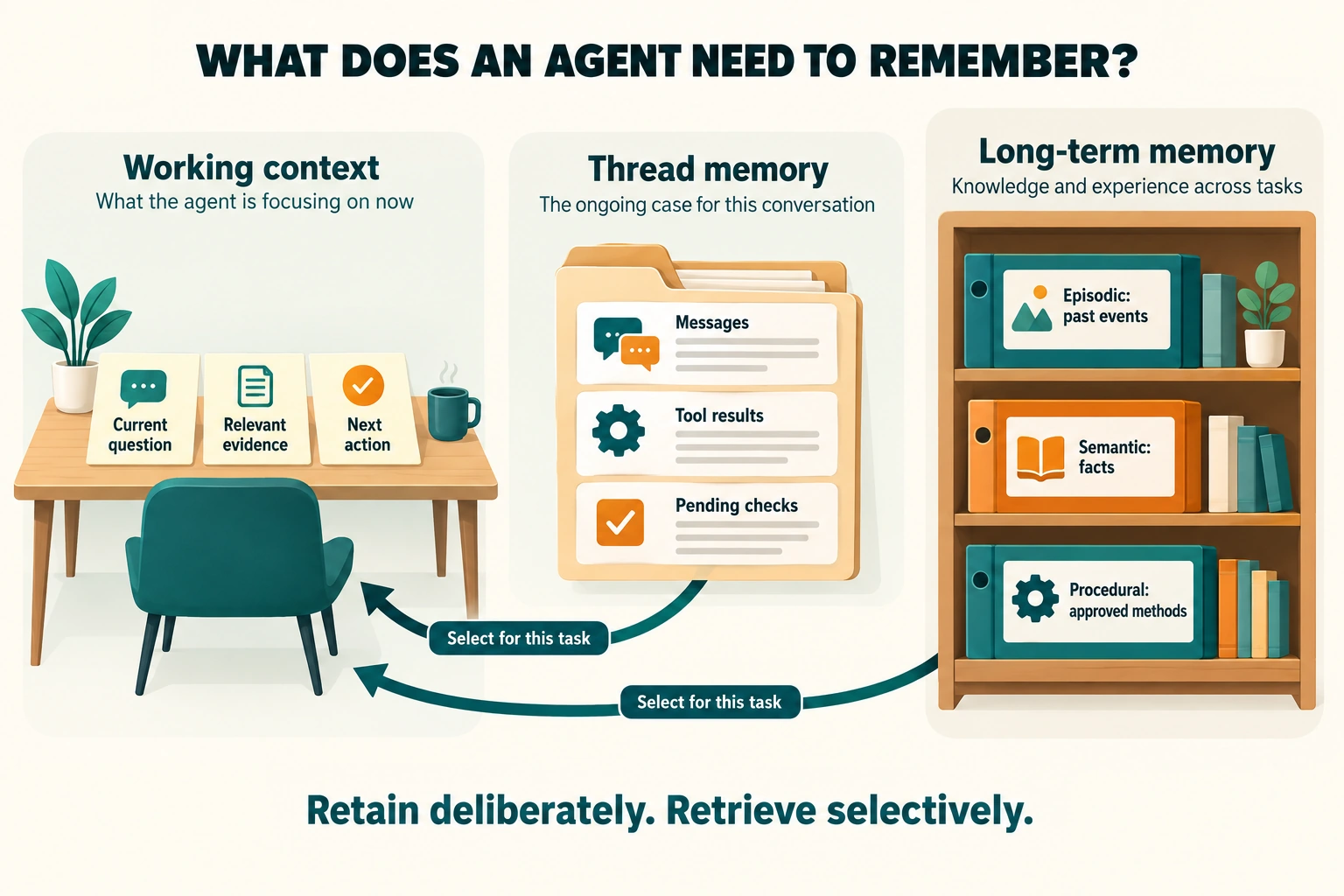
Start with a task that continues tomorrow
An agent is collecting evidence for an inspection. Today it finds a report, identifies a missing photograph, and asks for a site check. Tomorrow it should know what remains open. Next month a different investigation may benefit from the completed case, but should not inherit an unverified guess as an established fact.
A long chat transcript alone does not make these distinctions. Neither does putting every document into a vector database. We need to decide what belongs to this task, what may help future tasks, and what must remain traceable to a source.
Follow the memory story
The main path has three parts. Start with the first and follow the continuation at the end of each page.
1. Understand what to remember
2. Make it usable as evidence
3. Test the design
Go deeper when the question calls for it
The sidebar separates the main story from optional visual tours and advanced design choices. You do not need to read every embedding article to understand memory. The vector-space tour explains the different information forms together; its individual articles offer more detail.
The advanced pages compare storage designs, long context, large histories, and research findings. They are choices to investigate, not a list of components every enterprise needs.
Memory supplies evidence within the enterprise architecture. The memory story follows the data-to-memory pipeline and belongs to the build step on the Start page. The Intelligence ladder explains how an agent uses that evidence to do useful work at an acceptable cost.
Next step: start the story with what an agent should remember.
Cite this page
Written by Murali Sid, Founder and AI Systems Architect, last updated 15 October 2026. Licensed CC BY-SA 4.0, so quote it freely with attribution.
Murali Sid (2026). Knowledge & memory. Agentic Architecture Skills. https://www.agenticarchitectureskills.com/memoryMachine-readable version of this page: /memory.md