Explore memory in vector space
A visual tour of text, image, video, audio, geospatial, and time-series representations.
You have chosen what the agent should remember. Now choose what a search should treat as similar. These pictures explain the intuition; they are optional deeper reading after the memory foundations.
Different information needs different representations
An enterprise holds words, photographs, recordings, maps, and readings over time. Turning all of them into short text summaries is convenient. But a summary can lose what a later question needs. That may be a visual feature, a sequence of events, a surface pattern, or a changing signal.
The illustrations are conceptual maps, not measured embeddings. Start with text, then look at what changes for other forms of information.
Text: find related meaning
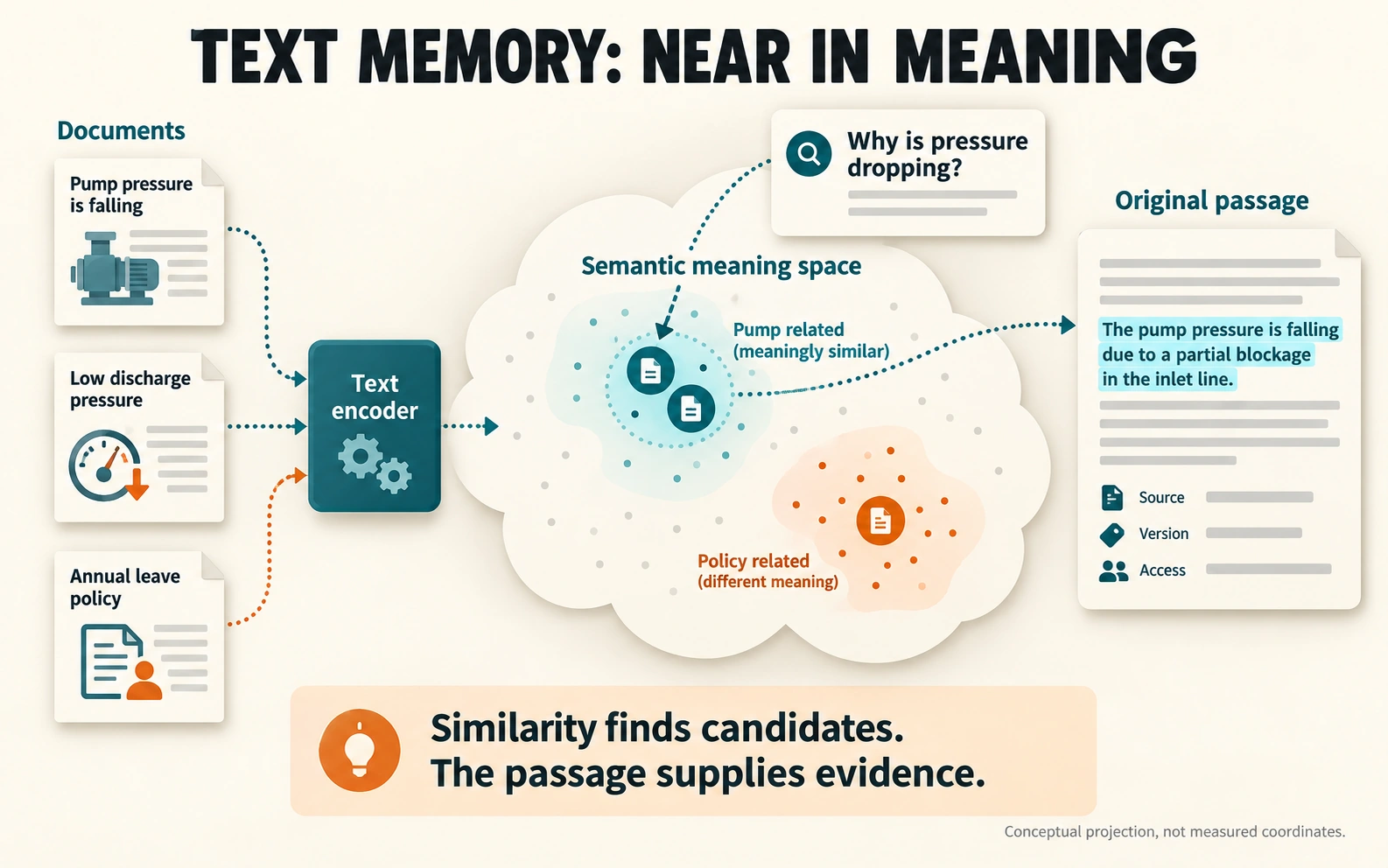
An embedding represents selected features as numbers so a search can find useful similarities. Picture a space in which related examples lie near each other. What counts as related depends on the model and its training. Real spaces use many numbers for each item. A flat picture cannot show every relationship.
A representation is not the whole memory. Keep the original sources, exact records, dates, and access rules alongside it. Start with the kind of question the agent will ask.
"Pump pressure is falling" and "low discharge pressure" may belong near each other even though their words differ. This helps find relevant procedures or earlier incidents. An exact asset number, policy version, or quantity still needs an exact check.
Images: find visual resemblance
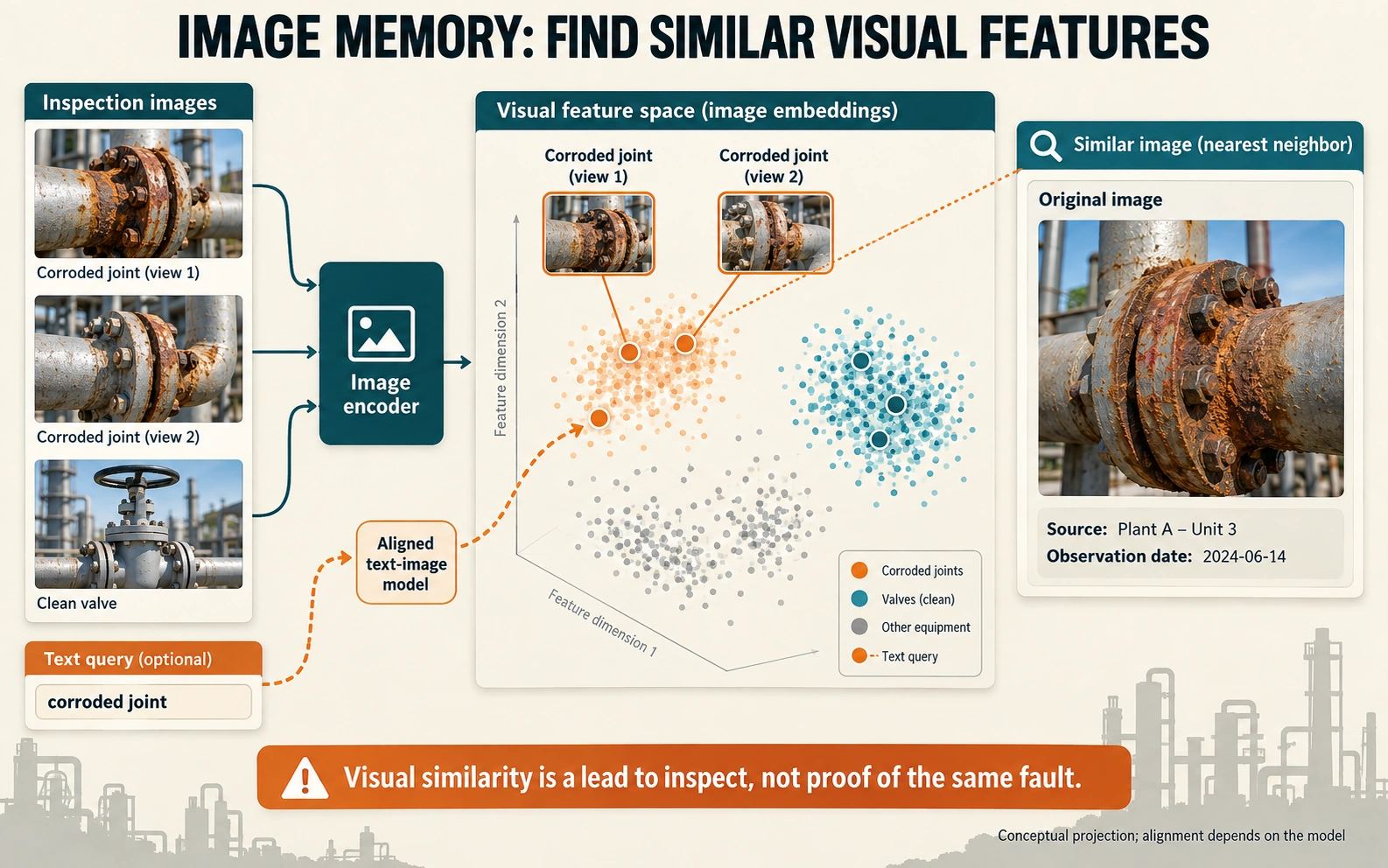
A model can place visually related inspection images near each other. Then you can look for earlier examples of corrosion or damage. With a suitably aligned text-image model, a written query can also find images. What counts as similar depends on training.
Video: find a similar event
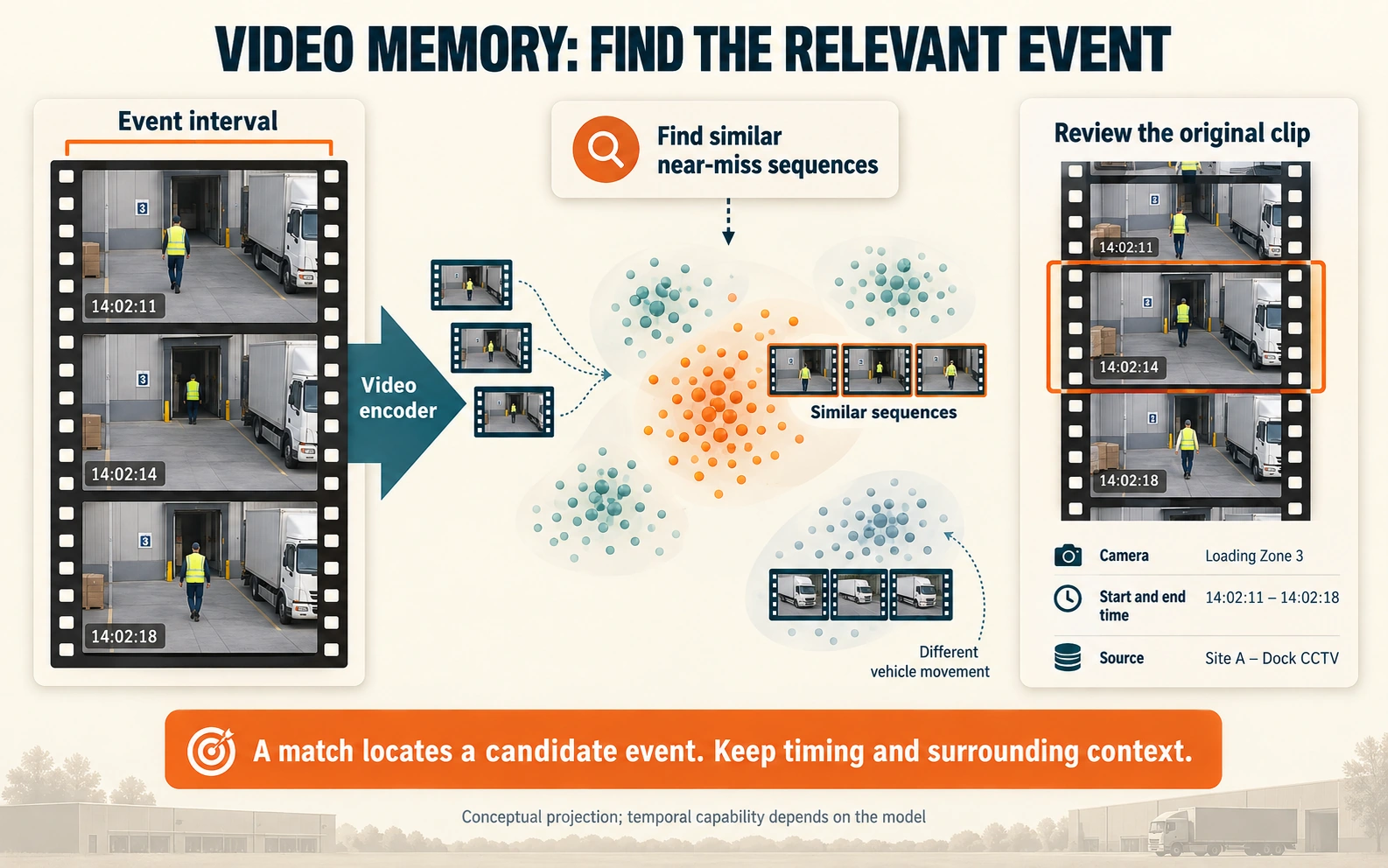
A video contains change: a person approaches a loading zone, a vehicle moves, or an inspection unfolds. A suitable representation can help search for similar clips or events. Finding a related video is different from locating the exact interval that supports a claim.
Audio: find a similar sound
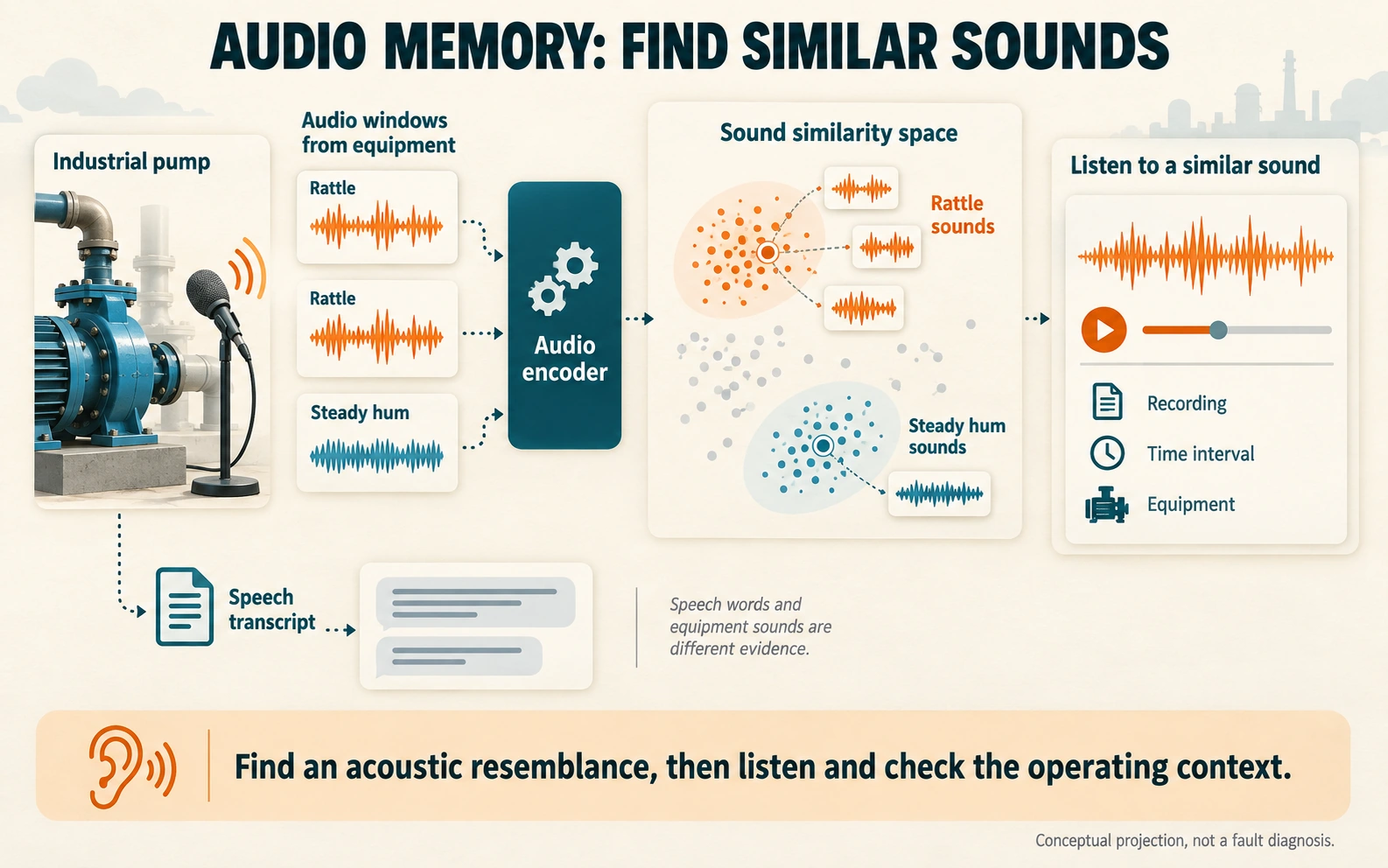
A pump rattle and a spoken maintenance instruction need different kinds of information. Sound representations can help find acoustic resemblance; a transcript can help find words. Choose the form that preserves what the question asks about.
Geospatial data: find similar places or change
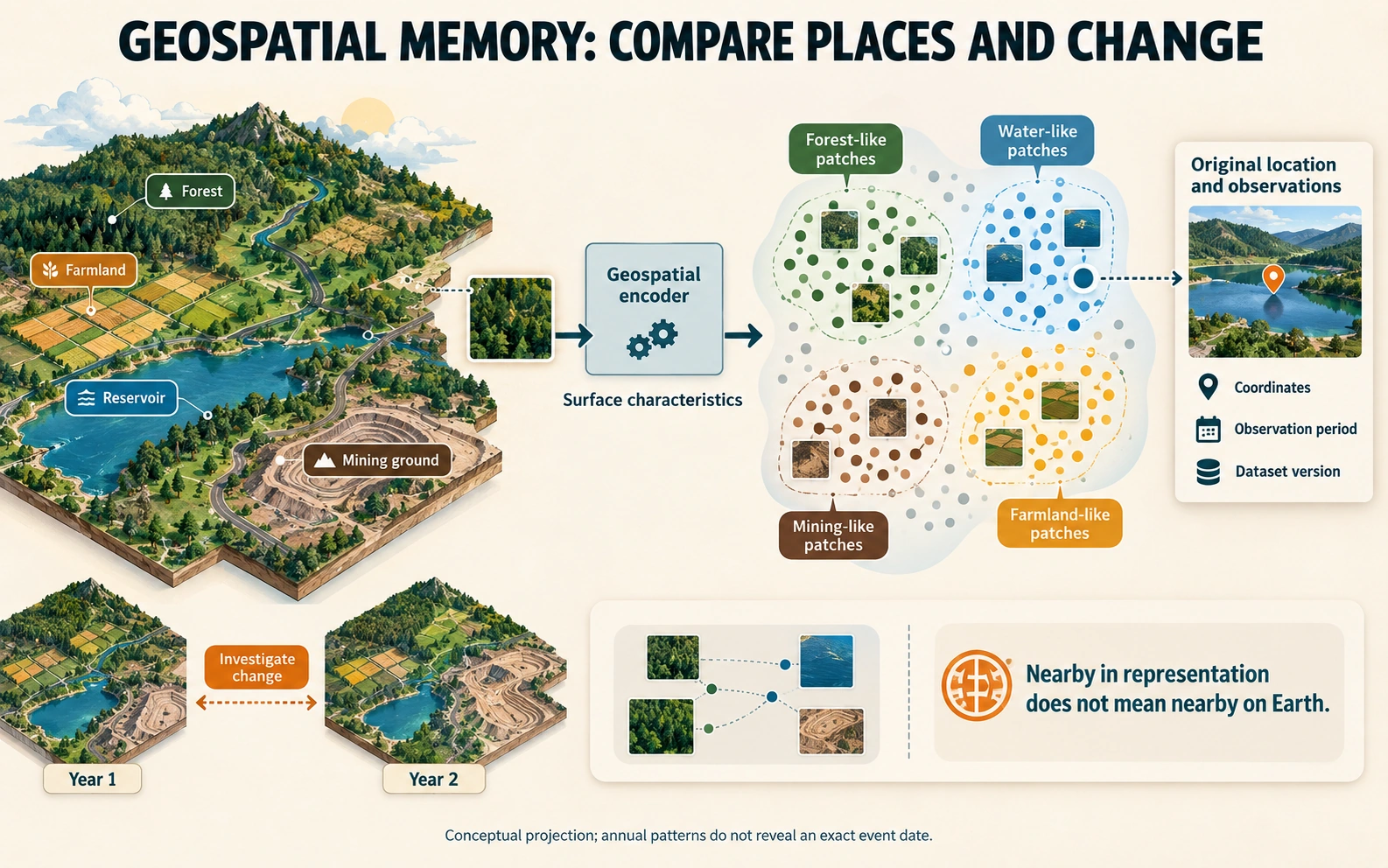
A place can be represented by learned surface characteristics and, in some models, behavior over a period. Distant areas may be similar in that space. Comparing the same location across years can guide a change investigation, while exact coordinates and dates remain explicit.
Time-series data: find similar behavior
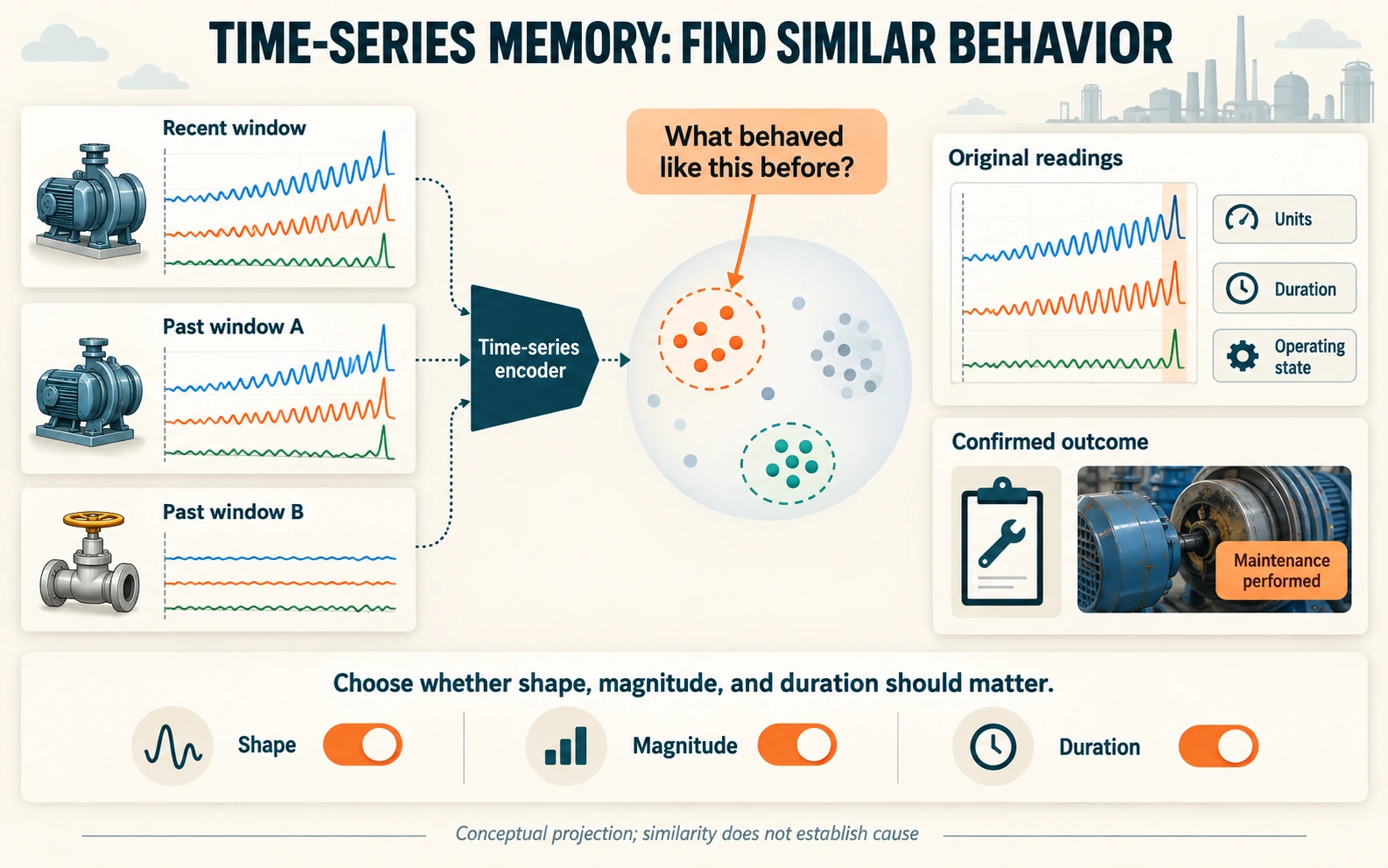
The useful resemblance may be a developing oscillation, a spike, or a sequence of changes across pressure and vibration. This lets an agent ask, "What behaved like this before?" Decide whether shape, magnitude, duration, or operating state should matter.
These are different spaces, not one universal memory map
Two models can produce vectors of the same length without giving those coordinates the same meaning. Search within a suitable space and combine the resulting evidence by asset, place, time, and source. A jointly trained or explicitly aligned model can support some cross-modal comparisons; do not assume every combination is aligned.
These six types describe the form of information. A different question is how long an agent should retain it and how it should be stored. Task context, past events, approved procedures, source records, summaries, and relationships can each use different representations. The six memory designs examine those storage choices.
Continue the story: Search text by meaning.
Cite this page
Written by Murali Sid, Founder and AI Systems Architect, last updated 15 October 2026. Licensed CC BY-SA 4.0, so quote it freely with attribution.
Murali Sid (2026). Explore memory in vector space. Agentic Architecture Skills. https://www.agenticarchitectureskills.com/memory/vector-spacesMachine-readable version of this page: /memory/vector-spaces.md