From information to usable memory
Preserve the evidence while making it easier to find and use.
A useful fact can lose its meaning on the way into memory
An inspection assistant reads a report and saves "inspection complete". That short note does not tell the next investigation which site or case it concerns, when the work happened, or what findings remain open. The short note preserved a topic while losing the facts needed to use it.
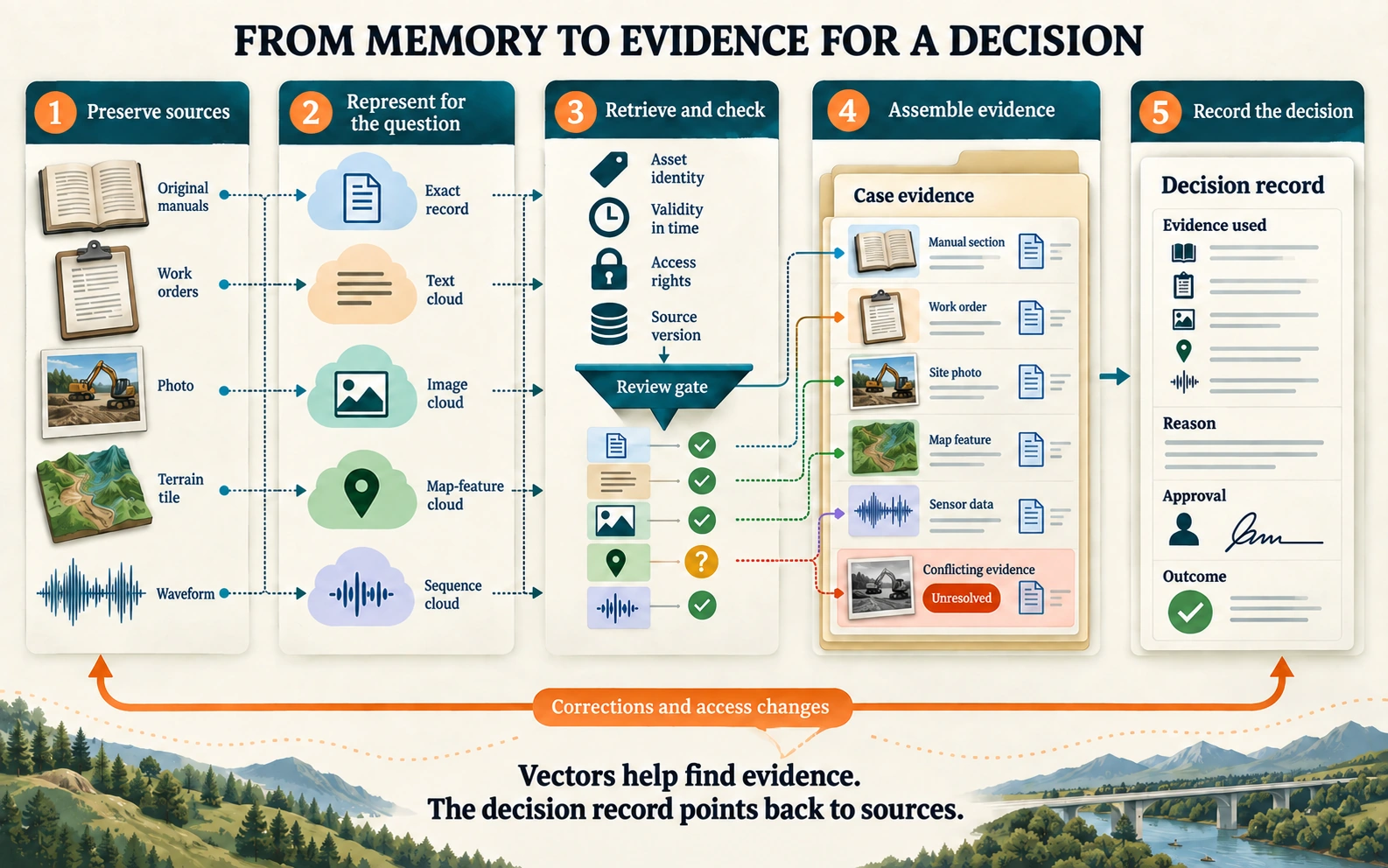
The design below keeps enough context to verify the statement later. Its preparation steps matter because identity, time, units, and source references are easier to preserve during ingestion than to reconstruct after a detail has been dropped.
Connect the decision back to its evidence
Retain the source references and versions used, a concise rationale tied to that evidence, unresolved contradictions, approval where required, and the observed outcome. The record should let a reviewer examine the decision even after sources change. Follow approved retention and access rules for historical evidence. A citation enables checking; it is not proof of correctness.
Start with the original
Keep a stable source reference and the evidence that supports a derived fact. For a document, this may be a page and passage. For a video, it is a clip and time interval. For a sensor, it is the readings, units, and observation window.
Check before adding intelligence
Resolve the asset or customer identity. Check timestamps, permissions, and quality. Separate missing information from a confirmed negative finding. If parsing loses a table heading or unit, a later model may produce a fluent but incorrect interpretation.
Prepare for a particular task
Use chunks, extracted fields, relationships, or representations where they help a known question. Retain the original evidence alongside summaries or extracted facts so a reader can inspect details that extraction omitted.
Govern durable memory
Task context is temporary working material. Information retained for future tasks needs an owner, a purpose, a retention decision, and an update path. A proposed lesson from one run is not automatically an approved policy.
Verify the complete path
Test a question whose answer changed, a record the user cannot access, a deleted source, and a question the evidence cannot answer. The result should respect the source state, not simply return the closest match.
External sources
- LandingAI document grounding, vendor documentation. Accessed 17 September 2026.
Continue the story: Choose how memory is represented.
Cite this page
Written by Murali Sid, Founder and AI Systems Architect, last updated 15 October 2026. Licensed CC BY-SA 4.0, so quote it freely with attribution.
Murali Sid (2026). From information to usable memory. Agentic Architecture Skills. https://www.agenticarchitectureskills.com/memory/information-to-memoryMachine-readable version of this page: /memory/information-to-memory.md