Bring evidence together
Join sources by identity, place, and time before combining their conclusions.
The agent finds an inspection report, a site photograph, and a similar sensor event. Together they look convincing. But the photograph might be from another site and the sensor event from last year. Relevance alone does not establish that the results describe the same case.
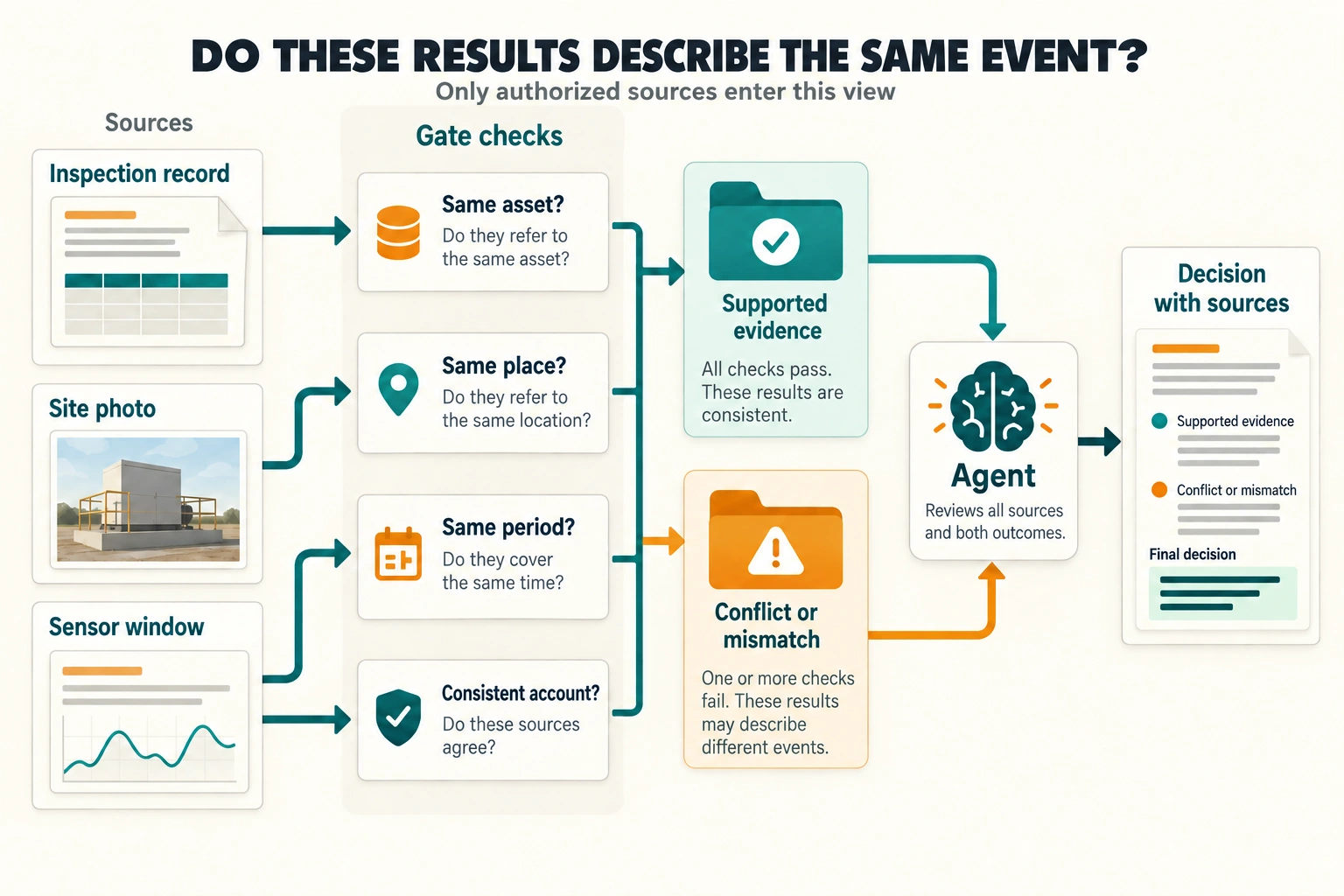
Give every search the same question
State the site, asset, period, and decision under investigation. Search official records by identifier, documents by relevant terms or meaning, and media or readings by suitable representations. Keep each result linked to its original source.
Combine the results through verified identity and time. Do not directly compare coordinates from unrelated embedding models. A shared space requires explicit alignment and a task-level evaluation.
Keep observations and conclusions apart
The report says an inspection was completed. The photograph shows a particular condition at a particular time. A sensor comparison finds a historical resemblance. None of these automatically confirms the others. Write down what each supports and what remains unknown.
Resolve disagreement without hiding it
If a recent report contradicts a photograph, check which period each describes and whether either source was corrected. Request the observation that could resolve the issue. If the conflict remains material, include it in the result and route the decision to its owner.
Preserve access across the combined view
The current reader must be permitted to see every source detail exposed. A summary made from several sources may need restricted access or regeneration when any source's permissions change. An apparently harmless combination can reveal more than each isolated item.
Ask whether the extra source helped
Compare records alone, text alone, and the proposed combination on the same tasks. Count evidence missed, unsupported conclusions, review effort, and cost. Keep extra kinds of media only when they improve the outcome enough to justify maintaining them.
This is a proposed case-assembly pattern. The underlying document, image, and signal representations are illustrated in the vector-space tour, with primary sources for each model family.
Continue the story: Handle facts that change.
Cite this page
Written by Murali Sid, Founder and AI Systems Architect, last updated 15 October 2026. Licensed CC BY-SA 4.0, so quote it freely with attribution.
Murali Sid (2026). Bring evidence together. Agentic Architecture Skills. https://www.agenticarchitectureskills.com/memory/combining-evidenceMachine-readable version of this page: /memory/combining-evidence.md