Intelligence ladder
How much intelligence does an agent need for its job, and what should that intelligence cost?
A team wants an agent to do a job. Before anyone picks a model, one question comes first. What must this agent understand, decide and do to finish the job well, and at what cost? The answer is to change the cheap things first. Those are the instructions, the context, and the tools and loop around the model. Change the model itself only when a measured limit remains. The intelligence ladder is the order in which to try those changes. It belongs to the build step on the Start page.
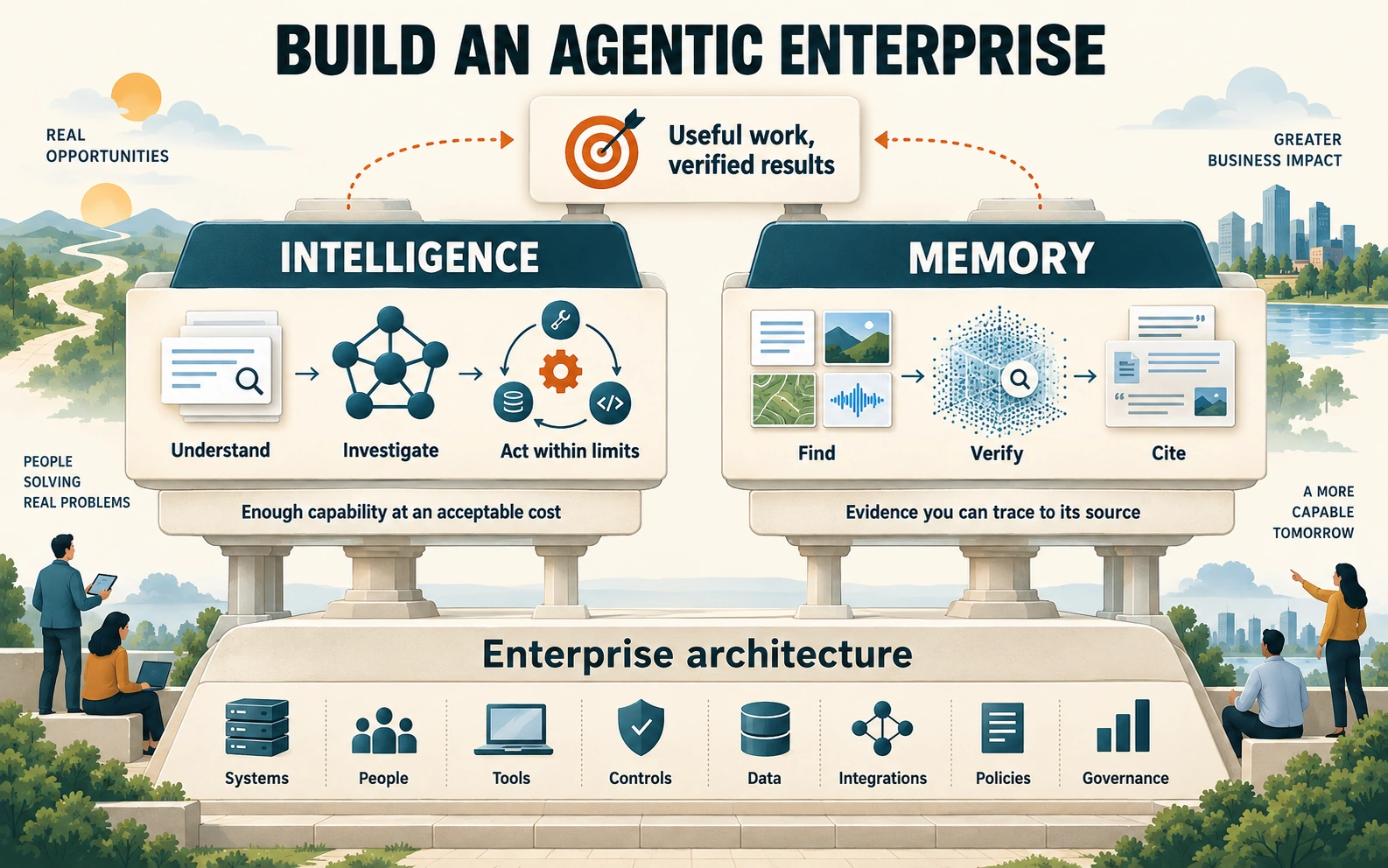
Two pillars: intelligence and memory
An agent needs two things. Intelligence decides how it handles the task. Memory gives it information it can find, check and use as evidence. This page covers intelligence. Knowledge and memory covers the other pillar. Models and their training sit in the intelligence and learning layer (R06), one of the fourteen layers of the estate.
Match intelligence to the work
Using one capable model for every task makes trials easy. It does not show where reasoning adds value, or whether a complex agent pays for itself. Compare three kinds of work instead. These are choices to test, not a fixed order.
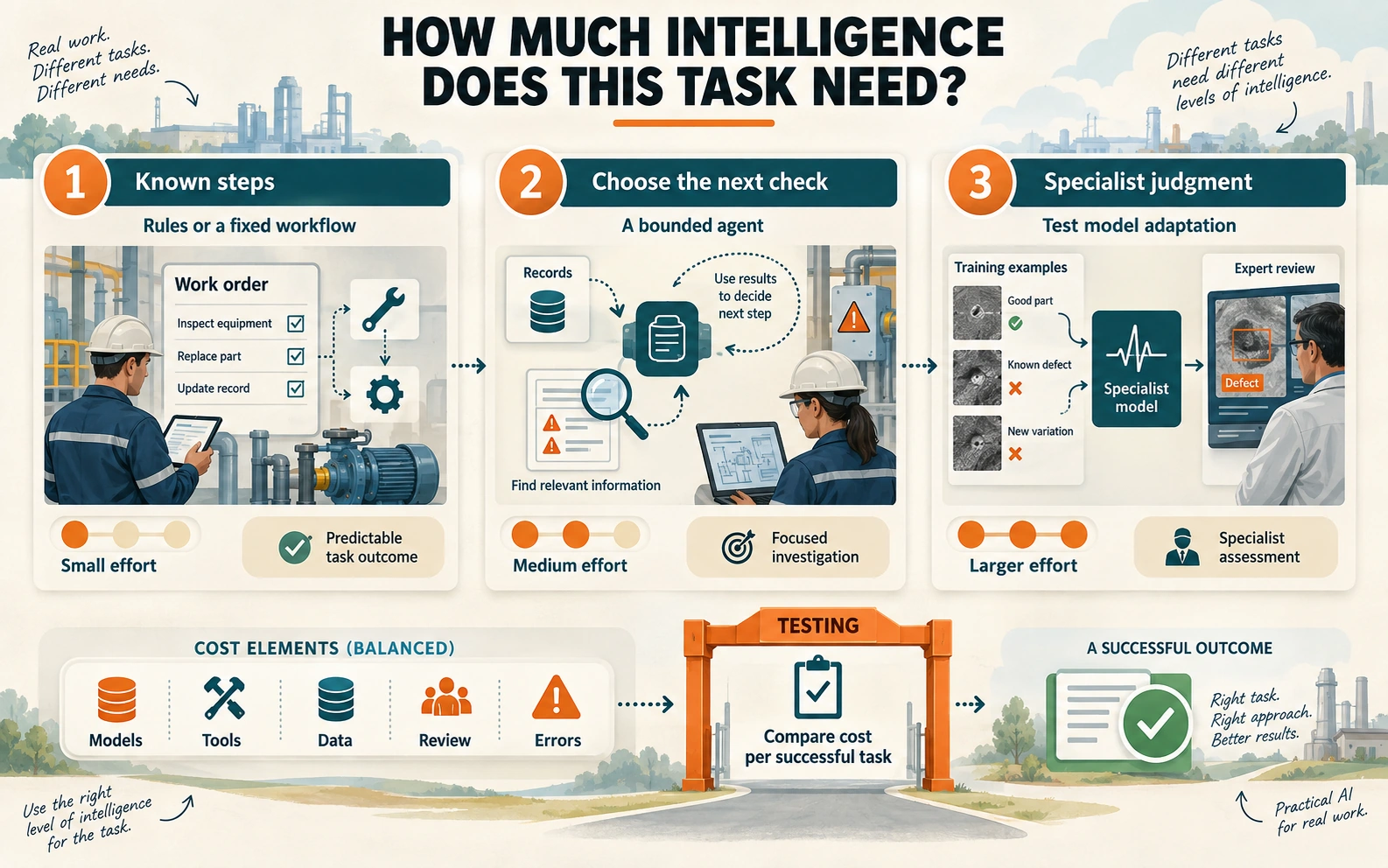
Known steps. Checking required fields before an inspection request goes in has known steps. Ordinary software or a fixed workflow may do it.
Steps that depend on what is found. Investigating an unexplained gap in production figures changes as it goes. The agent finds missing evidence, picks a tool, reads the result and decides what to check next.
Specialist judgement. Spotting a particular defect pattern needs expert judgement. Compare better inputs, specialist models and training. Train only when it fixes a demonstrated limit you can maintain.
A capable agent does not need broad authority. Set how freely it acts in the autonomy contract, apart from the model's capability.
Change the cheap things first
Try the three changes that cost least first.
Instructions: define good work
Context: supply what matters now
Tools and the loop: investigate and act
If those are enough, stop there. The Agentic OS sets out the harness you build around the model and the runtime you buy.
Count the full cost
Judge cost against the business outcome, not one model call. An investigation can involve many calls, tools, retries and expert review. A cheaper answer that creates rework can cost more in the end.
For a trial, add up the full cost of the evaluated cases, failed attempts included. Add supervision time at the full hourly cost of the people doing it. Add the cost of fixing wrong outcomes. Divide the total by the outcomes accepted as resolved to the agreed standard. That is the cost per resolved outcome. Report failures and serious errors separately, so a good average cannot hide them.
Compare designs on the same cases. For example, test a rules-based workflow, a smaller model with retrieval, and a stronger model allowed to investigate. Route hard cases to a stronger model only if you can reliably spot them. Spread build and upkeep costs over realistic volumes. Each agent has a budget with hard caps, tracked in the observability and FinOps layer (R12). Value and full cost builds the business case.
Change the model only when a measured limit remains
When the cheap changes stop helping, five options change the model itself. They can be combined. Use only the ones the failure calls for.
Adapters and fine-tuning
Distillation
Reinforcement fine-tuning
Continued pretraining
Custom pretraining
Any model change re-runs the evals and the risk check at the change stage of the agent lifecycle. The learning flywheel sets out how it is tested and promoted.
More help while you build
- Diagnose a failed task before changing anything.
- Choose between a workflow, one agent or several.
- Combine specialist models around one task.
- Give the agent evidence it can check, in knowledge and memory.
Evidence and limits
The three kinds of work and the order of changes are teaching designs, not measured rankings. Each step page carries its own sources, dates and limits.
Next step
Diagnose a failed task before changing anything, on choose what to change.
Cite this page
Written by Murali Sid, Founder and AI Systems Architect, last updated 15 October 2026. Licensed CC BY-SA 4.0, so quote it freely with attribution.
Murali Sid (2026). Intelligence ladder. Agentic Architecture Skills. https://www.agenticarchitectureskills.com/ladderMachine-readable version of this page: /ladder.md