Measure value and full cost
A sponsor asks what an agent will cost and what it will save. Count every cost, divide by the outcomes the business accepts as resolved, and compare with today.
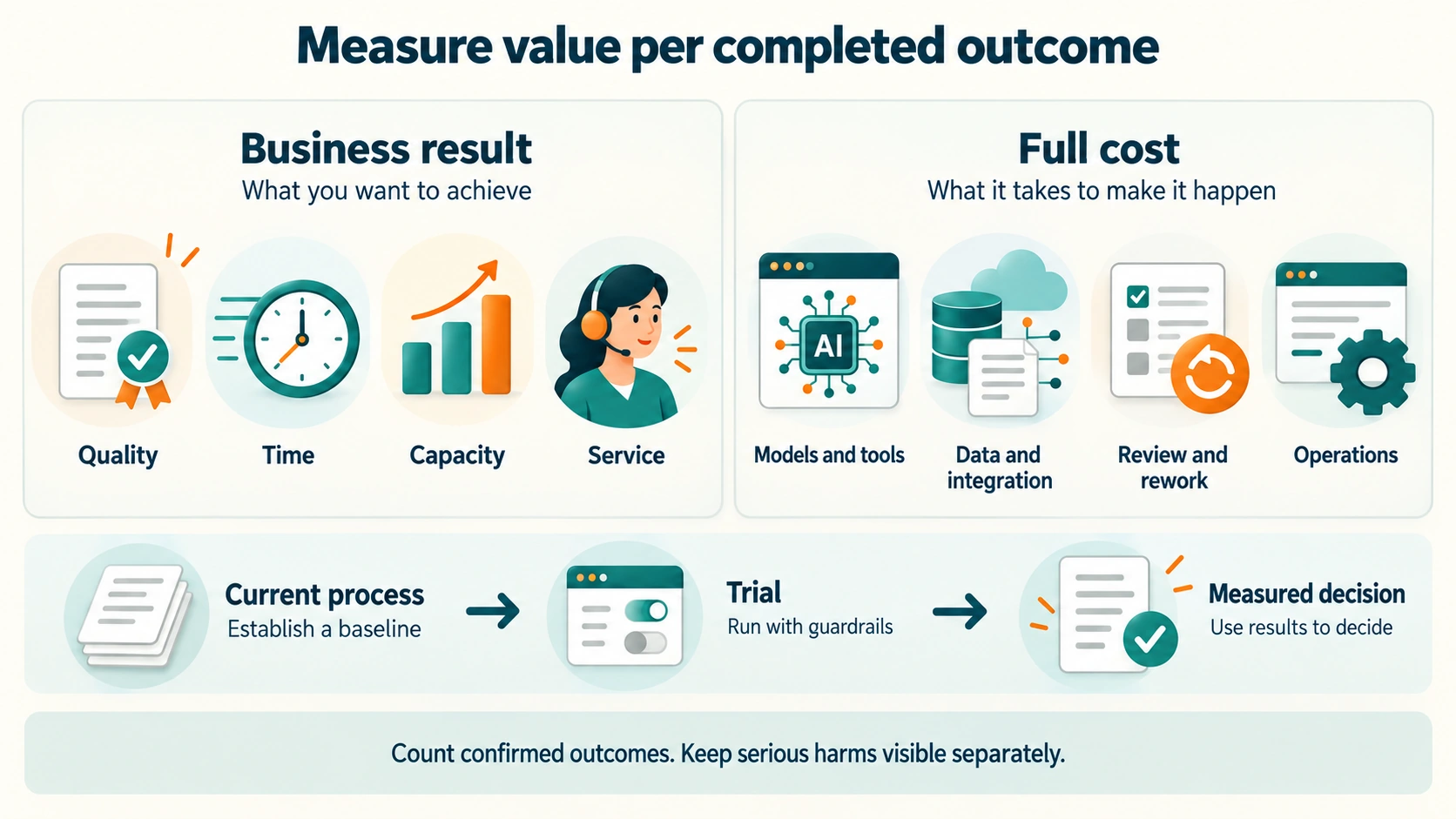
The head of billing at an energy retailer wants an agent for billing exceptions. Before funding it, finance asks two questions. What will the agent cost? And what will it save? Answer both with one number: the cost per resolved outcome. Count every cost, including the people who review the agent's work and the cost of fixing its mistakes. Divide by the cases the business accepts as resolved. Then compare that with what the same result costs today.
Pick the business result first
Choose the result before choosing a model. For billing exceptions, the result is a bill that goes out correct and on time. Other work needs other measures. Production throughput, customer resolution, evidence coverage and proposal quality are each measured differently.
Record today's starting point
Record the current time, quality, cost and volume of the work, exceptions included. For the retailer, that means how many exceptions arrive each week and how long each one takes. It also means how many bills go out wrong, and what fixing them costs. Keep the same definition of a resolved case when you compare options. Record what else changed besides the agent. Then a new billing rule or extra staff is not credited to the agent.
Count the full cost
Include model calls, tools, infrastructure, data preparation, integration and licences. Include human review, retries, wrong outcomes and maintenance. The economics model has the full list.
Platforms charge per run. A run that ends in a wrong bill still counts as one run. So the decision needs a cost per outcome, not a cost per run.
Divide by the outcomes accepted as resolved
Cost per resolved outcome is:
- all model, tool and platform cost for the period, failed and retried attempts included,
- plus supervision time at a loaded rate,
- plus the cost of fixing wrong outcomes,
- divided by the outcomes accepted as resolved under the agreed quality standard.
A loaded rate is the full cost of an hour of a reviewer's time, overheads included.
Divide by resolution, never by containment. Containment counts contacts that never reached a person, whether or not the problem was solved. Resolution counts problems actually solved. A cheap run that creates expensive rework is not a cheap outcome.
Report four numbers beside it: the resolution rate, the failure rate, serious errors and repeat contacts. Show severe or delayed harms on their own. Do not hide them inside an average.

Keep the benefits apart
- Time released creates capacity. It is not automatically a cash saving.
- More qualified opportunities are not yet signed contracts.
- Contract value is not recognised revenue or profit.
- Faster evidence collection is not proof of compliance.
- More automated actions do not always mean better service.
For the retailer, specialists freed from routine exceptions can work the hard cases. That is capacity. It becomes a saving only if the work or the staffing changes.
Count the people who review
Measure the time people spend reviewing and resolving exceptions, especially at peak. Plan for absence, escalations and reviewer training. The operating model and supervision layer (R13) shows how to size review for the busiest period, not the average day.
Track the number every week
Once the agent is live, the weekly loop on Operate tracks this number. It also tracks the agent's budget and the reviewers' queue. Each agent has a budget with hard caps, owned by its sponsor. The traces and costs come from the observability and FinOps layer (R12).
Decide whether to continue
Continue when quality, value, permissions and review capacity meet the agreed bar. Change the scope when one gap in evidence or integration dominates the result. Stop when a simpler process gives a better outcome at an acceptable cost. Stopping is a normal outcome.
To compare agents across departments, use the use-case portfolio. It ranks ideas on their value, their volume and their cost per resolved outcome.
Evidence and limits
This page assumes no return-on-investment figure. Every number must come from your own baseline. The definition above has been the one definition across this guide since October 2026. The economics model explains each of its three cost lines.
The warning against containment targets comes from public service reversals. Every documented reversal of an AI-first service programme had set a containment or headcount target. The economics model lists the research behind this.
The sources stop short in two places. No enterprise has published running per-agent budgets. No published study compares the cost of vendor-embedded agents and your own agents on the same tasks.
Next step
Grow from one task to shared capability on build an agentic enterprise.
Explore this topic
- The economics model: cost per run, cost per resolved outcome, and the worksheet for who pays when an agent loops. One definition of cost per resolved outcome since October 2026.
- Observability and FinOps findings: how supervision load and cost are measured.
- The use-case portfolio: the scoring that uses cost per resolved outcome.
Cite this page
Written by Murali Sid, Founder and AI Systems Architect, last updated 15 October 2026. Licensed CC BY-SA 4.0, so quote it freely with attribution.
Murali Sid (2026). Measure value and full cost. Agentic Architecture Skills. https://www.agenticarchitectureskills.com/use-cases/value-and-investmentMachine-readable version of this page: /use-cases/value-and-investment.md
Agents and packaged applications
Most processes run inside packaged software you cannot rewrite. Two tests decide whether to wait for the vendor's agent, buy it, or build a thin one.
Build an agentic enterprise
One agent works. Grow to many by sharing what repeats, naming owners, counting the agents you buy, and expanding only on measured results.