Build an agentic enterprise
One agent works. Grow to many by sharing what repeats, naming owners, counting the agents you buy, and expanding only on measured results.
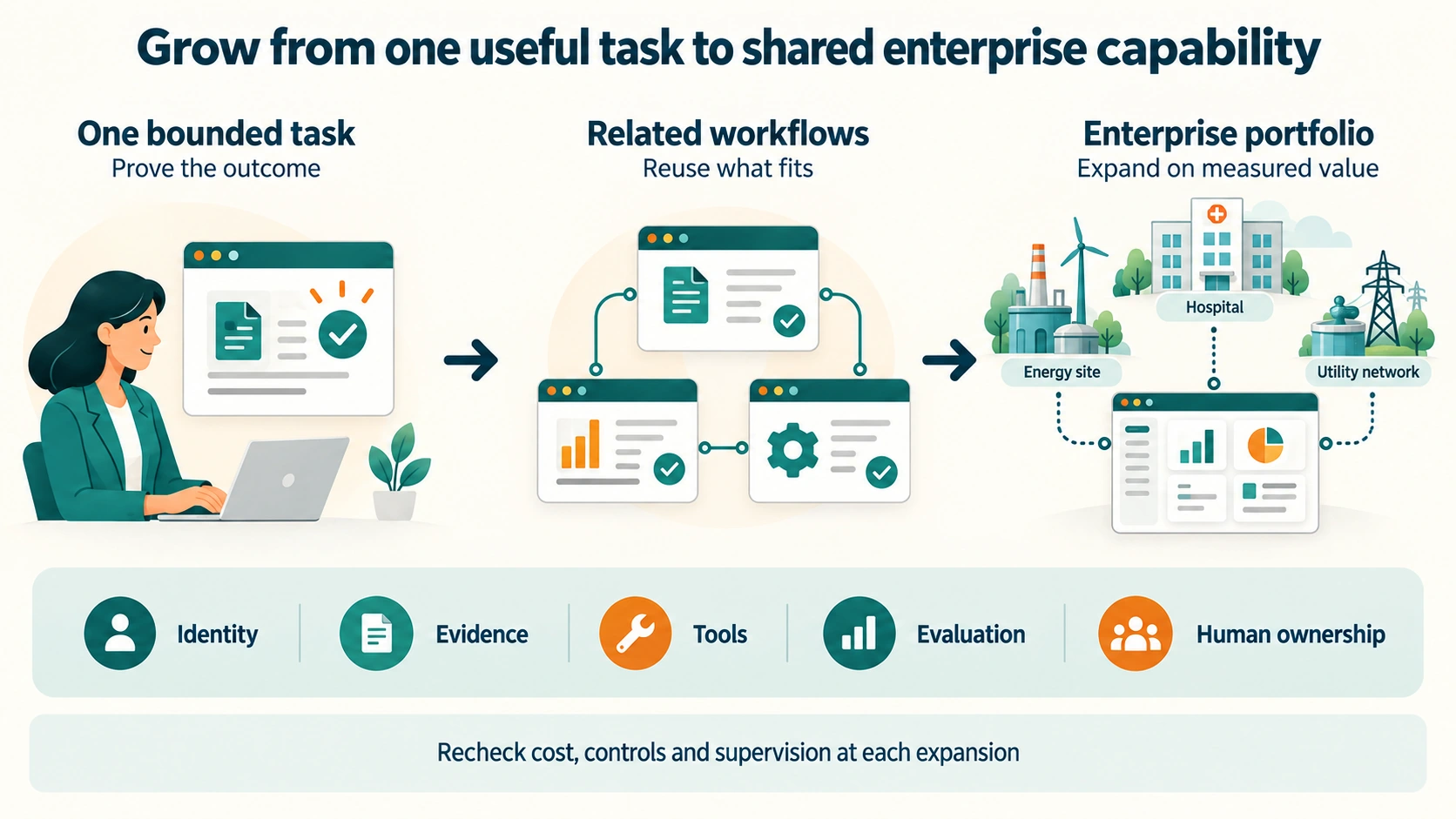
A water utility has one agent working. It investigates network anomalies, and the engineers trust its findings. Now the sponsors ask how to get from one agent to many without losing control. The answer has six steps. Prove one task first. Share what every agent needs. Name the owners and change how the teams work. Count the agents you buy inside vendor products. Expand only where measured results justify it. Keep improving, with a way back. This is step 7 of the seven steps on Start here.
1. Prove one task
Pick one use case with clear limits and show the result. Use the trial to learn what information, interfaces and supervision the work really needs. Do not build a general platform before you know those needs. Choose where to start has the checks for the first task.
2. Share what every agent needs
An agent platform provides seven capabilities. Five of them repeat from the first agent to the second. Build them once and share them where the needs match.
- What every agent needs
- Its own identity, and a check on every action
- The capability
- Identity and policy
- Where it sits in the estate
- Security and identity (R10)
- What every agent needs
- Governed access to business systems
- The capability
- Tool gateway
- Where it sits in the estate
- Integration fabric (R03)
- What every agent needs
- A record of what it did that it cannot change
- The capability
- Observability and audit trail
- Where it sits in the estate
- Observability and FinOps (R12)
- What every agent needs
- A way to pause and resume long tasks
- The capability
- Runtime
- Where it sits in the estate
- Agent platform (R07)
- What every agent needs
- Tests that every change must pass
- The capability
- Evaluation and release
- Where it sits in the estate
- Intelligence and learning (R06)
The last column names the main layer for each capability. The fourteen layers page shows the rest. Two rules hold for every agent you add. Policy is enforced outside the model. The audit trail is written where the agent cannot touch it.
Keep a specialist model or a specialist knowledge source separate where its task needs it.
3. Name the owners and change how the teams work
Name a business owner for results and a technical owner for the service. Name data owners for the evidence, and the people who handle exceptions. Agree how incidents are reported, how changes are released and how work goes back to a person.
The agent lifecycle gives each agent a sponsor and an owner. It also gives each agent a path from registration to retirement. Autonomy and learning are separate choices for each task. The autonomy contract sets both.
As the number of agents grows, the teams need a shape. How the teams are organised sets out one design. A small office writes the rules and holds the money. One platform team turns the rules into automatic checks. Three small lanes build each new pattern once, then step back.
4. Count the agents you buy
Some agents arrive inside products the enterprise buys. These are vendor-embedded agents. Agents you build run through your own gateway. Vendor-embedded agents run on the vendor's platform, and you govern them through its settings. Check what permissions, logs, cost data and controls each product exposes. Put every agent in one registry, bought or built. Agents and packaged applications sets out when to wait for a vendor's agent and when to build your own.
5. Expand only on measured results
Move from one working task to related tasks. Then move to a department, then to work that crosses departments. A good pilot does not prove that a larger or riskier scope is ready.
Each step up needs the same evidence as the first. Recheck the shared supervision capacity and the cost per resolved outcome. Vendor agents draw on the same reviewers as your own. Run the use-case portfolio every quarter, with measured inputs.

6. Keep improving, with a way back
Use production evidence to decide what to change: information, instructions, tools, workflow or model. Test each change before release and keep a way to roll it back. The learning flywheel shows how. Research covers open questions that may change the design.
A worked example: the utility's second agent
The utility's second agent handles billing exceptions. It reuses the identity, the tool gateway and the audit trail built for the first agent. Its tests are new, written by billing specialists. Its risk is higher, because a bill change moves money. So a person approves every bill change in the billing system. A trained person decides anything about hardship or a payment plan. The reviewers come from the billing team, so supervision capacity is counted again for them.
Evidence and limits
This order is a suggested approach. It has not been tested as a whole programme. Each step rests on the evidence in the pages it links. The portfolio's gates, scoring and stop criteria are practitioner rules, not validated thresholds. The team design on the organisation page is a proposal. The utility in the example is illustrative, not a named deployment.
Next step
Describe each new agent with the four questions, or run the weekly checks on Operate.
Explore this topic
- The use-case portfolio: the gates, the scoring, the constraints across the set, the stop criteria and the quarterly cadence.
- The economics model: cost per resolved outcome and who pays when an agent loops.
- Vision and target state: the full research view of the agentic enterprise.
Cite this page
Written by Murali Sid, Founder and AI Systems Architect, last updated 15 October 2026. Licensed CC BY-SA 4.0, so quote it freely with attribution.
Murali Sid (2026). Build an agentic enterprise. Agentic Architecture Skills. https://www.agenticarchitectureskills.com/use-cases/enterprise-transformationMachine-readable version of this page: /use-cases/enterprise-transformation.md