Explore business opportunities
Pick an industry and see its estate and use cases. Then follow one worked example from today's process to the process with agents.
An enterprise that wants to use agents asks two questions first. Where can an agent do useful work? And how does a process change when it does? This section answers both in the same way for three industries. Pick an industry and see its estate: the systems it runs in each of the fourteen layers. See the use cases that sit on that estate. Then follow one worked example. It walks through the process as it runs today, step by step. Then it walks through the same process with agents.
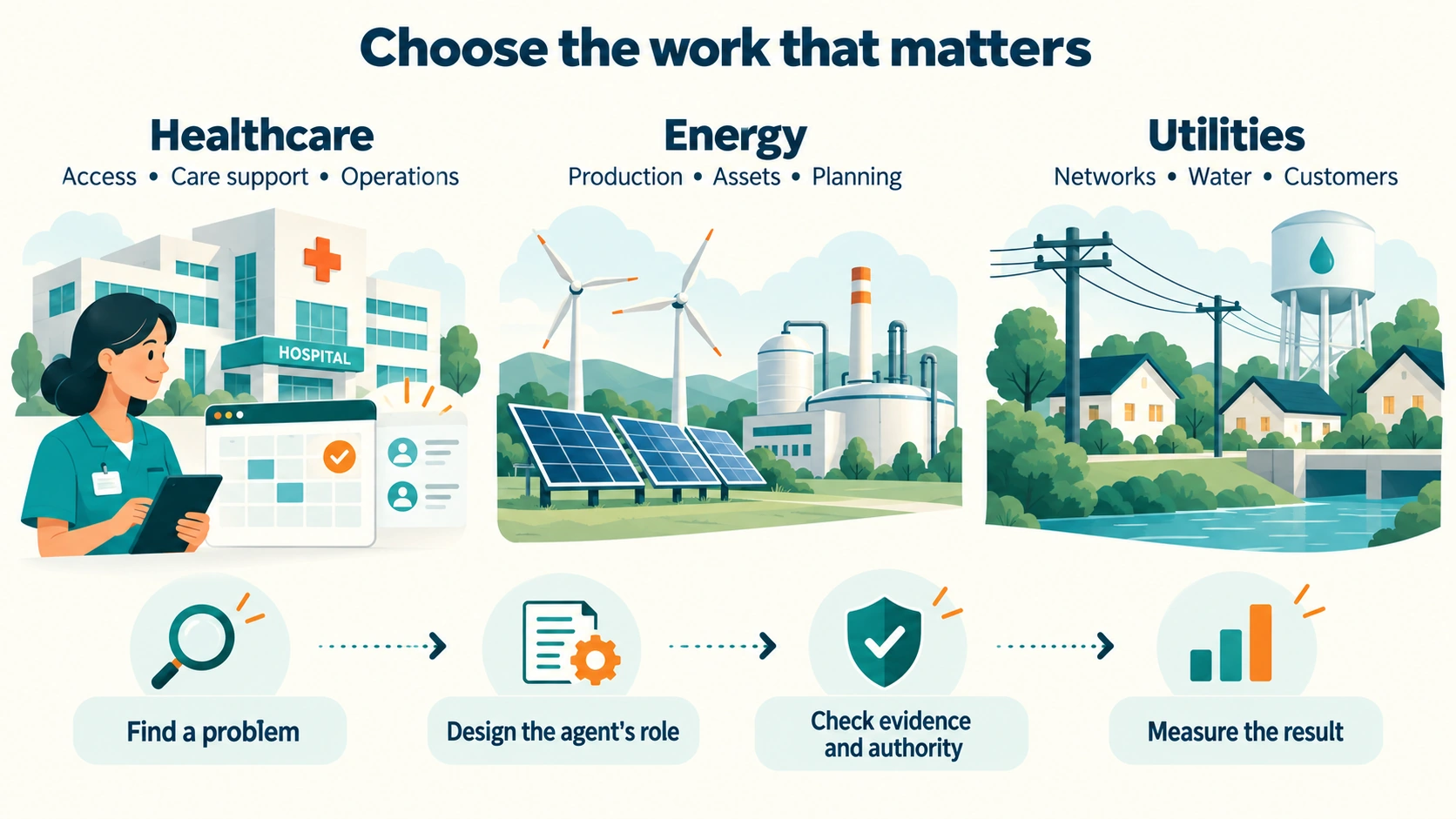
Pick an industry
Healthcare
Energy
Utilities
Each industry page is built the same way. It starts with the estate per layer: the systems a typical organisation runs in each layer. It then places the use cases on that estate. It ends with the rules that bind the industry. In healthcare, clinical decisions stay with clinicians. In energy, agents read plant data but never act on control or safety systems. In utilities, a trained person decides anything about hardship, disconnection or a payment plan.
Energy and utilities overlap. Here, energy starts with producing energy and resources. Utilities starts with running networks and essential services. An integrated company can use both pages.
Follow a worked example
Each worked example follows the same order. It names the systems the work touches, layer by layer. It shows today's process as numbered steps, then the process with agents. It says what each agent reads and writes, and who approves in which system. It ends with where the agent sits. That means its answers to the four questions and its tier on the risk profile. It also means how freely it may act under the autonomy contract.
- Worked example
- Referral coordination
- Industry
- Healthcare
- The work
- Turn a referral into a confirmed appointment
- Worked example
- Care follow-up
- Industry
- Healthcare
- The work
- Keep agreed follow-up actions from getting lost
- Worked example
- Consult briefing
- Industry
- Healthcare
- The work
- Prepare the evidence before a consult or a care team meeting
- Worked example
- Energy asset investigation
- Industry
- Energy
- The work
- Investigate an asset before planning work on it
- Worked example
- Production measurement
- Industry
- Energy
- The work
- Find and explain gaps between measured and recorded production
- Worked example
- Safety coaching
- Industry
- Energy
- The work
- Help crews learn from risky events caught on camera
- Worked example
- Systemic audit issues
- Industry
- Energy
- The work
- Find the cause of audit issues that recur across sites
- Worked example
- Compliance evidence
- Industry
- Energy and healthcare
- The work
- Collect and check the evidence a standard asks for
- Worked example
- Vegetation inspection
- Industry
- Utilities
- The work
- Turn image-based risk near power lines into field work
- Worked example
- Water operations
- Industry
- Utilities
- The work
- Investigate an anomaly in the water network
- Worked example
- Billing exceptions
- Industry
- Utilities
- The work
- Clear failed bills and meter reads that look wrong
- Worked example
- AI use inventory
- Industry
- Utilities
- The work
- List every use of AI for a regulator
Take an idea to a decision
The first three pages below are step 3 of the seven steps on Start here. The fourth belongs to step 7, when one working agent grows into many.
Choose where to start
Wait, buy or build
Measure value and full cost
Build an agentic enterprise
Evidence and limits
The work maps lean on frameworks that describe work before any AI. APQC publishes process frameworks for healthcare providers and utilities. WHO's digital-health classification sorts digital uses by health need. EPA's Effective Utility Management guidance helps utilities review outcomes across their service. Sources reviewed 18 September 2026.
The maps are original teaching aids. They do not reproduce a standard or certify an agent design. A working process still needs named owners, local requirements and an evaluation.
Next step
Pick a first task with the five checks on choose where to start.
More industries and shared business functions
The wider library remains available: mining and resources, manufacturing, financial services, and public services.
Explore supporting functions: IT, customer service, finance, HR, sales, marketing, and supply chain.
Cite this page
Written by Murali Sid, Founder and AI Systems Architect, last updated 15 October 2026. Licensed CC BY-SA 4.0, so quote it freely with attribution.
Murali Sid (2026). Explore business opportunities. Agentic Architecture Skills. https://www.agenticarchitectureskills.com/use-casesMachine-readable version of this page: /use-cases.md