Collect and check compliance evidence
The assurance pattern that every regulated industry shares, worked through for hospital accreditation against the NSQHS Standards. The systems by layer, the work today, the same work with one agent, and the utility and energy variants.
A standard asks for proof by a date. Someone must collect records from many teams, check each one, and show which requirement it meets. Then a named person attests. The pattern is the same in hospitals, water and power utilities, and generators. This page works it through for a hospital network preparing for accreditation. Today a quality manager runs the work with spreadsheets and email. With an agent, collecting and checking move to the agent. A named person still attests, and a person still submits.
The pattern in any industry
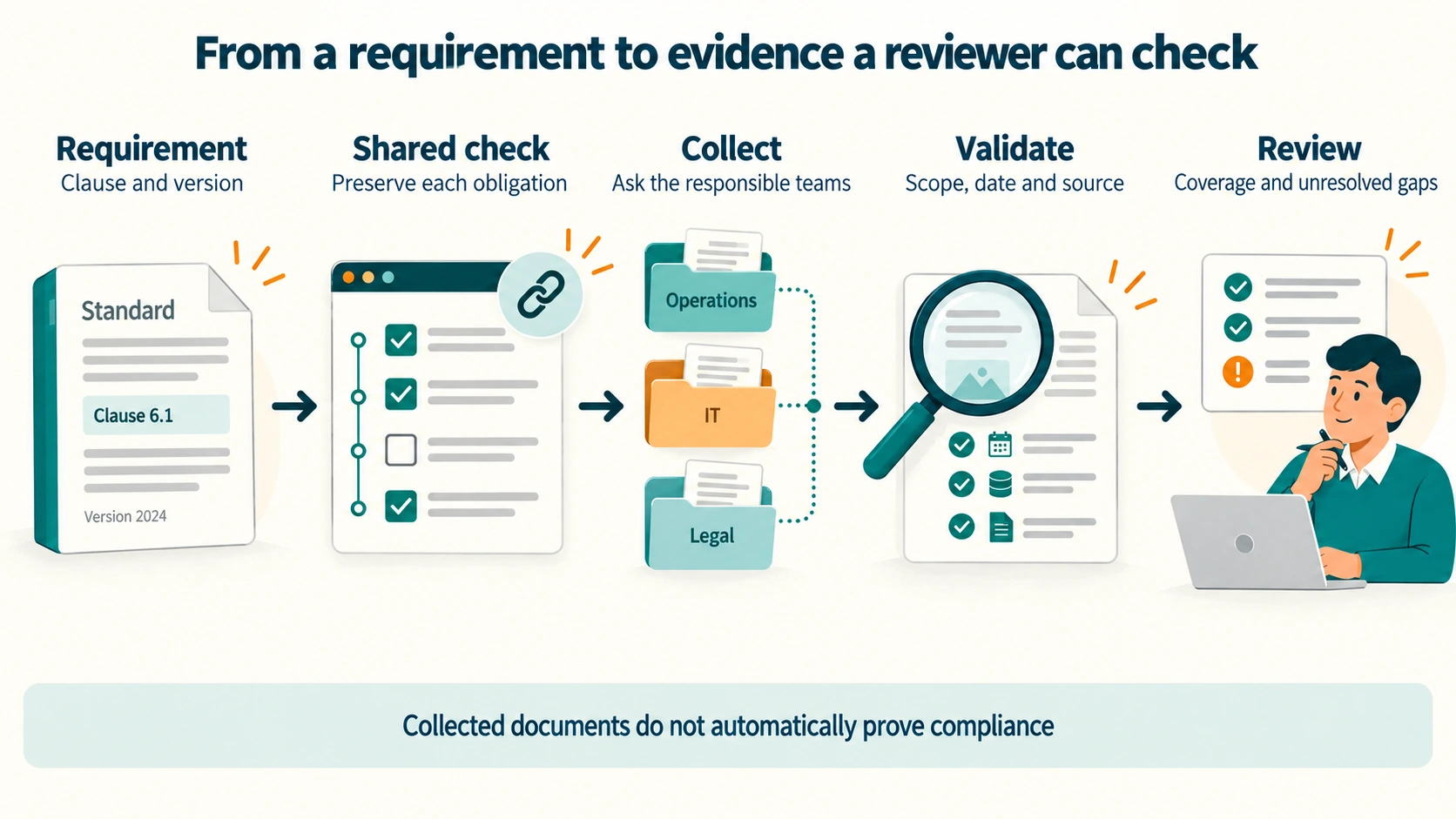
Five moves repeat in every industry.
- Keep each requirement with its version and its original clause.
- Map shared checks, without losing any single obligation.
- Ask the team that owns each record for one specific item.
- Check the issuer, date, scope and completeness of what comes back.
- Give a reviewer a pack with every item linked to its source, and the gaps listed.
The systems involved
The hospital case touches these layers. The healthcare page shows the full hospital estate.
- Systems in this use case
- Hosting in an Australian or New Zealand region.
- Layer
- Data platform (R02)
- Systems in this use case
- Clinical indicators in the data warehouse. Dashboards.
- Systems in this use case
- Interfaces or scheduled reports from the learning system, the maintenance system and the incident system. Microsoft Graph for SharePoint.
- Systems in this use case
- Incident system (RiskMan, ims+, VHIMS, Datix). HR and learning system. Credentialing. Policy library.
- Systems in this use case
- Maintenance management system (CMMS) for biomedical equipment. Sterilisation tracking. Building management.
- Systems in this use case
- Reading documents and matching them to requirements.
- Layer
- Agent platform (R07)
- Systems in this use case
- The agent.
- Systems in this use case
- Committee minutes on SharePoint. Teams. Email requests.
- Systems in this use case
- Little patient contact. The consumer feedback system is a source.
- Systems in this use case
- Read-only service accounts. Personal data kept to a minimum.
- Systems in this use case
- The NSQHS Standards and the accreditation scheme. Nga Paerewa in New Zealand. The evidence register. Attestation.
- Systems in this use case
- Traces. Pack history.
- Systems in this use case
- The quality manager supervises. Standard leads attest.
- Systems in this use case
- Requirement versions. Evidence links. Rules for when evidence goes stale.
How it runs today
Australian hospitals are assessed against the eight National Safety and Quality Health Service (NSQHS) Standards. They cover clinical governance, partnering with consumers, infection control and medication safety. They also cover comprehensive care, communicating for safety, blood management, and acute deterioration. Since 1 July 2023, assessments come at short notice, with at least 24 hours' warning (the Commission). A secondary summary says hospitals are reaccredited at least every three years. Internal audits, mock surveys and board reporting run between visits. In New Zealand, services are audited against Nga Paerewa, NZS 8134:2021.
- #
- 1
- Step
- Keep the evidence register
- Role
- Quality manager
- System
- Spreadsheet or SharePoint list. Some use accreditation software (Ideagen Healthcare Guardian [vendor]).
- How the data moves
- Each NSQHS requirement mapped to evidence items and owners, by hand.
- #
- 2
- Step
- Assign owners
- Role
- Quality manager and standard committees
- System
- Email. Committee minutes.
- How the data moves
- Each standard has a committee and an executive sponsor (typical, unsourced).
- #
- 3
- Step
- Collect records from each owner
- Role
- Education unit, biomedical engineering, patient safety unit, ward managers, policy officer, performance team
- System
- Learning system, maintenance system, incident system, audit tools, policy library, data warehouse
- How the data moves
- Each team exports a report. Training by ward, maintenance done and overdue, incident trends, audit results, policies with review dates, indicator screenshots.
- #
- 4
- Step
- Check and chase
- Role
- Quality team
- System
- Email, spreadsheets
- How the data moves
- Dates and scope checked by eye. Gaps chased by email.
- #
- 5
- Step
- Self-assessment
- Role
- Quality manager
- System
- The accrediting agency portal
- How the data moves
- The self-assessment and evidence lists are uploaded.
- #
- 6
- Step
- Assessment visit
- Role
- Assessors and staff
- System
- On site
- How the data moves
- Assessors ask for evidence on the spot. They watch practice and talk to staff. They judge Met or Not Met.
- #
- 7
- Step
- Fix gaps
- Role
- Action owners
- System
- Spreadsheet action plan
- How the data moves
- Not Met actions are fixed within the period the scheme sets. Check the current rule.
- #
- 8
- Step
- Report
- Role
- Quality and safety unit
- System
- Board papers
- How the data moves
- Status goes to the clinical governance committee and the board.

Handoffs. The quality team hands requests to every evidence owner and gets records back. Committees report to the quality team. The health service deals with the accrediting agency. The agency reports to the state health department and the Commission.
Where reporting comes in. Clinical indicator dashboards come from the data warehouse. Incident and risk reports come from the incident system. Board and committee papers carry the status. The agency reports the accreditation outcome.
Volumes and cycle time. There are eight standards. A large network holds many hundreds of evidence items (typical, unsourced). Before short notice, the big push came in the months before a planned visit. Now readiness must be continuous (typical, unsourced). Recent short notice assessments include Albury Wodonga Health in November 2025 and Cohuna District Hospital on 2 December 2025.
Pain points.
- Evidence goes stale, and owners change.
- One document serves several requirements, but its scope differs for each.
- Screenshots have no date.
- A policy on paper does not show the policy was followed.
- Short notice means the register must always be current.
- Training records name staff, so they are personal data.
How agents run it
One agent runs fixed steps. It collects and checks. It never marks a requirement Met.
- #
- 1
- Step
- Keep the obligation register
- Agent or person
- Quality manager, with agent help
- Reads, and from where
- The NSQHS Standards, with the version recorded. State directives. Local policies.
- Writes
- A register entry for each requirement, with its version, checks and owner
- Who approves, and where
- The quality manager approves every mapping.
- #
- 2
- Step
- Collect on a schedule
- Agent or person
- Agent
- Reads, and from where
- Learning system report or interface. Maintenance system interface or scheduled report. Incident system report. Policy library and SharePoint through Microsoft Graph. Data warehouse indicators.
- Writes
- Evidence items with source, date and scope: ward, site and period
- Who approves, and where
- Read-only access
- #
- 3
- Step
- Check each item
- Agent or person
- Fixed rules, run by the agent
- Reads, and from where
- The evidence items
- Writes
- A status of present, stale, wrong scope or missing. Never "Met".
- Who approves, and where
- The quality manager approves the rules.
- #
- 4
- Step
- Ask for gaps
- Agent or person
- Agent drafts
- Reads, and from where
- The owner from the register
- Writes
- One specific request as a ServiceNow task, Teams message or email. For example: "Ward 4B hand hygiene audit for Q2 is missing."
- Who approves, and where
- The quality team approves the templates.
- #
- 5
- Step
- Build the pack
- Agent or person
- Agent
- Reads, and from where
- The register and the evidence
- Writes
- A pack per requirement, with a link to each source
- Who approves, and where
- No one at the draft stage
- #
- 6
- Step
- Review and attest
- Agent or person
- Standard lead and executive sponsor
- Reads, and from where
- The pack
- Writes
- The attestation, recorded in the register
- Who approves, and where
- A named person attests.
- #
- 7
- Step
- Submit
- Agent or person
- Quality manager
- Reads, and from where
- The pack
- Writes
- The self-assessment in the accrediting agency portal
- Who approves, and where
- A person only
- #
- 8
- Step
- Support a short notice visit
- Agent or person
- Agent
- Reads, and from where
- The register
- Writes
- A current evidence index within hours of the notice
- Who approves, and where
- The quality manager
- #
- 9
- Step
- Track fixes
- Agent or person
- Agent
- Reads, and from where
- Actions from the assessment report
- Writes
- Tasks with due dates. Reminders.
- Who approves, and where
- Action owners close their own actions.

What stays with a person, and why.
- Met or Not Met. That is the assessor's judgement.
- Attesting the pack. It is a formal record a regulator relies on.
- How to fix a gap. That is a management decision.
- Anything about one staff member's performance. That is a decision about a person.
- Submitting to the agency. It is a formal regulatory record.
Where the evidence is kept. The pack keeps a link to every source. The register history shows who mapped what, and when. Request history stays in ServiceNow, Teams or email. Agent traces sit outside the agent.
What changes in the systems.
- The register becomes a structured store with status fields, in a risk and compliance tool or a SharePoint list.
- Read-only connectors to the learning system, maintenance system, incident system and policy library.
- Scheduled collection runs.
- Requests tracked as tasks.
- Training data used at ward level, unless a named record is needed.
What does not change. The accreditation scheme and its rules stay. The assessor still judges. The incident system stays the record of incidents. The committee structure stays.
Who does this today
- Who
- Ideagen Healthcare Guardian, accreditation management
- What
- Links standards, audits, policies and corrective actions in one place. It is not an agent.
- Status and date
- Commercial product in Australia and New Zealand [vendor]
- Who
- The Joint Commission and the Coalition for Health AI, US
- What
- Joint guidance on responsible AI use, and a planned AI certification
- Status and date
- Guidance released. Certification planned. Dates not confirmed.
- Who
- The author's earlier work
- What
- Used a GPT model to turn standards into checklists and find overlapping requirements
- Status and date
- Past work. Collecting the evidence is the proposed extension on this page.
No agent was found collecting NSQHS or Nga Paerewa evidence in an Australian or New Zealand health service.
The utility and energy variants
Water and power utilities. The obligations are many and specific. Examples are life support registration, hardship policies, guaranteed service level payments, vegetation clearance and drinking water quality. Most sit in an obligations register in a risk and compliance tool (ServiceNow IRM, Archer, Protecht). Few are linked to the system steps that meet them. Reporting runs from the data warehouse to the regulators. Energy retailers send quarterly data on hardship, payment plans and disconnections to the Australian Energy Regulator. Water utilities report to the state economic regulator, the health regulator and the environment regulator. In Victoria, water service levels sit in the Essential Services Commission's Water Industry Standard. The agent's steps are the same as above, with records from the billing, asset and work systems. No compliance agent was found at any named utility (line of business and OT findings, August 2026). An agent that reads protected system information may itself fall inside critical infrastructure rules. Confirm that before building.
Generators and resources. A generator keeps a performance standards compliance program under the National Electricity Rules. It also files environmental licence returns and National Greenhouse and Energy Reporting emissions reports. US generators keep evidence for the NERC reliability standards. Miners have licence conditions, statutory inspections, and tailings conformance under the Global Industry Standard on Tailings Management. A compliance coordinator keeps the obligations in a risk tool (SAI360, Enablon, ServiceNow IRM) or in Excel. Owners email PDFs from the asset system, the laboratory system and emissions monitoring. The coordinator checks dates, scope and signatures by eye. With an agent, the same five moves apply. A named person attests in the risk tool or the regulator portal. No deployment was found. AVEVA's PI Audit Reporter (May 2026) reviews audit trails. It is a report tool, not an agent [vendor].
Where this sits
The four questions place this agent.
- Role. It coordinates. The domain is compliance and assurance.
- Permissions. These are what its own credentials let it do. It reads, through read-only accounts, from the learning, maintenance and incident systems, the policy library and SharePoint. It writes evidence items, statuses, packs and requests. It sends requests inside the organisation only. Certificates from outside issuers are untrusted input. The highest data class is personal, since training records name staff.
- Autonomy. It is designed and permitted for delegated tasks (A2) on the autonomy contract. The quality manager reviews every pack. Deciding how to close a gap drops to assisted (A1), where the owner decides.
- Impact. It sits in the formal regulatory records zone of the deterministic zones. The agent drafts and assembles. A named person attests. The agent never files, signs or alters a record. The rule for decisions about people applies to anything about one staff member's performance.
It is Tier 3 (strict), because its pack feeds work a regulator relies on. It sends requests inside the organisation only. So it holds two parts of the Rule of Two, not three.
Its learning level is curated learning (L1). People choose which past reviews it learns from, and review each change before release. Changes go through the agent lifecycle.
It has its own identity (ID2) on the delegation chain. Policy is enforced outside the model: its accounts are read-only, and the register refuses an attestation from the agent. Of the seven capabilities, observability and audit trail does the most work. Every pack links to its sources, and the history sits where the agent cannot touch it.
Measure the result
Compare with the current register and the last cycle's evidence. Measure these:
- Requirements with current, checked evidence.
- Stale or wrong-scope evidence caught before review.
- How often reviewers agree with the agent's status.
- Duplicate requests to owners.
- Hours of collection and review.
- Time to produce the short notice index.
Do not count a collected document as a met requirement.
Start with a trial
Pick one standard at one hospital, such as medication safety. Use last cycle's register and the reviewers' own findings as the reference. Run the agent with no live requests first. Then let it send requests from approved templates, with the quality manager reviewing every pack. Register the agent with a named sponsor and owner before go-live.
Evidence and limits
No agent was found collecting compliance evidence in any of the three industries. The design is a proposal.
Three accreditation facts were not verified. They are the current NSQHS version, its number of actions, and the period to fix a Not Met action. The Commission's site timed out during research. The number of days a service can exclude comes from a search summary. Nga Paerewa audits were not checked.
The National Electricity Rules clause for the generator program was not re-checked. The utility obligations are examples from the obligations register, not a full list.
Next step
See the hospital estate these systems sit in. Or choose where to start.
Explore this topic
Research for this page was done on 15 October 2026.
Accreditation facts. The eight NSQHS Standards are Clinical Governance; Partnering with Consumers; Preventing and Controlling Infections; and Medication Safety. The others are Comprehensive Care; Communicating for Safety; Blood Management; and Recognising and Responding to Acute Deterioration. The names were checked against a secondary summary on 15 October 2026. A service can exclude up to 20 business days per cycle from short notice assessment. That figure comes from a search summary of the Commission's page. The Commission lists the approved accrediting agencies.
Sources.
- ACSQHC, short notice assessments, from 1 July 2023.
- ACSQHC, NSQHS Standards. The site timed out on 15 October 2026.
- Ideagen, Healthcare Guardian accreditation management, product page [vendor].
- Becker's, Joint Commission moves, undated.
- Health service reports of short notice assessments at Albury Wodonga Health and Cohuna District Hospital, 2026.
- Utility obligations and reporting: research notes on electricity and water utilities, 15 October 2026. Australian Energy Regulator retail performance data, January to March 2026 update. ESC Victoria, Water Industry Standards, versions effective 2024.
- Generator obligations: research notes on energy producers, 15 October 2026. AVEVA PI Audit Reporter, May 2026 [vendor].
- LandingAI document grounding, vendor documentation, accessed 17 September 2026 [vendor].
- NIST, AI Risk Management Framework Playbook, accessed 17 September 2026.
Cite this page
Written by Murali Sid, Founder and AI Systems Architect, last updated 15 October 2026. Licensed CC BY-SA 4.0, so quote it freely with attribution.
Murali Sid (2026). Collect and check compliance evidence. Agentic Architecture Skills. https://www.agenticarchitectureskills.com/use-cases/compliance-evidenceMachine-readable version of this page: /use-cases/compliance-evidence.md
Safety coaching from CCTV, incident and observation data
Turn a risky moment caught on camera, or logged as an observation, into coaching the safety owner approves. Real-time interventions, discipline and any decision about a person stay with people.
Build an AI use inventory a regulator can read
How a utility builds a list of every AI use that a regulator can read. One row per use, with the decision it shapes, its safeguards and the evidence that they work.