Keep agreed follow-up from getting lost
Follow-up after a discharge or a clinic visit, step by step. The systems by layer, the work today, the same work with one agent that tracks evidence, and who closes what.
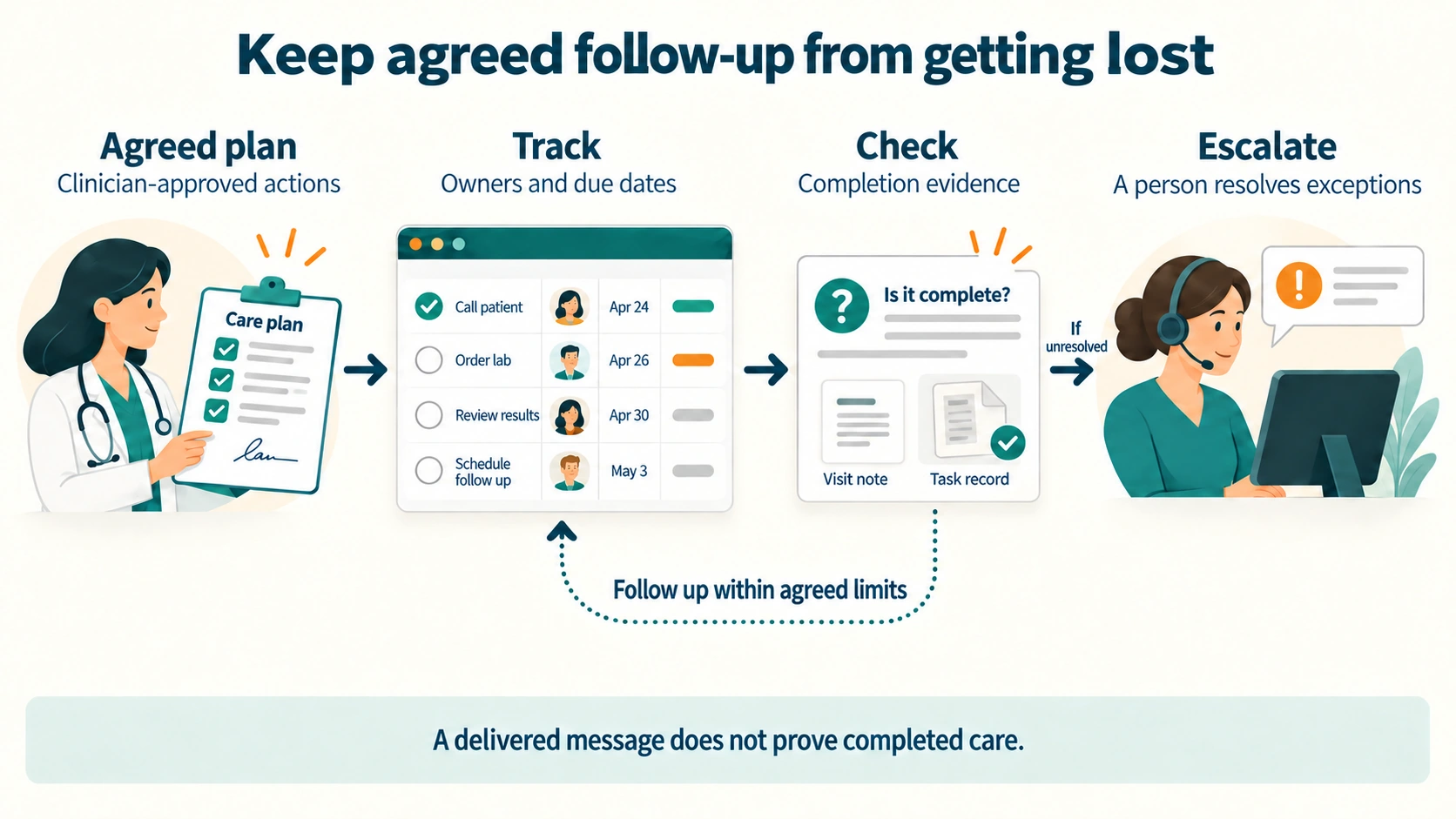
A patient leaves a ward or a clinic with actions the care team agreed. Typical ones are a blood test in a few weeks and a review appointment. Others are a community nursing referral, actions for the GP, and results still pending. The result should be each action done, with evidence that it was done. Today the actions sit in free text and the responsible doctor rotates. Mostly no one checks. With an agent, each action becomes a tracked task with an owner and a due date. Only the responsible team closes a clinical task.
The systems involved
Follow-up touches these layers. The healthcare page shows the full hospital estate.
- Systems in this use case
- Hosting for the agent in an Australian or New Zealand region.
- Layer
- Data platform (R02)
- Systems in this use case
- Clinical data repository for results. Data warehouse for readmissions and overdue reviews.
- Systems in this use case
- Integration engine for result messages, appointment events, discharge events and delivery receipts. FHIR server and its event subscriptions.
- Systems in this use case
- Electronic medical record, EMR, for the discharge summary, orders and results acknowledgement. Patient administration system, PAS, for review appointments. Laboratory system, LIS. Radiology system, RIS.
- Systems in this use case
- Community health system (CHIME and others). Virtual care platform. Hospital in the home.
- Systems in this use case
- Reading agreed actions out of free text. The lab's own abnormal flag, used as a rule.
- Layer
- Agent platform (R07)
- Systems in this use case
- The agent and its task loop.
- Systems in this use case
- Teams and email for requests to teams.
- Systems in this use case
- SMS reminders, phone, and a patient portal where one exists. Secure messages to the GP.
- Systems in this use case
- The agent's own identity. Access limited to recently discharged patients on the list.
- Systems in this use case
- Clinical governance owns the follow-up policy, the missed-appointment policy and contact limits.
- Systems in this use case
- Traces per task. Overdue counts.
- Systems in this use case
- A care coordinator or discharge nurse supervises. The responsible clinician closes clinical tasks.
- Systems in this use case
- Task memory. Each action linked to the sentence it came from.
How it runs today
- #
- 1
- Step
- Agree actions and write the discharge summary
- Role
- Treating team and junior doctor
- System
- EMR progress notes and discharge summary template, or paper
- How the data moves
- Actions sit in free text in the notes. The summary is free text plus coded medicines, signed in the EMR.
- #
- 2
- Step
- Send the summary
- Role
- EMR and integration engine
- System
- Secure messaging. My Health Record.
- How the data moves
- A clinical document to My Health Record. An HL7 message with a PDF to the GP. Some are still faxed or printed (typical, unsourced).
- #
- 3
- Step
- Request a review appointment
- Role
- Ward clerk or clinic clerk
- System
- Outcome form. PAS.
- How the data moves
- The form goes to clinic booking. The clerk books in the PAS, or adds the patient to a review list.
- #
- 4
- Step
- Order tests after discharge
- Role
- Doctor
- System
- EMR future order, or a paper request slip
- How the data moves
- The patient takes the request to a community lab. The result comes back by HL7 message to the doctor who asked.
- #
- 5
- Step
- Refer to community services
- Role
- Discharge nurse or allied health
- System
- EMR referral, fax or email. Community health system.
- How the data moves
- The community intake team keys it into its own system again.
- #
- 6
- Step
- Watch pending results
- Role
- Responsible doctor
- System
- EMR results inbox
- How the data moves
- Results arrive after discharge. The doctor may have moved to another team. Acknowledged by a click.
- #
- 7
- Step
- Phone after discharge
- Role
- Nurse or virtual care team
- System
- Phone. Spreadsheet or EMR call note.
- How the data moves
- A call one to three days after discharge, for some patient groups (typical, unsourced).
- #
- 8
- Step
- Check the work was done
- Role
- Mostly no one
- System
- Lists kept by some teams
- How the data moves
- Completion shows only when the patient turns up, or does not.
- #
- 9
- Step
- Handle missed appointments
- Role
- Clinic clerk and clinician
- System
- PAS
- How the data moves
- After one or two missed appointments, local policy may send the patient back to the GP. A letter goes out.
- #
- 10
- Step
- Report
- Role
- Performance team
- System
- Data warehouse
- How the data moves
- Unplanned readmissions. Discharge summary timeliness. Overdue review lists. Missed appointment rates.

Handoffs. The ward hands to clinic booking and to community health intake. The hospital hands to the GP through the discharge summary. One rotating junior doctor hands pending results to the next. The hospital sends the patient to a community lab, and the result comes back.
Where reporting comes in. Readmission rates and discharge summary timeliness are standard hospital measures. Overdue review lists sit in the PAS and are often not reported upward (typical, unsourced). NSQHS Standards 5 and 6 cover comprehensive care and communicating for safety. Accreditation looks at both.
Volumes and cycle time. Most follow-up actions fall due between one and twelve weeks after discharge (typical, unsourced). Studies name tests pending at discharge as a patient safety risk. Their figures vary by study and setting. No Australian or New Zealand figure was found for the share of agreed actions completed.
Pain points.
- Actions sit in free text. There is no single list.
- There is no single owner, because the responsible doctor rotates.
- Review requests get lost between the ward and the clinic.
- Community referrals are sent but not acknowledged.
- The GP gets the summary late, or not at all.
- A reminder is sent, but nobody checks the work was done.
- Results that arrive after discharge sit unacknowledged.
How agents run it
One agent runs a task loop on fixed steps. It records evidence. It never decides that clinical care happened.
- #
- 1
- Step
- Pull out the agreed actions
- Agent or person
- Agent
- Reads, and from where
- The discharge summary or clinic letter through the FHIR interface. Orders (ServiceRequest). The care plan if one is used.
- Writes
- A draft follow-up list. Each action has an owner, a due date and what counts as done. Each links to the sentence it came from.
- Who approves, and where
- The discharging clinician or care coordinator confirms the list. The agent cannot add an action that is not in the source.
- #
- 2
- Step
- Open tasks
- Agent or person
- Agent
- Reads, and from where
- The confirmed list
- Writes
- One FHIR Task per action, with its owner, due date and completion rule
- Who approves, and where
- The coordinator
- #
- 3
- Step
- Watch for completion
- Agent or person
- Agent
- Reads, and from where
- Events. Results and acknowledgements come from the integration engine. Bookings and attendances come from the PAS. Acceptances come from the community system. Delivery receipts come for the summary.
- Writes
- An evidence link on each task: a result, appointment or encounter number
- Who approves, and where
- No one. Recording evidence needs no approval.
- #
- 4
- Step
- Flag gaps on the due date
- Agent or person
- Agent
- Reads, and from where
- Task due dates
- Writes
- Status "overdue", with the reason
- Who approves, and where
- No one
- #
- 5
- Step
- Ask the owner
- Agent or person
- Agent drafts
- Reads, and from where
- The owner team from the task
- Writes
- A request to the responsible team through the EMR in-basket, Teams or email
- Who approves, and where
- The coordinator approves anything outside the templates.
- #
- 6
- Step
- Remind the patient
- Agent or person
- Agent, within contact limits
- Reads, and from where
- Contact preferences and consent
- Writes
- An SMS from an approved template
- Who approves, and where
- Clinical governance approves the limits and templates.
- #
- 7
- Step
- Watch pending results
- Agent or person
- Agent
- Reads, and from where
- Results that arrive after discharge. Acknowledgement status in the EMR. The lab's abnormal flag.
- Writes
- An escalation to the responsible team if a result is not acknowledged in the set time. The agent does not interpret the result.
- Who approves, and where
- Clinical governance sets the escalation rules.
- #
- 8
- Step
- Close
- Agent or person
- The responsible team for clinical tasks. A fixed rule for admin tasks.
- Reads, and from where
- The task with its evidence
- Writes
- Clinical tasks closed in the EMR by the team. Admin tasks, such as "appointment attended", closed by rule.
- Who approves, and where
- The agent's credential cannot close a clinical task.
- #
- 9
- Step
- Report
- Agent or person
- Agent and performance team
- Reads, and from where
- The tasks
- Writes
- Counts of open tasks, overdue tasks, and tasks closed with evidence
- Who approves, and where
- The coordinator

What stays with a person, and why.
- Deciding the follow-up plan. That is a clinical decision.
- Reading and acting on a result. That is a clinical decision.
- Closing a clinical action. The team must confirm the care happened.
- Sending a patient back to the GP after missed appointments. That is a decision about a person.
- Anything the patient reports about symptoms. It goes to the care team's approved process.
Where the evidence is kept. The task history in the FHIR server shows who or what made each change. The EMR audit log records every read and write under the agent's identity. Agent traces sit outside the agent, keyed to the task. Message receipts stay in the secure messaging and SMS systems.
What changes in the systems.
- A follow-up worklist for the coordinator, built on FHIR Task.
- Event subscriptions for results, appointments and discharges.
- A structured "follow-up actions" section in the discharge summary template. Step 1 is probably not reliable without it.
- Task statuses: proposed, confirmed, in progress, overdue, done with evidence, closed by team.
- Task memory keeps requests, replies, due dates and reasons together. Reference memory holds the approved procedure and templates. Both follow the retention policy. Knowledge and memory sets out the kinds.
What does not change. The discharge summary stays the legal record. Results acknowledgement stays with the clinician. The missed-appointment policy stays. The GP's own recall system stays.
The standard behind the task list. The HL7 FHIR R4 Task resource records a task's status, owner, inputs and outputs. It can hold the difference between requested work and completed work. Local workflow design and clinical governance are still needed (HL7, reviewed 15 October 2026).
Who does this today
- Who
- Epic Art, The Christ Hospital, US
- What
- Pulls incidental findings out of radiology reports to drive follow-up
- Status and date
- Live. Epic reports a 69 percent early lung cancer detection rate against a 46 percent national average [vendor]. HIT Consultant, 10 March 2026.
- Who
- Epic Emmie, Sutter Health, US
- What
- A patient assistant inside MyChart that uses the patient's own record
- Status and date
- Live at the first site, March 2026 [vendor]
- Who
- Heidi II, Australia and New Zealand
- What
- Finds patients due for recalls, screening and pathology. Drafts follow-ups. A clinician reviews.
- Status and date
- Launched 28 September 2026. Primary care first. No Australian public hospital site found [vendor].
- Who
- Ambience Kait, US
- What
- A patient agent that checks symptoms and care plan follow-through between visits
- Status and date
- Previewed 13 April 2026. Not shown as shipping [vendor].
- Who
- Hyro, US
- What
- Outreach that reminds patients to book screenings and other care
- Status and date
- In development [vendor]
- Who
- SA Virtual Hospital, SA Health
- What
- An AI assistant for non-clinical triage. An algorithm across the EMR finds patients suited to virtual care.
- Status and date
- Reported at a RACMA conference. Date not confirmed.
No Australian or New Zealand public health service was found using an agent to check that agreed follow-up was completed.
Where this sits
The four questions place this agent.
- Role. It coordinates. The domain is health follow-up.
- Permissions. These are what its own credentials let it do. It reads discharge summaries, orders, result status, appointments and community acceptances. It writes tasks, evidence links and statuses. It sends requests to teams, and SMS within limits. It cannot close a clinical task or interpret a result.
- Autonomy. It is designed and permitted for delegated tasks (A2) on the autonomy contract. The care coordinator reviews its output. Anything clinical drops to assisted (A1), where the care team decides.
- Impact. It touches none of the four deterministic zones. The rule for decisions about people applies to closing clinical tasks and to sending a patient back to the GP. A named person makes both.
It is Tier 3 (strict), because it reaches regulated health data. Patient replies are untrusted input. It reaches health data, and it sends messages. That is all three parts of the Rule of Two. So it stays at A2, with approved templates only.
Its learning level is fixed (L0). It follows the approved procedure and does not learn from cases. Changes go through the agent lifecycle.
It has its own identity (ID2) on the delegation chain. Policy is enforced outside the model: the task server refuses a clinical close from the agent's account. Of the seven capabilities, observability and audit trail does the most work here. It keeps the task history where the agent cannot touch it.
Measure the result
Compare with the simplest alternative, a reminder queue. A queue may be enough when every task has the same inputs and the same completion rule. Measure these:
- Tasks closed with evidence, and tasks still unresolved.
- Wrong closures. The target is none for clinical tasks.
- Unneeded contacts with patients.
- Coordinator workload.
- Time from due date to verified completion.
Keep adverse events and patient complaints visible separately.
Start with a trial
Pick one ward and one kind of action, such as blood tests after discharge. Run the agent on past discharges first, and check its list against what the team agreed. Then run it live with the coordinator confirming every list. Register the agent with a named sponsor and owner before go-live.
Evidence and limits
No Australian or New Zealand figure was found for how much agreed follow-up gets done. The size of the gap is not measured here.
No public health service in either country was found using an agent for this. The named cases are US vendors or primary care in Australia and New Zealand.
Step 1 depends on how actions are written. Free-text summaries make it unreliable. A structured follow-up section in the discharge template is probably needed first.
Next step
See how the same evidence discipline works before a meeting on consult and MDT preparation. Or go back to the hospital estate.
Explore this topic
Research for this page was done on 15 October 2026.
- HL7, FHIR R4 Task, reviewed 15 October 2026. FHIR Subscriptions backport gives event notices on R4 servers.
- ACSQHC, NSQHS Standards. Standard names checked. Action numbers not checked.
- HIT Consultant, Epic at HIMSS 2026, 10 March 2026.
- The Medical Republic, Heidi II agents, 30 September 2026.
- Ambience Kait, from aggregator summaries such as IT Digest, April 2026 [vendor].
- Pulse 2.0, Hyro funding, undated [vendor].
- RACMA conference, SA Virtual Hospital, date not confirmed.
Cite this page
Written by Murali Sid, Founder and AI Systems Architect, last updated 15 October 2026. Licensed CC BY-SA 4.0, so quote it freely with attribution.
Murali Sid (2026). Keep agreed follow-up from getting lost. Agentic Architecture Skills. https://www.agenticarchitectureskills.com/use-cases/care-follow-upMachine-readable version of this page: /use-cases/care-follow-up.md
From referral to a confirmed appointment
A referral to a public hospital clinic, step by step. The systems by layer, the work today, the same work with one agent, and who runs it.
Prepare the evidence before a consult or multidisciplinary meeting
Before a cancer meeting or a clinic, gather results, reports and outside records into one brief. Every fact shows its source and date. The systems by layer, the work today, the same work with one agent, and who signs.