Investigate recurring audit issues across sites
When the same finding keeps appearing at several sites, an agent tests competing explanations against maintenance, inspection and procedure records. The assurance owner decides the response.
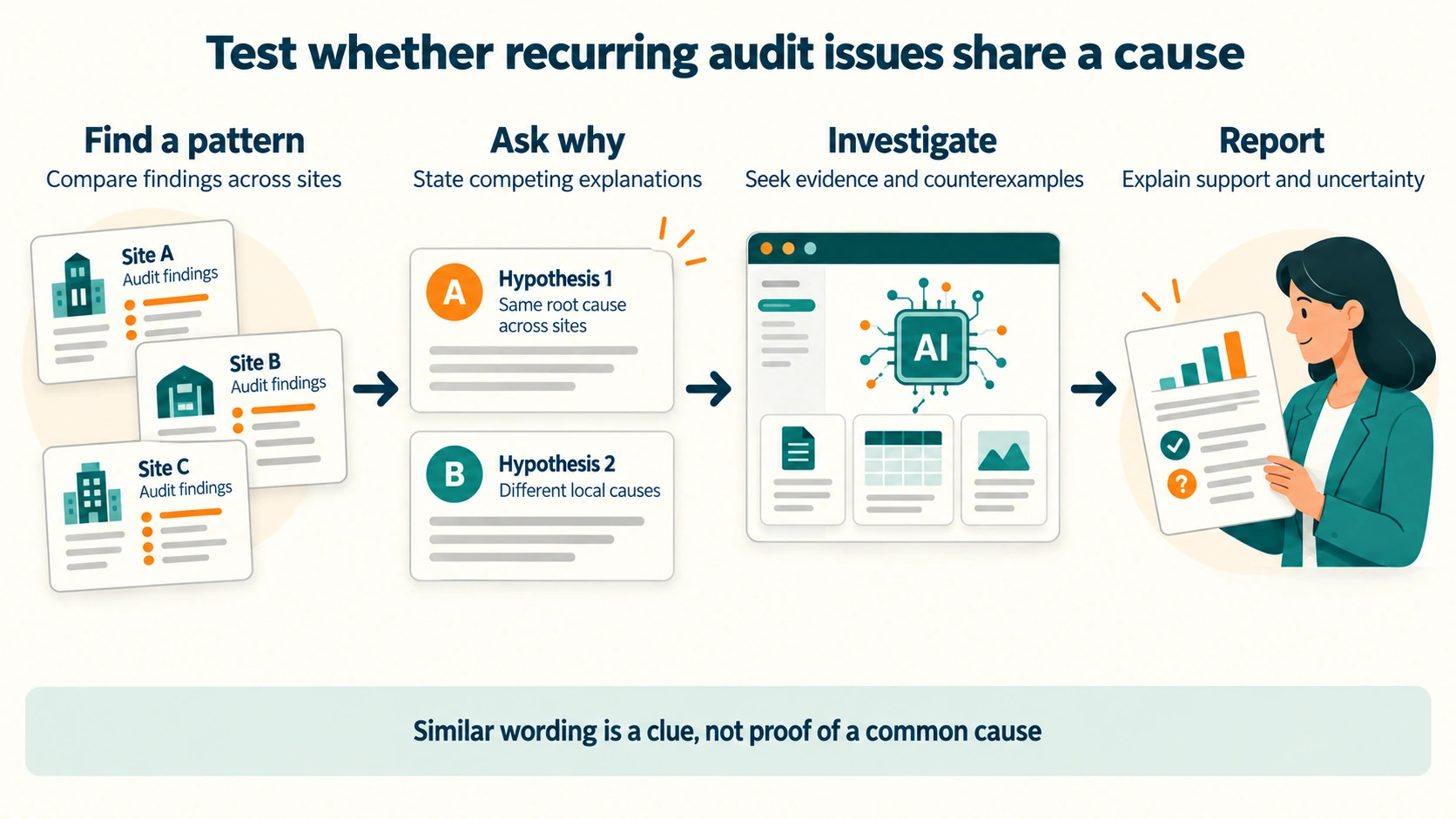
A miner audits ground control at six sites. The same kind of finding keeps showing up: slope inspections overdue, or prism data not reviewed. Is there one shared cause, or six local ones? Today an assurance analyst groups findings by their words and reports the repeats to the board. In this design an agent states competing explanations and asks for the records that would test each one. It also looks at the sites that did not have the finding. The assurance owner decides the response. The formal audit record stays untouched by the agent.
Experience behind this example
The design builds on the author's own topic-modelling work on geotechnical audit gaps across sites.
The systems involved
The work touches seven of the fourteen layers. The full estate is on the energy and resources page.
- Systems in this use case
- Audit system (Enablon, Cority, Intelex, SAP Audit Management, Ideagen), or Excel. The action module of the health, safety and environment (HSE) system. Enterprise asset management (EAM) with maintenance and inspection history. Document store with procedures and closure evidence
- Systems in this use case
- Geotechnical monitoring: slope radar (GroundProbe) and survey prisms. Read only
- Systems in this use case
- Topic models, which group findings that use similar words
- Layer
- Agent platform (R07)
- Systems in this use case
- New: the agent, its case store, and an evidence request queue
- Systems in this use case
- The assurance program. The board risk committee. Certification to ISO 45001, 14001 and 55001. Tailings governance (GISTM)
- Systems in this use case
- Assurance manager, auditors, site owners, standard owners, executives
- Systems in this use case
- Links across sources: site, asset, procedure version, auditor and audit template
How it runs today
The trigger is a periodic assurance review, a question from the board, or a serious finding that looks familiar. The work then runs in nine steps.
- Step
- 1. Plan
- Who
- Assurance manager
- System
- Audit system, or Excel
- How the data moves
- An annual audit program, by site and topic
- Step
- 2. Audit
- Who
- Auditor: internal, third party, geotechnical review board or insurer
- System
- Checklists. Site visit
- How the data moves
- Findings written in a Word or PDF report
- Step
- 3. Enter findings
- Who
- Auditor or coordinator
- System
- Audit system
- How the data moves
- Copied from the report. Severity and category set by hand
- Step
- 4. Assign actions
- Who
- Site owners
- System
- HSE action module
- How the data moves
- An owner and a due date for each action
- Step
- 5. Close actions
- Who
- Site owners
- System
- Audit system. Evidence in SharePoint
- How the data moves
- A document or a note is uploaded. Often closed without a check
- Step
- 6. Look for patterns
- Who
- Assurance analyst
- System
- Excel export, keyword search, topic models
- How the data moves
- Findings grouped by their words
- Step
- 7. Report
- Who
- Head of assurance
- System
- Board risk or sustainability committee pack
- How the data moves
- Repeat findings and overdue actions
- Step
- 8. Decide on a systemic fix
- Who
- Executive, standard owner
- System
- Standards and procedures
- How the data moves
- Change a standard, or fund a program
- Step
- 9. Check it worked
- Who
- Assurance
- System
- The next audit cycle
- How the data moves
- Months later
Geotechnical audits draw on more than findings. They use slope radar and prism data, inspection records, ground control plans and tailings dam reviews. The tailings standard GISTM (August 2020) sets the frame for tailings.

Handoffs
Findings pass from auditors to site owners, then to assurance. Assurance reports to the executive and the standard owners. The next audit checks whether the fix worked.
Where reporting comes in
Audit dashboards track open and overdue actions. The board risk or sustainability committee reads the repeat findings. Certification audits for ISO 45001, 14001 and 55001 and regulator inspections use the same records.
Cycle time and volumes
- The audit program runs once a year (typical, unsourced).
- Actions fall due in 30 to 90 days (typical, unsourced).
Pain points
- The same issue is written in different words.
- Different issues share the same words.
- Text is copied between reports.
- Categories differ by auditor.
- Audit scope changes from year to year.
- Closure evidence is weak.
- Findings are not linked to maintenance or inspection records.
How agents run it
The agent tests explanations. It reads the audit system through a read interface, and other records only through internal requests. It writes its own case and evidence requests. It never writes the audit record.
- Step
- 1. Group
- Agent or person
- The topic model calculates
- Reads from, and how
- Audit system export, by its programming interface
- Writes to
- The case: candidate groups
- Who approves, and where
- No one
- Step
- 2. State explanations
- Agent or person
- Agent
- Reads from, and how
- The groups. Audit scope. Changes to the audit method
- Writes to
- Explanations, each with what would disprove it
- Who approves, and where
- No one
- Step
- 3. Check for false patterns
- Agent or person
- Agent
- Reads from, and how
- Audit dates, auditor, template version
- Writes to
- Notes on copied wording or changed coverage
- Who approves, and where
- No one
- Step
- 4. Ask for evidence
- Agent or person
- Agent drafts
- Reads from, and how
- EAM history. Inspection records. Procedure versions. Closure evidence
- Writes to
- Evidence requests to the owning teams, in a request queue
- Who approves, and where
- The assurance owner approves the request list. Or a rule allows internal requests
- Step
- 5. Look for counterexamples
- Agent or person
- Agent
- Reads from, and how
- The same records at sites without the finding
- Writes to
- Case store
- Who approves, and where
- No one
- Step
- 6. Report
- Agent or person
- Agent
- Reads from, and how
- The case
- Writes to
- A report on support, uncertainty and gaps. Each statement links to its source
- Who approves, and where
- The assurance owner reviews it
- Step
- 7. Decide
- Agent or person
- Assurance or engineering owner
- Reads from, and how
- The report
- Writes to
- The audit system: a systemic issue record and its actions
- Who approves, and where
- A person, in the audit system
Similar wording alone does not prove a shared cause. The agent checks whether apparent repeats come from changed audit coverage, copied text or different categories. It stops when the evidence supports a bounded answer, or when the explanations stay unresolved.

What stays with a person
- The audit opinion and the formal findings. They are formal records, in the formal records zone.
- Closing actions. An accountable owner signs.
- Changing a standard. That is a management decision.
- Anything sent to the board or a regulator.
Where the evidence is kept
The case links each statement to its source record. Requests and replies are kept. The formal audit record is untouched by the agent. The agent cannot change its own log either. That is the observability and audit trail capability at work.
What changes in the systems
- A read interface on the audit system.
- An "evidence request" action type, or a request queue.
- A "systemic issue" link field on findings.
- Site permissions carried into every read the agent makes.
- A search index over procedures and past findings, held in knowledge and memory.
What does not change
The audit method and the audit record stay as they are. The same people close actions. Certification audits do not change.
Who does this today
No named deployment of a cross-site audit agent was found by 15 October 2026.
- Intelex with COMET launched investigations and root cause analysis on 27 October 2025. It aims to find systemic failure patterns in incidents [vendor].
- Cognite with ABB announced agents on ABB's safety and alarm tools on 21 May 2026. Aker BP is the first customer. Aker BP aims for "hundreds of agents by 2026" [vendor]. The release does not say whether its agents can write anywhere.
- Aker BP with Cognite lists barrier management among its current agent uses (World Oil, 16 September 2025) [vendor].
Where this sits
The four questions place this agent as follows. Its role is assist. Its permissions are read only on the audit system, and it reaches other records only through internal requests. It writes its own case, notes and requests. It never writes the audit record. It runs at delegated tasks (A2) on the autonomy contract, as designed and as permitted. The assurance owner reviews every report. For the decision on a response, the agent only assists (A1). Its impact is small. A wrong pattern costs review time, and the owner catches it before anything is recorded.
On the risk profile it is Tier 2 (enhanced). Production systems of record and internal requests score Medium. It takes no action inside a deterministic zone. It starts at curated learning (L1). People choose the past findings it learns from.
Measure the result
Measure how often experts agree with the report, and the useful issues it finds. Count false systemic conclusions. Measure evidence completeness and investigation effort. Compare against topic models plus expert review. More clusters or more records found is not the result.
Start with a trial
Take two years of findings from one topic, such as ground control, across all sites. Pick a pattern experts already investigated. Run the agent on it, with requests drafted but not sent. Compare its report with what the experts found. Then run it live on the next audit cycle. Register the agent through the agent lifecycle, with a named sponsor.
Evidence and limits
No named deployment of this agent exists. The as-is is typical practice. The cycle times are typical and unsourced.
The vendor products named above aim at patterns in incidents, not audit findings across sites. None reports a measured result for this work.
The topic-model step comes from the author's own work. The agent's evidence requests and counterexample search are a proposal. They have not been tested.
Next step
Score this agent on the risk profile. Then read how evidence from several sources is combined in knowledge and memory.
Explore this topic
Sources were read on 15 October 2026 unless a line says otherwise. [vendor] marks a vendor's claim about its own product or customer.
- Business Wire, Intelex and COMET, 27 October 2025 [vendor].
- Cognite and ABB release, ANSA copy, 21 May 2026 [vendor].
- World Oil, Aker BP and Cognite Atlas AI, 16 September 2025 [vendor].
- ReAct: reasoning and acting with language models. Accessed 17 September 2026. The loop of stating a hypothesis, acting and checking.
- GISTM, the Global Industry Standard on Tailings Management, August 2020. Known from background, not re-checked in this round.
Cite this page
Written by Murali Sid, Founder and AI Systems Architect, last updated 15 October 2026. Licensed CC BY-SA 4.0, so quote it freely with attribution.
Murali Sid (2026). Investigate recurring audit issues across sites. Agentic Architecture Skills. https://www.agenticarchitectureskills.com/use-cases/systemic-audit-issuesMachine-readable version of this page: /use-cases/systemic-audit-issues.md
Build an AI use inventory a regulator can read
How a utility builds a list of every AI use that a regulator can read. One row per use, with the decision it shapes, its safeguards and the evidence that they work.
Investigate production discrepancies
When truck tonnes from the pit and belt-scale tonnes at the plant disagree, an agent checks timing, instruments and material. A named owner accepts any adjustment to the production record.