Safety coaching from CCTV, incident and observation data
Turn a risky moment caught on camera, or logged as an observation, into coaching the safety owner approves. Real-time interventions, discipline and any decision about a person stay with people.
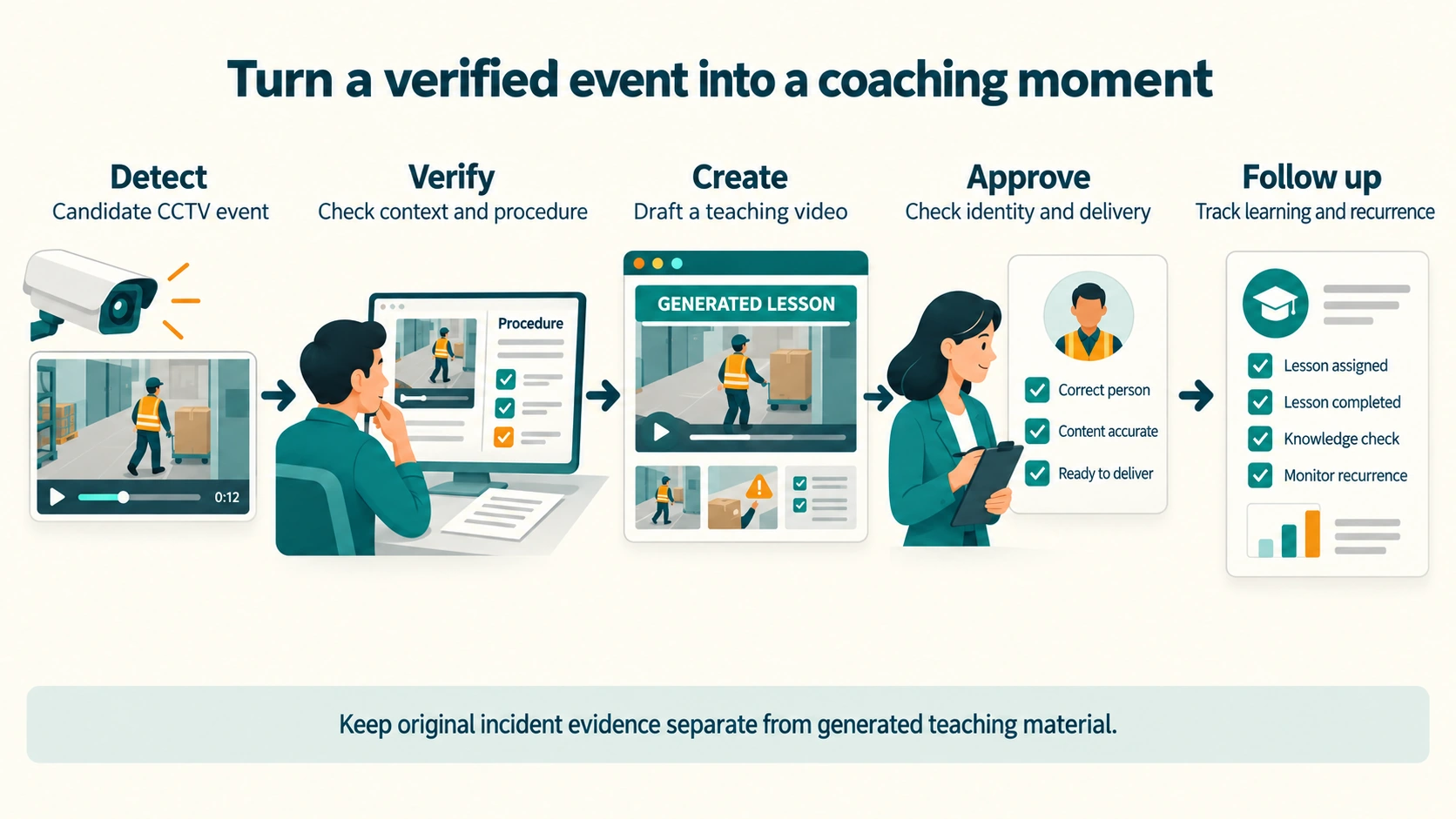
On a mine site, a camera catches a worker walking behind a reversing truck. Or a supervisor logs an observation, or someone reports an incident. Someone must check the event, then turn it into a lesson for the right person. Today a supervisor or a safety advisor does this by hand. They use the health, safety and environment (HSE) system and a toolbox talk. In this design an agent checks the event against the clip and the site rules, and drafts the coaching. The safety owner approves every item before it goes out. Real-time interventions, discipline and any decision about a person stay with people.
Experience behind this example
The design builds on the author's earlier risk-bot work, which found at-risk behaviour in CCTV streams.
The systems involved
The work touches seven of the fourteen layers. The full estate is on the energy and resources page.
- Layer
- Data platform (R02)
- Systems in this use case
- Video management system (Milestone, Genetec) and its video store
- Systems in this use case
- HSE system (Cority, Enablon, Intelex): observations, incidents and actions. Permit to work. HR system and roster. Learning system
- Systems in this use case
- Video analytics (Protex AI, Intenseye). In-cab fatigue monitoring (Seeing Machines Guardian). Collision avoidance (Hexagon). The agent reads these only as events, if at all
- Layer
- Agent platform (R07)
- Systems in this use case
- New: the agent, a restricted video tool, and an approved lesson library
- Systems in this use case
- Pre-start meetings, toolbox talks, crib-room screens, mobile apps
- Systems in this use case
- Worker identity, access to clips, contractor induction records
- Systems in this use case
- Workplace surveillance law, privacy rules, regulator notification
How it runs today
The trigger is a video analytics event, an in-cab fatigue or proximity alert, a supervisor's observation, or an incident report. The work then runs in eleven steps.
- Step
- 1. Event happens
- Who
- Worker. Camera. In-cab system
- System
- Video management. Fatigue monitoring. Collision avoidance
- How the data moves
- Video is stored. In-cab alerts go live to the driver and a monitoring centre
- Step
- 2. Real-time response
- Who
- Monitoring centre or dispatcher
- System
- Radio
- How the data moves
- Calls the driver, and stands the driver down if needed. This is a safety intervention
- Step
- 3. Detection, where analytics exist
- Who
- Video analytics
- System
- Video system plus analytics
- How the data moves
- A candidate event with a clip, a time and a label
- Step
- 4. Review
- Who
- Supervisor or safety advisor
- System
- Video system, analytics screen
- How the data moves
- Watches the clip and decides if the event is real
- Step
- 5. Record
- Who
- Supervisor
- System
- HSE system
- How the data moves
- An observation, hazard or incident is logged. Potential severity is rated
- Step
- 6. Investigate, for incidents
- Who
- Investigation team
- System
- HSE system, with a set investigation method (ICAM or TapRooT)
- How the data moves
- Interviews, timeline, causes and actions
- Step
- 7. Notify the regulator, for serious incidents
- Who
- Site senior executive or delegate
- System
- Regulator form or portal
- How the data moves
- Sent within the time state law sets
- Step
- 8. Coach
- Who
- Supervisor
- System
- Pre-start meeting, toolbox talk
- How the data moves
- Face to face. Sometimes a slide or a short clip
- Step
- 9. Share the lesson
- Who
- Safety team
- System
- Safety alert as a PDF or slides, by email and intranet
- How the data moves
- Sent to other sites
- Step
- 10. Train
- Who
- Training coordinator
- System
- Learning system, HR system
- How the data moves
- Retraining is recorded
- Step
- 11. Report
- Who
- HSE manager
- System
- HSE dashboards
- How the data moves
- A monthly safety report and a board safety committee pack

Handoffs
The event passes from the monitoring centre to the supervisor and the safety advisor. Serious incidents go to an investigation team. HR and employee relations come in if conduct is involved. Then training, site leadership and the regulator.
Where reporting comes in
HSE dashboards and the monthly safety report count injuries, high-potential incidents and critical control checks. The board safety committee reads the same report. Serious incidents go to the regulator.
Cycle time and volumes
- A large site logs thousands of observations a month (typical, unsourced).
- A safety alert reaches other sites in days to weeks (typical, unsourced).
Pain points
- There is far more video than anyone can watch.
- Detectors raise false events.
- Coaching is generic.
- Lessons spread slowly between sites.
- Workplace surveillance law applies. New South Wales has the Workplace Surveillance Act 2005. Workers and unions expect consultation.
- Coaching gets mixed up with discipline. That kills trust.
- Completing a lesson is counted as learning.
How agents run it
The agent checks events and drafts coaching. It reads clips by ID only, through a restricted video tool. It writes draft coaching items to a review queue in the HSE system. It has no path to any machine, alarm, in-cab system or permit.
- Step
- 1. Take the event
- Agent or person
- Agent
- Reads from, and how
- The detector event (clip ID, time, label, score), by event subscription
- Writes to
- Case store
- Who approves, and where
- No one
- Step
- 2. Check the label
- Agent or person
- The agent calls a vision tool
- Reads from, and how
- The clip, by ID only, through a restricted video interface
- Writes to
- The case: supported, not supported, or unclear
- Who approves, and where
- No one
- Step
- 3. Check the context
- Agent or person
- Agent
- Reads from, and how
- Permit system: was work permitted here? Roster. Site procedure and hazard plan in the document store
- Writes to
- Case store
- Who approves, and where
- No one
- Step
- 4. Draft coaching
- Agent or person
- Agent
- Reads from, and how
- The approved procedure. The approved lesson library
- Writes to
- A draft coaching note. A labelled teaching video with faces blurred, kept apart from the evidence
- Who approves, and where
- Not yet
- Step
- 5. Approve
- Agent or person
- Safety owner
- Reads from, and how
- The draft
- Writes to
- A coaching item in the HSE system
- Who approves, and where
- The safety owner, for every item, in the HSE review queue
- Step
- 6. Confirm the recipient
- Agent or person
- The agent proposes. The identity process checks
- Reads from, and how
- HR worker ID. Roster
- Writes to
- The recipient on the coaching item
- Who approves, and where
- The identity process. Unclear cases go to the safety team
- Step
- 7. Deliver
- Agent or person
- Supervisor, or an approved channel
- Reads from, and how
- The coaching item
- Writes to
- Status "delivered"
- Who approves, and where
- The supervisor
- Step
- 8. Track recurrence
- Agent or person
- Agent
- Reads from, and how
- HSE records. Later detector events
- Writes to
- The case, and a periodic report
- Who approves, and where
- The safety owner reviews it
If the clip does not support the label, the case stays unconfirmed and nothing is drafted. A failed delivery stays visible as incomplete. It is never reported as completed coaching.

What stays with a person
- Real-time interventions for fatigue or proximity. They are safety actuation, a deterministic zone.
- Anything about discipline or a person's performance. The rule for decisions about people applies. A named person decides any significant decision about a person.
- Incident classification and regulator notification. They are legal records.
- Investigation findings. They are legal records too.
- Stopping work. That is a safety authority.
Where the evidence is kept
The original clip stays unchanged, under the video system's retention rules. The coaching item sits in the HSE system, with its approver and its links. The agent's log sits with the operator, and the agent cannot change it. Teaching videos are kept apart from the evidence, under their own retention rule.
What changes in the systems
- A new HSE record type, "coaching item", with a status and a link to the clip ID.
- A review queue for the safety owner.
- A video interface limited to fetching a clip by its ID.
- A retention rule for teaching videos.
- Notice and consultation under surveillance law, before the trial starts.
What does not change
In-cab alerts, fatigue monitoring and collision avoidance stay as they are. Incident notification and the investigation method do not change. The discipline process does not change, and the agent has no part in it.
Who does this today
No named mining or oil and gas deployment of a coaching agent was found by 15 October 2026.
- Protex AI with Bendix, a vehicle parts factory. Protex reports 84 percent fewer targeted at-risk behaviours within 60 days (GlobeNewswire, 14 January 2026) [vendor]. It is a factory, not a mine.
- Intenseye lists mining as a target market. It names no mining customer.
- HSE vendors have added AI features: Cority Cortex AI, Enablon incident management, and Intelex with COMET (27 October 2025) [vendor]. They are features, not agents.
- Forwood calls its critical risk management "AI-driven", across more than 800 sites [vendor]. The profile's sources date from October 2023. It gives no AI detail.
- DataRobot with Chevron (2 June 2026) is the nearest case of an agent entering the permit process. Its "Safe Start" agent aims to replace mission permit approval with continuous checks [vendor]. This design keeps control of work with a person.
Where this sits
The four questions place this agent as follows. Its role is create: it drafts coaching material. Its permissions are read only on detector events, clips by ID, the permit system, the roster and procedures. It writes draft coaching items to the review queue and nothing else. It has no path to any machine, alarm or control system. It runs at delegated tasks (A2) on the autonomy contract, as designed and as permitted. The safety owner approves every item. Its impact is on people. Footage shows identifiable workers, and coaching goes to a named person.
On the risk profile it is Tier 2 (enhanced). Personal data scores Medium. If coaching records ever feed discipline, the rule for decisions about people applies, and it becomes Tier 3 (strict). This design keeps them apart. It touches no deterministic zone. It starts at curated learning (L1). People choose the reviewed events it learns from.
Watch for automation bias. People stop checking a detector that is usually right. The safety owner's review must stay a real check.
Measure the result
Measure how often the detector is right, and missed events in a reviewed sample. Measure review effort, coaching relevance and delivery errors. Then measure whether the same behaviour comes back. Completing a lesson does not prove less risk.
Start with a trial
Consult workers and unions first, and give notice under surveillance law. Then take a month of past clips from one site. Run the agent on them, with nothing sent. Ask the safety owner to grade every draft. Then go live with one crew. Register the agent through the agent lifecycle, with a named sponsor.
Evidence and limits
No mining or oil and gas deployment of this agent was found. The best measured case is a factory, and its figure is the vendor's own.
The as-is is typical practice. The volumes are typical and unsourced. The surveillance law named here was not re-checked in this round.
The detector work comes from the author's own experience. The agent extension is a proposal.
Next step
Score this agent on the risk profile. Then read how the rule for decisions about people works on the deterministic zones page.
Explore this topic
Sources were read on 15 October 2026 unless a line says otherwise. [vendor] marks a vendor's claim about its own product or customer.
- GlobeNewswire, Protex AI and Bendix, 14 January 2026 [vendor].
- Protex Intelligence assistant, undated [vendor].
- Cority incident management, Cortex AI, undated [vendor].
- Enablon incident management, undated [vendor].
- Business Wire, Intelex and COMET, 27 October 2025 [vendor].
- Macquarie, investing in workplace fatality prevention software. A profile of Forwood. Its sources date from October 2023 [vendor].
- DataRobot and Chevron, agents for autonomous inspections, 2 June 2026 [vendor].
- NVIDIA video search and summarization blueprint, vendor documentation. Accessed 17 September 2026.
- Workplace Surveillance Act 2005 (NSW). Known from background, not re-checked in this round.
Cite this page
Written by Murali Sid, Founder and AI Systems Architect, last updated 15 October 2026. Licensed CC BY-SA 4.0, so quote it freely with attribution.
Murali Sid (2026). Safety coaching from CCTV, incident and observation data. Agentic Architecture Skills. https://www.agenticarchitectureskills.com/use-cases/safety-coachingMachine-readable version of this page: /use-cases/safety-coaching.md
Resolve billing exceptions without deciding hardship
How an energy retailer clears implausible meter reads and held bills today. How agents can run the same work, with a rule or a specialist approving every change. A water variant is included.
Collect and check compliance evidence
The assurance pattern that every regulated industry shares, worked through for hospital accreditation against the NSQHS Standards. The systems by layer, the work today, the same work with one agent, and the utility and energy variants.