Investigate an energy asset before planning work
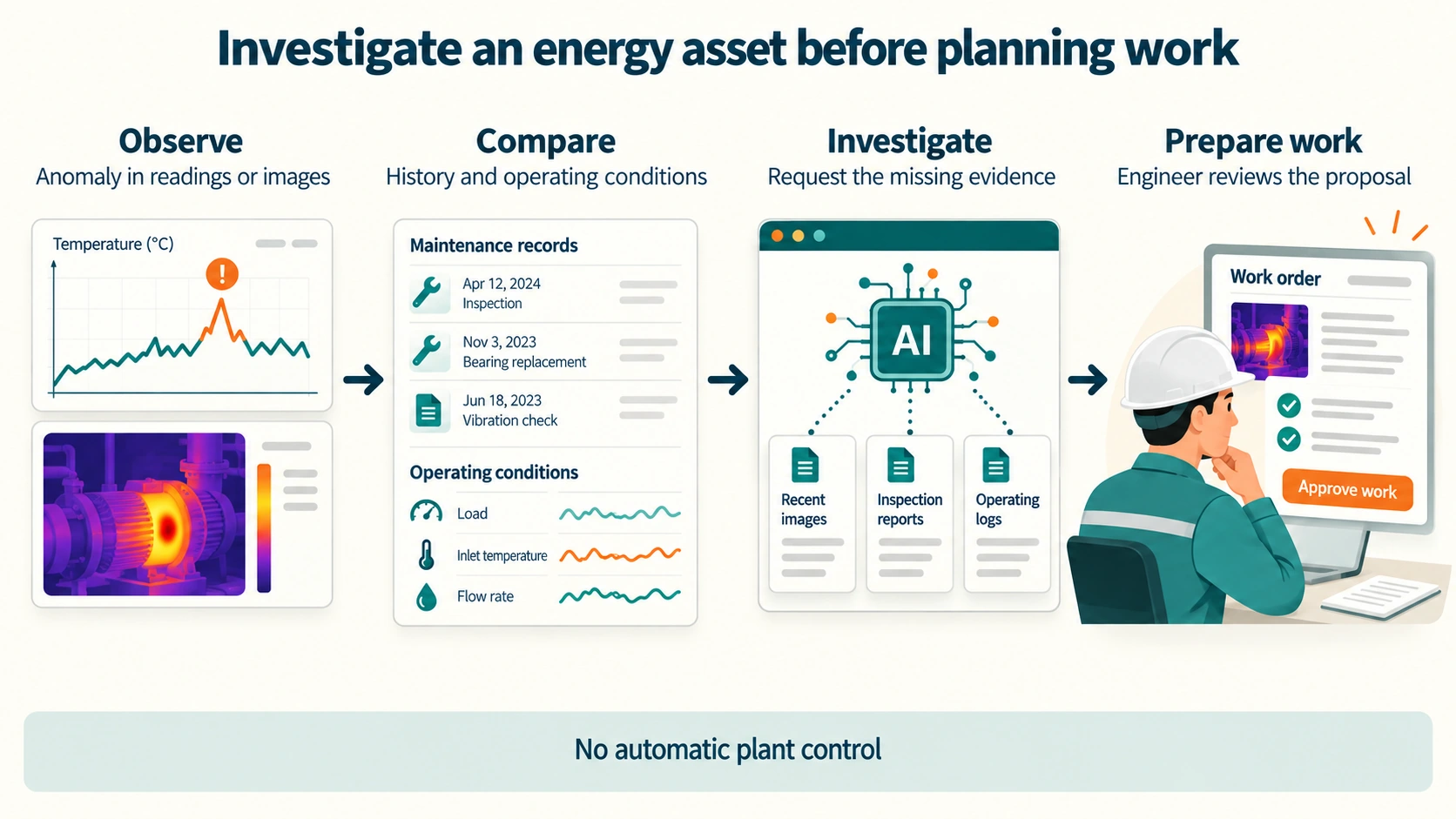
When plant equipment runs outside its normal range, an agent gathers the evidence from the historian, the asset management system and engineering tools. An engineer decides what work to plan.
A gas turbine bearing runs hot, or a feed pump vibrates more than usual. An alarm or an asset performance alert flags it. Before anyone plans work, someone must find out why. Today a reliability engineer owns that investigation, with the control room and the maintenance planners. The evidence sits in five or more systems, and the work takes days. In this design an agent gathers the evidence into one case and drafts a work notification. An engineer decides, in the asset management system. The agent never touches the plant. The same work applies to a gas compressor on a platform, or a mill bearing at a mine.
The systems involved
The investigation touches seven of the fourteen layers. The full estate is on the energy and resources page.
- Layer
- Data platform (R02)
- Systems in this use case
- Process historian (AVEVA PI), which stores every sensor reading over time. Lab system for oil samples. Lakehouse and reports
- Systems in this use case
- The buffer network between plant and business networks, with a historian copy. A read broker for agents. The EAM programming interface
- Systems in this use case
- Enterprise asset management, or EAM (SAP PM, IBM Maximo): notifications, work orders and history. ERP for parts. Permit to work. Document store with equipment manuals
- Systems in this use case
- Distributed control system (DCS) and its alarms. Asset performance management, or APM (AVEVA, GE Vernova, Aspen Mtell). Condition monitoring (Bently Nevada). For a generator, the bidding link to the market operator
- Systems in this use case
- Anomaly models, performance models, vibration analysis and a digital twin
- Layer
- Agent platform (R07)
- Systems in this use case
- New: the agent, its case store, and a search index over manuals and past work orders
- Systems in this use case
- Control room operator, reliability engineer, maintenance planner, superintendents, trading desk or production planner
How it runs today
The work starts with an APM alert or a DCS alarm. It can also start with an email from the equipment maker's diagnostics centre, or an operator who notices a trend. It then runs in eleven steps.
- Step
- 1. Alert
- Who
- APM software, or the control room operator
- System
- APM reading the historian. Or a DCS alarm
- How the data moves
- APM raises an alert when a reading leaves its normal band. It shows on a screen and goes out by email
- Step
- 2. First look
- Who
- Control room operator, shift supervisor
- System
- DCS trends, historian screen (PI Vision)
- How the data moves
- The operator looks at the trend and checks load and air temperature. A line goes in the shift log
- Step
- 3. Raise a notification
- Who
- Operator, or diagnostics analyst
- System
- EAM (SAP PM notification, Maximo service request)
- How the data moves
- Typed by hand: free text, equipment number, priority
- Step
- 4. Engineering review
- Who
- Reliability or plant engineer
- System
- Historian, APM, condition monitoring, EAM history, equipment manuals
- How the data moves
- Exports trends to Excel. Reads past work orders on screen. Emails the equipment maker
- Step
- 5. Ask for more evidence
- Who
- Engineer, then a condition monitoring technician or an oil lab
- System
- Vibration route, oil sample, thermal camera
- How the data moves
- Asked by email or notification. Results come back as PDF reports, often days later
- Step
- 6. Decide
- Who
- Engineer, maintenance and operations superintendents
- System
- Morning meeting, Teams
- How the data moves
- A spoken decision: keep watching, change how the unit runs, fix at the next outage, or fix now
- Step
- 7. Plan the work
- Who
- Maintenance planner
- System
- EAM work order. ERP parts reservation
- How the data moves
- The notification becomes a work order with tasks, parts and labour
- Step
- 8. Tell the market or production planning
- Who
- Trading desk, or production planner
- System
- Bidding system to the market operator (AEMO). Production forecast
- How the data moves
- A generator rebids its availability, with a reason. An oil and gas operator books the lost volume
- Step
- 9. Control of work
- Who
- Area authority, isolating authority
- System
- Permit to work system, or paper permits
- How the data moves
- A permit is issued. The equipment is isolated and locked
- Step
- 10. Do and close
- Who
- Technician, supervisor
- System
- Mobile work app (Maximo Mobile, SAP Asset Manager)
- How the data moves
- Hours, parts and findings recorded. Failure codes are often left blank
- Step
- 11. Report
- Who
- Reliability engineer, plant manager
- System
- Reports over copies of EAM and historian data
- How the data moves
- A monthly reliability report. US generators also file event reports to NERC

Handoffs
The case passes from the control room to engineering, then to maintenance planning. For a generator it then goes to the trading desk. For an oil and gas operator it goes to production planning. Finance codes the cost as operating or capital spend.
Where reporting comes in
APM and historian analytics start the work. Monthly dashboards report availability and the forced outage rate. Board packs carry availability and major failures. Generators also report availability to the market and the regulator.
Cycle time and volumes
- From alert to an engineering decision: one to ten working days (typical, unsourced).
- From notification to scheduled work, when not urgent: one to four weeks (typical, unsourced).
- A fleet diagnostics centre may review tens to hundreds of alerts a week (typical, unsourced).
Pain points
- The evidence sits in five or more systems. Engineers move it by Excel export and email.
- Many alerts are false or already known. So people stop reading them.
- A failing sensor can look like a failing machine.
- Work orders close with thin findings and no failure code. The next investigation starts from scratch.
- Know-how sits with a few experienced engineers.
- The equipment maker's diagnostics data and the site's data rarely join.
How agents run it
The agent runs the evidence gathering. People keep every decision. The agent reads plant data only from the historian copy, through a read broker in the buffer network. It never reads from a controller. It writes only to its own case store and to a draft notification in EAM.
- Step
- 1. Open a case
- Agent or person
- Agent
- Reads from, and how
- APM alerts and alarm history, as events through the read broker
- Writes to
- Its own case store
- Who approves, and where
- No one. Opening a case changes nothing in the plant
- Step
- 2. Check the reading
- Agent or person
- Agent
- Reads from, and how
- Historian programming interface (PI Web API, Seeq): quality flags, flat lines, drift, nearby sensors
- Writes to
- Case store
- Who approves, and where
- No one
- Step
- 3. Check how the unit ran
- Agent or person
- Agent
- Reads from, and how
- Historian: load, air temperature, fuel, recorded setpoints. Shift log. Dispatch targets
- Writes to
- Case store
- Who approves, and where
- No one
- Step
- 4. Check recent work
- Agent or person
- Agent
- Reads from, and how
- EAM tool, read only: recent work orders, open notifications. Maximo offers this through an MCP server, a standard way to give agents tools
- Writes to
- Case store
- Who approves, and where
- No one
- Step
- 5. Run engineering tools
- Agent or person
- The agent calls them. The tools calculate
- Reads from, and how
- Anomaly model, performance model, vibration analysis, digital twin
- Writes to
- Case store, with each output and tool version
- Who approves, and where
- No one
- Step
- 6. Check each finding
- Agent or person
- Fixed rules
- Reads from, and how
- Live data and similar past cases
- Writes to
- Drops a claim, or marks it unverified
- Who approves, and where
- No one. Only checked findings go on
- Step
- 7. Ask for evidence
- Agent or person
- Agent drafts
- Reads from, and how
- Gaps in the case
- Writes to
- A draft request to the condition monitoring queue
- Who approves, and where
- The engineer. Or an agreed rule for internal requests
- Step
- 8. Propose
- Agent or person
- Agent
- Reads from, and how
- The case
- Writes to
- A finding pack, and a draft EAM notification marked "agent draft"
- Who approves, and where
- The engineer, in the EAM worklist
- Step
- 9. Decide and plan
- Agent or person
- Engineer, superintendents, planner
- Reads from, and how
- The finding pack
- Writes to
- EAM work order
- Who approves, and where
- People, as today
- Step
- 10. Market or production change
- Agent or person
- Trading desk, or production planner
- Reads from, and how
- The work plan
- Writes to
- Rebid with a reason. Outage plan. Production forecast
- Who approves, and where
- People. The participant owns every bid
- Step
- 11. Control of work
- Agent or person
- Area authority
- Reads from, and how
- Permit system
- Writes to
- Permit and isolation
- Who approves, and where
- People only. The agent has no path to it
- Step
- 12. Learn
- Agent or person
- Engineer
- Reads from, and how
- Findings on the closed work order
- Writes to
- An "accepted" or "rejected" label on the case
- Who approves, and where
- The engineer reviews each label
The finding pack holds the finding, the other explanations considered, the sources, the gaps and a suggested work scope. Step 6 is the validation loop described on the line of business and OT layer (R05) page. Suggestion tools already ship, so this check is the part worth designing.

What stays with a person
- How the unit runs, and any setpoint change. That is the control path.
- The safety instrumented system and protection settings. Safety actuation is a deterministic zone.
- Permits and isolation. Control of work is a legal safety record.
- Outage commitments and rebids. The market participant owns every bid (Australian Energy Regulator, 5 August 2026).
- Work priority and spend. These are delegated authorities.
Where the evidence is kept
The case store keeps each source reference: the tag, the time range and the query. It keeps each tool output with its version, the check result and who approved. The EAM notification carries the case ID. The operator holds the logs, not the vendor, and the agent cannot change them. This is the observability and audit trail capability at work.
What changes in the systems
- A new EAM notification type or status: "agent draft".
- A case ID field on notifications and work orders.
- A review queue in the engineer's EAM worklist.
- An event subscription to APM alerts.
- A read-only agent identity on the historian and in the buffer network.
- An EAM tool that can only read history and create a draft notification. It sits behind the tool gateway.
- A search index over equipment manuals and past work orders, held in knowledge and memory.
- Model hosting that respects where plant data may go. Plant data often may not leave the site or the country.
What does not change
The DCS, the SIS, alarm settings and protection settings stay as they are. So do the APM models, unless reviewed. The permit process, the maintenance strategy, the market bidding rules and finance approvals do not change.
Who does this today
Vendors now ship the part that covers one system. No one was found doing the join across historian, EAM, lab and permits.
- TotalEnergies and Chevron with Honeywell. Honeywell's Experion Operations Assistant launched on 19 March 2026. Chevron and TotalEnergies piloted it. It warned operators 5 to 10 minutes before alarms, and operators acted [vendor]. At TotalEnergies' Port Arthur refinery it forecast five events, about 12 minutes ahead (Hydrocarbon Processing, November 2025) [vendor]. Status: launched. It advises.
- Aker BP with Cognite. Aker BP uses Cognite Atlas AI agents for root cause analysis. Cognite says they cut engineering time by more than 70 percent (World Oil, 16 September 2025) [vendor]. The article does not say who measured it. Status: in use, by the release. It advises.
- Shell with C3 AI. C3 AI reliability agents find root causes, draft work orders and check parts, "with human approval or override". The source is one article (Portal Tela, 5 June 2026). Status: unverified. The article is machine-written and cites no source.
Asset system vendors have announced agents too. IBM announced Maximo Condition Insight on 5 December 2025. It says automatic work order creation is coming "soon" [vendor]. SAP planned its Maintenance Planner Agent for late 2025. This research could not confirm it shipped [vendor]. Seeq (3 March 2026) and Emerson (11 May 2026) announced investigation agents and advisors [vendor].
The same pattern runs in network planning. The agent chooses the studies, a solver calculates, and an engineer decides. AgenticGrid and Duke Energy's work with AWS are described on the energy and resources page.
Where this sits
The four questions place this agent as follows. Its role is assist: it does work for an engineer. Its permissions are read only on the historian copy, the APM events and the EAM history. It can write only to its own case store and create a draft EAM notification. It has no path to the control system, the permit system or the bidding system. It runs at delegated tasks (A2) on the autonomy contract, both as designed and as permitted. It does a set task, and an engineer approves every output. Its impact is small. A draft can be rejected, and nothing physical moves.
On the risk profile it is Tier 2 (enhanced), because it writes drafts into a production EAM. Many operators class historian data as control-system data. If yours does, it is Tier 3 (strict). It touches no deterministic zone. Safety actuation stays out of its reach by design.
It starts at curated learning (L1). People choose the past cases it uses. Accepted and rejected findings can later feed reviewed learning (L2), through the learning flywheel.
Measure the result
Compare the agent with existing alarms, fixed checks and engineer-led investigation. Count accepted findings, missed issues in a reviewed sample, false work requests and review time. Track the time from alert to decision against today's one to ten days. Reduced downtime is a separate result. It needs a fair comparison over a long period.
Start with a trial
Take a year of closed investigations on one unit or one class of pump. Run the agent on that history, with no live drafts. Ask two engineers to grade each finding pack against what was actually found. Then allow live drafts at one site. Register the agent through the agent lifecycle, with a named sponsor, before it goes live.
Evidence and limits
The as-is steps are typical industry practice, not one company's process. No published cycle times or volumes were found, so all of them are marked typical and unsourced.
The vendor results are the vendors' own. The Aker BP figure does not say who measured it. Shell's story exists only in a machine-written article.
No vendor agent found joins the historian, EAM, lab, permits and production accounting. That join is the part this design adds. It has not been tested.
The IEA's Energy and AI report (2025) discusses AI in maintenance. It does not report a result for this workflow.
Next step
Score this agent on the risk profile. Then see how the read broker works on the line of business and OT page.
Explore this topic
Sources were read on 15 October 2026 unless a line says otherwise. [vendor] marks a vendor's claim about its own product or customer.
Named deployments:
- Honeywell, commercial launch of Experion Operations Assistant, 19 March 2026 [vendor].
- Hydrocarbon Processing, Honeywell and TotalEnergies pilot, November 2025 [vendor].
- World Oil, Aker BP expands its AI-first strategy with Cognite Atlas AI, 16 September 2025 [vendor].
- Portal Tela, C3 AI agents at Shell, 5 June 2026. Machine-written, no source named. Unverified.
Vendor agents for this process:
- Vendor
- IBM
- Agent or feature
- Maximo Condition Insight
- Date
- 5 December 2025
- Status as of 15 October 2026
- Announced. Automatic work orders "soon" [vendor]
- Vendor
- IBM
- Agent or feature
- Maximo Application Suite 9.2, MCP server for outside agents
- Date
- 25 June 2026
- Status as of 15 October 2026
- Announced [vendor]
- Vendor
- SAP
- Agent or feature
- Maintenance Planner Agent
- Date
- Planned for Q4 2025
- Status as of 15 October 2026
- Not confirmed. SAP pages refused access [vendor]
- Vendor
- Seeq
- Agent or feature
- Agent Q and Build Your Own Agent
- Date
- 3 March 2026
- Status as of 15 October 2026
- Announced [vendor]
- Vendor
- Emerson
- Agent or feature
- AspenTech AVA, four advisors
- Date
- 11 May 2026
- Status as of 15 October 2026
- Launched. Advisors not named [vendor]
- Vendor
- Interloc
- Agent or feature
- Interloc AI agents on Maximo, with approval steps and audit trails
- Date
- Date not found
- Status as of 15 October 2026
- Announced [vendor]
- Vendor
- Siemens
- Agent or feature
- Senseye maintenance copilot. Pilots reported 25 percent less reactive maintenance time
- Date
- Date not found
- Status as of 15 October 2026
- Not confirmed [vendor]
Context:
- Equinor, AI saved USD 130 million, 7 January 2026. Equinor monitors over 700 rotating machines with 24,000 sensors, mainly with traditional machine learning.
- EDF and Mistral partnership, 28 May 2026. Agents to query the technical memory of the nuclear fleet, on sovereign hosting, not for plant control.
- K&L Gates on the AER automated bidding bulletin, 10 August 2026. The participant owns every bid.
- IEA, Energy and AI, 2025. Reviewed 18 September 2026.
- Race for 2030, AgenticGrid at Broken Hill, undated, accessed 14 October 2026, and T&D World, AWS and Duke Energy, 18 September 2026. Both show the pattern where the agent plans, tools calculate and an engineer decides.
Cite this page
Written by Murali Sid, Founder and AI Systems Architect, last updated 15 October 2026. Licensed CC BY-SA 4.0, so quote it freely with attribution.
Murali Sid (2026). Investigate an energy asset before planning work. Agentic Architecture Skills. https://www.agenticarchitectureskills.com/use-cases/energy-asset-investigationMachine-readable version of this page: /use-cases/energy-asset-investigation.md
Prepare the evidence before a consult or multidisciplinary meeting
Before a cancer meeting or a clinic, gather results, reports and outside records into one brief. Every fact shows its source and date. The systems by layer, the work today, the same work with one agent, and who signs.
Prioritize vegetation inspections
How an electricity distributor turns imagery into vegetation work today. How an agent can carry a finding to a proposed work request that a planner approves.