Energy and resources: the estate and where agents fit
The systems a generator, an oil and gas operator and a miner run, layer by layer. The rule that keeps agents off the control path. The use cases and named deployments placed on that estate.
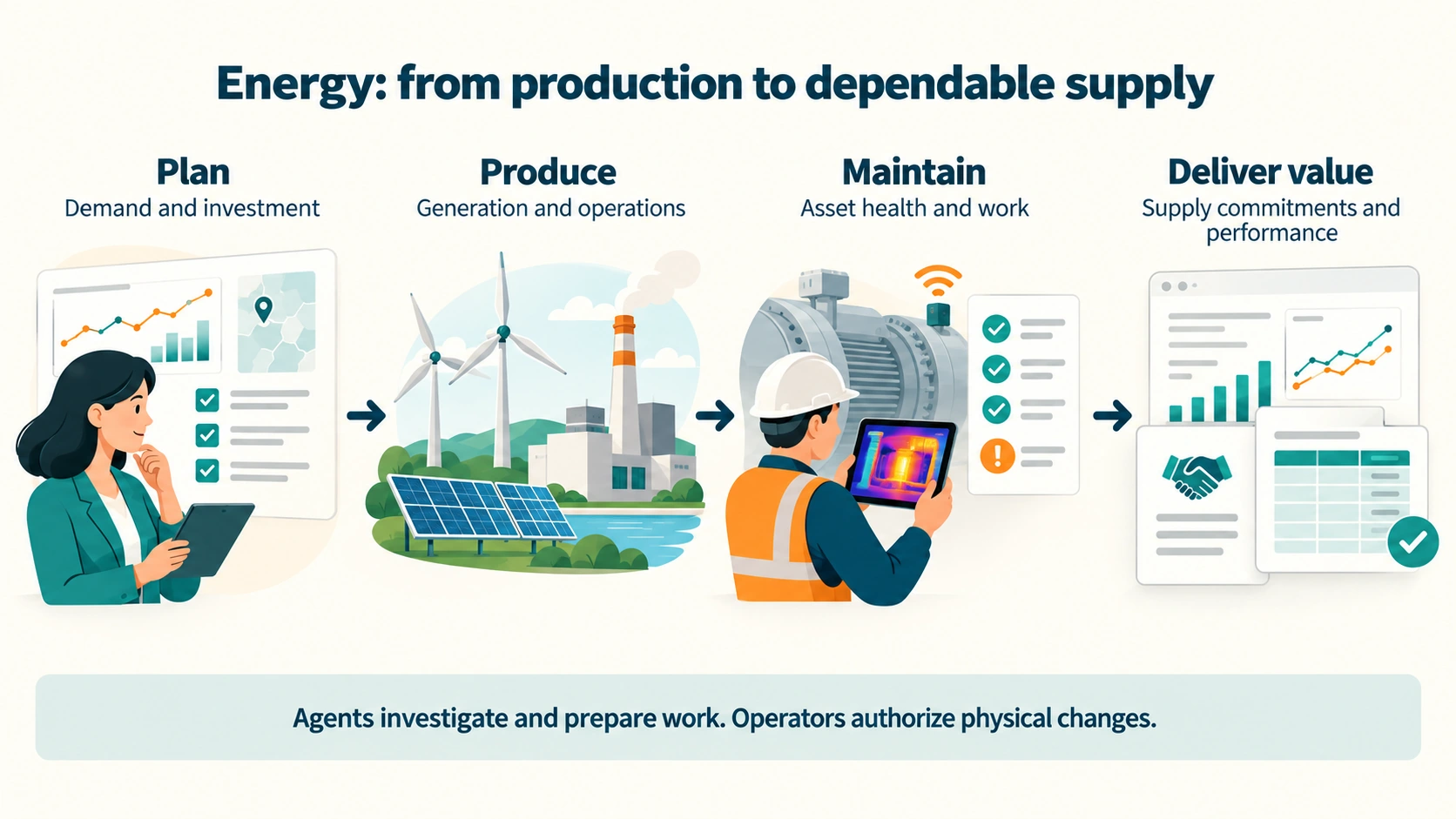
Energy and resources companies do four kinds of work. They trade in markets, plan networks and plants, run generation and network assets, and run mines and processing plants. This page shows the systems they run, layer by layer, and where agents fit. The short answer is this. Agents read plant data through a read-only broker and draft work for people. They never write to a control or safety system. The frame is the same as on every page: layers you own, a lifecycle you run, and capabilities you add.
The estate
Two kinds of producer share most of this estate. The first is a power generator or an upstream oil and gas operator with several sites. It runs plants or wells, with a control room at each site. The second is a miner with pits, a processing plant, rail and a port. It often runs them from a remote operations centre in the city. The two differ most in the line of business and OT layer (R05), where the plant and fleet systems sit.
The table names the main systems in each of the fourteen layers. Vendor names in brackets are examples, not endorsements.
- Generator or upstream oil and gas
- Servers in each control building. Fibre, microwave or satellite links. A data centre and public cloud
- Miner with a processing plant
- Site server rooms. Rugged computers on trucks and drills. Private wireless for autonomous haulage. Cloud
- Layer
- Data platform (R02)
- Generator or upstream oil and gas
- Process historian (AVEVA PI, AspenTech IP.21). Lab system (LIMS). Lakehouse. Industrial data platform (Cognite). Reports and dashboards
- Miner with a processing plant
- Historian. Fleet management database. Geology database and block models. LIMS. Lakehouse (Palantir Foundry at Rio Tinto)
- Generator or upstream oil and gas
- A buffer network between plant and business networks, with historian copies. OPC servers. MQTT broker. Integration platform. Market links (AEMO bidding API)
- Miner with a processing plant
- The same buffer network. Fleet system adapters. Equipment maker telematics (Caterpillar, Komatsu). Rail and port links
- Generator or upstream oil and gas
- ERP. Enterprise asset management, or EAM (SAP PM, IBM Maximo). Production accounting. Trading and bidding system. Health, safety and environment (HSE) system. Permit to work. Documents
- Miner with a processing plant
- ERP. EAM (SAP PM, Ellipse). Metal accounting (ION Algosys). HSE and critical control (Forwood). Isolation and permits. Rostering. Tenement register
- Generator or upstream oil and gas
- Distributed control system, or DCS (Emerson, ABB, Honeywell). Safety instrumented system (SIS). Turbine control. Protection relays. Asset performance management (APM). Condition monitoring. Alarm management
- Miner with a processing plant
- Fleet management (Modular DISPATCH, Cat MineStar). Autonomous haulage. Collision avoidance. Fatigue monitoring. Slope radar. Plant control (PLC and SCADA). Belt scales. Mine planning (Deswik)
- Generator or upstream oil and gas
- Advanced process control. Anomaly models. Price and demand forecasts for bidding. Seismic models
- Miner with a processing plant
- Expert control on mills. Fleet dispatch optimisation. Predictive maintenance on haul trucks. Ore vision. Drilling optimisation
- Layer
- Agent platform (R07)
- Generator or upstream oil and gas
- Mostly new. Robotic process automation in finance. Copilots. Agent builders inside vendor products (Cognite, Seeq, IBM, SAP)
- Miner with a processing plant
- Mostly new. Robotic process automation in finance and payroll. Palantir AIP at Rio Tinto. Cat AI Assistant
- Generator or upstream oil and gas
- Email, Teams, SharePoint and Excel. Shift handover logs. Radio
- Miner with a processing plant
- The same, plus pre-start and toolbox talk material
- Generator or upstream oil and gas
- Control consoles. Historian screens. Mobile work apps. Tablets rated for hazardous areas. Trading screens
- Miner with a processing plant
- Dispatch consoles. In-cab displays. Remote operations centre screens. Inspection apps
- Generator or upstream oil and gas
- Corporate directory. A separate OT directory. Privileged access. OT network monitoring (Claroty, Dragos). Security event monitoring
- Miner with a processing plant
- The same, plus contractor site access and fleet network security
- Generator or upstream oil and gas
- Risk register. Process safety and the safety case. Management of change. Market compliance (AER, AEMO). Emissions reporting (NGER)
- Miner with a processing plant
- Critical control management. Tailings governance (GISTM). Statutory mine safety. Royalties. Reserve reporting (JORC Code)
- Generator or upstream oil and gas
- IT monitoring. Historian interface health. OT asset inventory. Service management (ServiceNow)
- Miner with a processing plant
- The same, plus fleet network health
- Generator or upstream oil and gas
- Control room operators. Shift supervisors. Reliability engineers. Maintenance planners. Trading desk. HSE and assurance
- Miner with a processing plant
- Dispatchers. Geology, survey and planning. Metallurgists. Maintenance. Remote operations centre. Statutory roles such as the site senior executive
- Generator or upstream oil and gas
- Mostly new. Pipelines from historian to lakehouse. Equipment hierarchies and tag names (PI AF, KKS codes). Document capture
- Miner with a processing plant
- Mostly new. The same pipelines. Geology and survey files. Document capture for permits and assays
Three control systems matter most on this page. The distributed control system (DCS) runs the process. Programmable logic controllers (PLC) run machines. The safety instrumented system (SIS) shuts the plant down safely when limits are passed. It is kept separate by design.

Plant networks do not talk straight to business networks. A buffer network, often called the DMZ, sits between them. Historians copy plant data across it. Some sites use a data diode, which lets data flow one way only. Agents run on the business side or in the cloud. A read broker in the buffer network serves them plant data from the copy. That broker is how the tool gateway reaches the plant.
Vendors now ship agents for single systems: one control system, one EAM, one historian. This research found no vendor agent that joins the historian, EAM, lab, permits and production accounting for one investigation. That join is where a thin build fits. The method is on agents and packaged applications.
Agents stay on the information path
One rule binds this industry. Agents sit on the information path, never the control path. The information path is reading data, checking it and drafting work. The control path is anything that moves equipment.
Nothing an agent does writes to a DCS, PLC, SIS, protection relay or turbine control. Nothing writes to a collision avoidance or fatigue system. Nothing an agent does issues a permit or applies an isolation. A person, or a certified system, makes every physical change. Safety actuation is one of the four deterministic zones, where a model may never approve.
Three vendor claims made in 2026 cross this line. This guide does not cross it with them.
- Honeywell Experion Cognition, announced 9 June 2026. Honeywell says it will "proactively act on behalf of the operator" [vendor]. A proof of concept runs at Borouge in Ruwais. Honeywell promised it for the third quarter of 2026. This research found no confirmation that it shipped.
- Cognite with ABB, announced 21 May 2026. It adds agents to ABB's safety and alarm tools. Aker BP is the first customer. The release says agents can "trigger cross-system actions" and does not say which ones [vendor].
- DataRobot with Chevron, announced 2 June 2026. A "Safe Start" agent checks conditions for robotic inspection missions. It aims to replace the permit approval for each mission with continuous checks [vendor]. The stage is not stated.
None of the three says what its agent may not touch. A control vendor acting inside its own control system needs its own safety case. Yokogawa's reinforcement-learning control at two plants is the same kind of case. It is described on the line of business and OT page. It is not an agent on the information path.
The use cases on this estate
Four worked examples sit on this estate. Each is a proposal from this guide, built for a producer. A fifth, compliance evidence, is shared with utilities. The table shows what each one reads, where it writes and who decides.
- Use case
- Asset investigation
- Reads from
- Historian copy, asset performance alerts, EAM history, equipment manuals
- Writes to
- Its own case store. A draft EAM notification
- Who decides
- An engineer, in EAM
- Use case
- Production measurement
- Reads from
- Fleet database copy, belt-scale totals, lab results, calibration records
- Writes to
- A reconciliation case. A draft measurement check
- Who decides
- A metallurgist or production accountant
- Use case
- Safety coaching
- Reads from
- Detector events, clips by ID, permits, roster, procedures
- Writes to
- A draft coaching item in the HSE system
- Who decides
- The safety owner
- Use case
- Recurring audit issues
- Reads from
- Audit findings, EAM history, inspection records, procedures
- Writes to
- A case and internal evidence requests
- Who decides
- The assurance owner
- Use case
- Compliance evidence
- Reads from
- Obligations register, inspection records, lab and emissions reports
- Writes to
- An evidence package
- Who decides
- A named person attests
Investigate an asset before planning work
Investigate production discrepancies
Safety coaching from CCTV and observations
Investigate recurring audit issues
Collect and check compliance evidence
The named deployments below sit in three areas of the work: markets, planning, and generation and network assets. Each says who runs it, whether it advises or acts, and who reported the result.
Markets
Battery bidding
Battery owners in Australia's National Electricity Market (NEM) use software that bids and rebids. No person signs each bid. Tesla's Autobidder and Fluence's Mosaic are two such bidders. Fluence names Akaysha Energy among its users (pv magazine Australia, 20 November 2024). The vendors say their bidders work inside limits the operator sets, with manual override [vendor]. No measured outcome is published. The bidders are in production.
That is managed autonomy (A4) on the autonomy contract. The bidder acts inside limits people set, without approval of each bid. Its learning is curated learning (L1) or reviewed learning (L2). In curated learning, people choose what it learns from. This guide asks for reviewed learning at A4. A bid moves money and creates a formal market record. Both are deterministic zones. A zone action makes the bidder Tier 3 (strict) on the risk profile. The control is a policy check and a log the bidder cannot change, both before the market gateway. That is enforcement outside the model.
What the regulator said. The Australian Energy Regulator (AER) issued a compliance bulletin on automated bidding on 5 August 2026. It creates no new obligations. The participant owns every bid, however it is made. Bids sent straight to the market operator without a participant check carry higher compliance risk. Participants should record the logic behind each rebid. Third-party providers may be liable too. This page could not retrieve the bulletin itself. It read the bulletin through a law firm's alert (K&L Gates, 10 August 2026).
Planning
Planning agents read documents, run studies and build evidence packs. All three cases below advise. Engineers or staff decide. Each is at delegated tasks (A2): the agent does a set task and a person decides.
Network models in hours. AgenticGrid comes from Monash University with Transgrid and Essential Energy. Its agents choose which studies to run. A conventional solver does the calculation. A network model of the Broken Hill area took about two hours, against about three weeks. Race for 2030, an energy research programme, reported the result. It is a trial.
Interconnection screening. PJM, the largest US grid operator, works with Tapestry from Alphabet. The partnership was announced in April 2025. Its agents screened 811 generation filings, about 220 gigawatts, for site control in under an hour. That is Tapestry's own count [vendor]. Each finding links to its source pages. PJM staff make the compliance call. That call is a formal queue decision, so it sits in the formal records zone.
Interconnection study data. Duke Energy runs agents with AWS on parts of its interconnection studies. The agents use Duke's own simulation software and grid models. AWS says data preparation fell from about two weeks to hours (T&D World, 18 September 2026) [vendor]. Duke says its engineers make all final engineering decisions. The stage is not stated.
Generation and network assets
Self-healing grid, the rule-based baseline. Duke Energy's self-healing grid isolates faults and restores supply on its own. Duke counts about 2.2 million customer outages avoided in 2025. It also counts 5.2 million outage hours saved. It announced both on 5 February 2026. The announcement does not mention AI. Self-healing usually means fixed switching logic. It is the rule-based autonomy regulators already accept. It is not an agent, and it needs no new control.
Outage request review. CAISO, the California grid operator, uses review agents built by OATI. OATI says they analyse more than 500 next-day outage requests in under eight minutes a night [vendor]. In July 2025 CAISO reported no results yet and called itself cautiously optimistic (Latitude Media, 28 July 2025). Operators keep final authority. It is delegated tasks (A2) with curated learning (L1). It touches no zone.
Control room assistants. Honeywell launched its Experion Operations Assistant on 19 March 2026, after pilots at Chevron and TotalEnergies. It warned operators 5 to 10 minutes before alarms, and operators acted [vendor]. It advises. Schneider Electric announced its Grid AI Assistant on 4 June 2026. It says every operational action stays subject to user review [vendor]. It names no utility. This research found no utility letting an agent operate protection or switching.
Proposals and commercial work
Commercial work is not an operations workflow, but it runs on the same estate. A generator's sales desk answers a large buyer's request for a power purchase agreement. A mining supplier answers a tender. Today an originator gathers the request, the buyer's meter data and past deals by hand. A structuring analyst prices the deal from forward curves in the trading system and a spreadsheet. Credit, legal and a risk committee then approve under delegated authority. It takes weeks to months (typical, unsourced).
An agent can help with the brief. It reads the CRM, public information about the buyer and approved summaries of past deals. It drafts an opportunity brief that keeps facts apart from guesses. It lists questions for the buyer and outlines the proposal. The originator reviews every draft. Price, credit, terms, every message to the buyer and deal booking stay with people. A price or contract change moves money, so it sits in the money zone. The agent has no write path to the trading system and no send path to the buyer.
It sits in the systems of record layer (R04) and the productivity and collaboration layer (R08). It works at delegated tasks (A2) with curated learning (L1). It is Tier 2 (enhanced) while it only drafts. Other customers' terms stay out of its reach. This research found no such deployment in energy or mining.
Evidence and limits
Most figures on this page come from the vendor or the operator. None is independently audited. This research found no independent figure showing that AI cut outage time at a named energy company.
The estate is typical practice, not a survey of one company. The vendor lists come from industry knowledge, and most are unsourced. Twenty searches found no agent from Deswik, Komatsu, Modular Mining, Sphera, Quorum or SLB Avocet for these processes. Absence in twenty searches is not proof of absence.
No agent deployment was found at BHP, Rio Tinto or Fortescue by 15 October 2026. They show machine learning, platform deals and job advertisements. Adoption is early in power too. A PwC study reported in April 2026 found 61 percent of utilities still in test or pilot.
The main guidance on AI and functional safety is ISO/IEC TR 5469. It is a technical report and is not binding. NAMUR Open Architecture describes a second channel that reads plant data without touching control. That is close to the information-path rule. This round did not check its primary text. The IEA's Energy and AI report (2025) surveys AI across energy. It does not validate the agent workflows proposed here.
Next step
Pick one worked example and score it on the risk profile. Technical readers can open the mining and resources blueprint or the energy and utilities blueprint. Electricity distribution and water continue in Utilities.
Explore this topic
Sources were read on 15 October 2026 unless a line says otherwise. [vendor] marks a vendor's claim about its own product or customer.
Markets and the regulator:
- AER compliance bulletin on automated bidding and third-party services, 5 August 2026. It could not be retrieved, so it was read through the next item.
- K&L Gates, AER guidance on automated bidding and third-party services, 10 August 2026.
- Tesla Autobidder support page, undated [vendor]. Read through a search summary.
- Fluence Mosaic brochure, undated [vendor]. Read through a search summary.
- pv magazine Australia, Fluence and Akaysha Energy, 20 November 2024.
- AEMO NEM Dispatch Bidding API, read 15 October 2026.
- AEMO Markets Portal bid file format, read 15 October 2026.
Planning and network assets:
- Race for 2030, AgenticGrid at Broken Hill, undated. Accessed 14 October 2026.
- PJM Inside Lines, PJM with Google and Tapestry, April 2025.
- Data Center Dynamics, Tapestry's first PJM deployment, reporting Tapestry's figures [vendor].
- T&D World, AWS and Duke Energy agents for interconnection studies, 18 September 2026.
- Duke Energy announcement, reproduced by StockTitan, 5 February 2026.
- Latitude Media, inside CAISO's outage management pilot, 28 July 2025.
- OATI, AI for energy, 2026 [vendor].
- Eurelectric, Schneider Electric Grid AI Assistant, 4 June 2026 [vendor].
Control room and the line agents do not cross:
- Honeywell, commercial launch of Experion Operations Assistant, 19 March 2026 [vendor].
- Honeywell, Experion Cognition for Borouge, 9 June 2026 [vendor]. Promised for the third quarter of 2026. Not confirmed shipped by 15 October 2026.
- Cognite and ABB release, ANSA copy, 21 May 2026 [vendor]. Aker BP aims for "hundreds of agents by 2026".
- DataRobot and Chevron, agents for autonomous inspections, 2 June 2026 [vendor].
- ISO/IEC TR 5469:2024, AI and functional safety.
- ISA-95 standard page and ISA/IEC 62443 series page, read 15 October 2026. ISA-95 names the plant levels. ISA/IEC 62443 splits a plant into security zones.
- NAMUR NE 175, NAMUR Open Architecture. Known from background, not re-checked in this round.
Mining and adoption:
- Business Wire, Rio Tinto renews Palantir, 12 November 2024 [vendor].
- BHP Insights, AI in mining, August 2024. Engineering News, BHP AI hub in Singapore, 27 May 2025.
- Fortescue job advertisement mentioning agentic automation, undated.
- Proactivo, GMG gathering in Lima, September 2026. It discussed why mining AI pilots stall: late data, clashing targets, no change plan, and budgets in the wrong place.
- innobu, AI for exception cases in metering, 26 September 2026, citing the PwC study.
- IEA, Energy and AI, 2025. Reviewed 18 September 2026.
Where vendor agents land in this estate, as of 15 October 2026:
- Layer and system
- Control system, Honeywell
- What ships
- Experion Operations Assistant, 19 March 2026 [vendor]
- Advises or acts
- Advises
- Status
- Launched
- Layer and system
- Control system, Honeywell
- What ships
- Experion Cognition, 9 June 2026 [vendor]
- Advises or acts
- Acts, by the vendor's words
- Status
- Not confirmed shipped
- Layer and system
- Control and models, Emerson
- What ships
- AspenTech AVA, four advisors, 11 May 2026 [vendor]
- Advises or acts
- Advises
- Status
- Launched. Advisors not named
- Layer and system
- Control, Yokogawa
- What ships
- Reinforcement-learning control at ENEOS Materials (March 2023) and Aramco Fadhili (October 2025) [vendor]
- Advises or acts
- Acts in closed loop. Not a language model
- Status
- Production
- Layer and system
- Historian and models, Seeq
- What ships
- Agent Q and Build Your Own Agent, 3 March 2026 [vendor]
- Advises or acts
- Advises
- Status
- Announced
- Layer and system
- Data platform, Cognite
- What ships
- Atlas AI at Aker BP, 16 September 2025 [vendor]
- Advises or acts
- Advises
- Status
- In use, by the release
- Layer and system
- EAM, IBM
- What ships
- Maximo Condition Insight, 5 December 2025. Maximo 9.2 with an MCP server for outside agents, 25 June 2026 [vendor]
- Advises or acts
- Recommends
- Status
- Announced
- Layer and system
- EAM, SAP
- What ships
- Maintenance Planner Agent, planned for the fourth quarter of 2025 [vendor]
- Advises or acts
- Suggests schedule changes
- Status
- Not confirmed shipped
- Layer and system
- EAM, C3 AI
- What ships
- Reliability agents at Shell, 5 June 2026
- Advises or acts
- Drafts for approval
- Status
- Unverified
- Layer and system
- HSE, several vendors
- What ships
- Cority Cortex AI, Enablon, Intelex with COMET (27 October 2025) [vendor]
- Advises or acts
- Advise
- Status
- Features, not agents
- Layer and system
- Mining fleet, Caterpillar
- What ships
- Cat AI Assistant, 6 January 2026 [vendor]
- Advises or acts
- Advises
- Status
- General availability not confirmed
- Layer and system
- Production accounting
- What ships
- TCS white paper, Groundhog Reconciliation Agent [vendor]
- Advises or acts
- Advises
- Status
- No named deployment
- Layer and system
- Batteries and bidding
- What ships
- Tesla Autobidder, Fluence Mosaic [vendor]
- Advises or acts
- Acts inside limits
- Status
- Production
Cite this page
Written by Murali Sid, Founder and AI Systems Architect, last updated 15 October 2026. Licensed CC BY-SA 4.0, so quote it freely with attribution.
Murali Sid (2026). Energy and resources: the estate and where agents fit. Agentic Architecture Skills. https://www.agenticarchitectureskills.com/use-cases/energyMachine-readable version of this page: /use-cases/energy.md
Healthcare: follow the work around the patient
The fourteen layers of a public hospital network and the systems in each. Four agent use cases, the rules that bind them, and what runs today.
Utilities: keep essential services working
The estate of an electricity distributor and a water utility on the fourteen layers. Four worked examples placed on it, who uses AI today, and the rules that bind the work.