Investigate production discrepancies
When truck tonnes from the pit and belt-scale tonnes at the plant disagree, an agent checks timing, instruments and material. A named owner accepts any adjustment to the production record.
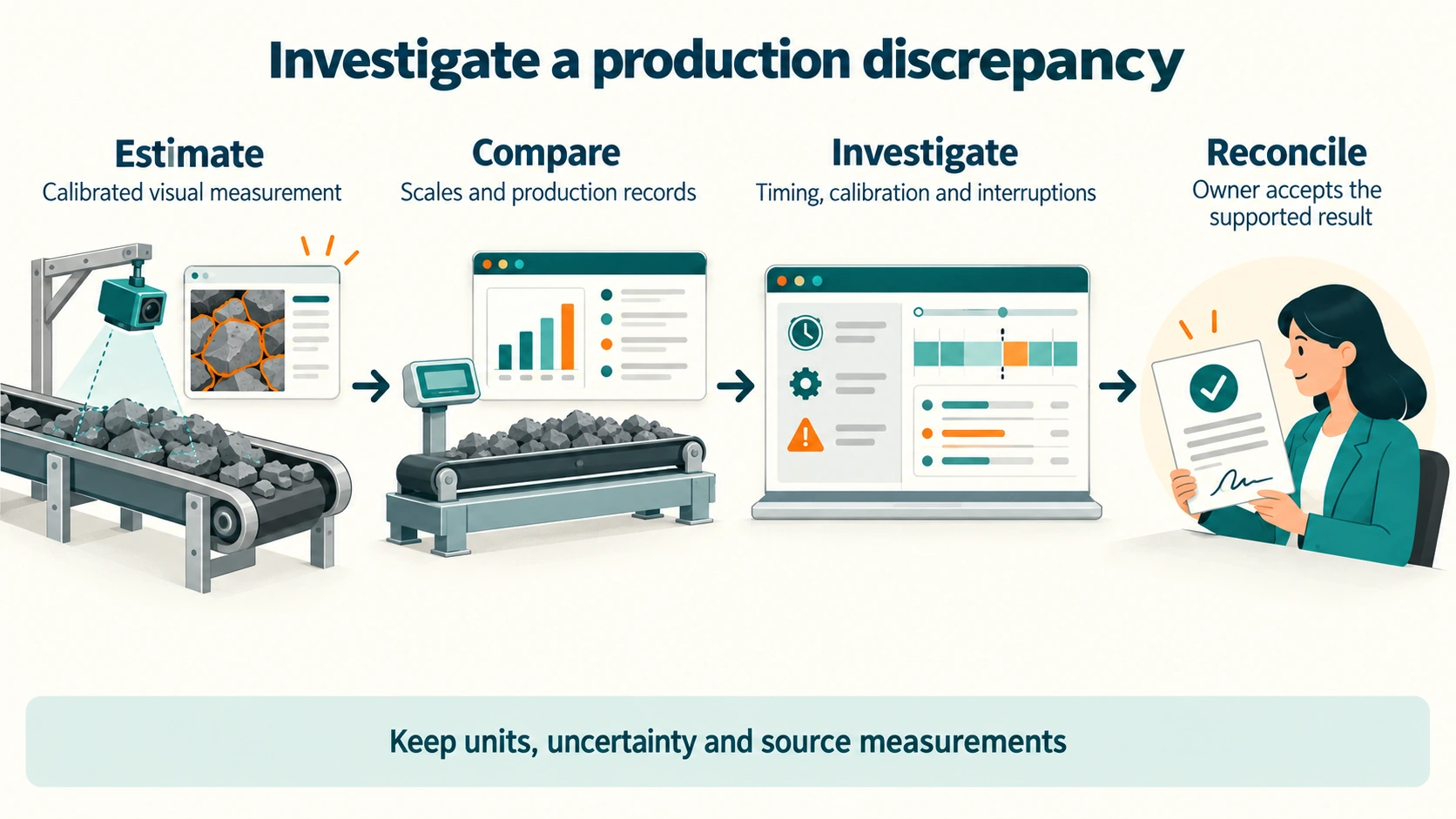
At a mine, trucks carry ore from the pit to the processing plant. The fleet system counts the truck tonnes. Belt scales at the plant weigh the ore again. When the two disagree by more than the agreed tolerance, someone must find out why. The official figure feeds royalties, tax and market reports, so the gap matters. Today a mine engineer or a metallurgist chases the cause by email and spreadsheet. In this design an agent checks timing, instruments and material, and prepares a reconciliation case. A named owner accepts any adjustment. The agent cannot write the accepted production record.
Experience behind this example
The design builds on the author's own computer-vision work on iron ore production measurement.
The systems involved
The investigation touches seven of the fourteen layers. The full estate is on the energy and resources page.
- Layer
- Data platform (R02)
- Systems in this use case
- Historian with belt-scale totals and scale faults. Lab system, or LIMS (CCLAS, LabWare), for grade and moisture. Fleet management database. Block model
- Systems in this use case
- The buffer network between plant and business networks, with a historian copy. A read-only copy of the fleet database. A read broker for agents
- Systems in this use case
- Metal accounting (ION Algosys, Caspeo), or a spreadsheet. Enterprise asset management (EAM) with calibration records. ERP inventory
- Systems in this use case
- Fleet management (Modular DISPATCH, Cat MineStar, Wenco). Belt scales and plant control. Camera volume system. Survey tools (Maptek). Mine planning (Deswik)
- Layer
- Agent platform (R07)
- Systems in this use case
- New: the agent and its case store
- Systems in this use case
- Royalty returns to the state. Stock exchange reports. The annual reserve statement under the JORC Code
- Systems in this use case
- Dispatcher, mine engineer, surveyor, metallurgist, instrument technician, production accountant, competent person
How it runs today
The trigger is the daily production report, or the month-end reconciliation, showing a gap larger than the tolerance. The work then runs in eleven steps.
- Step
- 1. Count loads
- Who
- Fleet system, dispatcher
- System
- Fleet management (Modular DISPATCH, Cat MineStar, Wenco)
- How the data moves
- Every truck load is logged: truck, shovel, material, destination, payload. The dispatcher fixes wrong tags by hand
- Step
- 2. Weigh at the plant
- Who
- Plant control system
- System
- Belt scales to the historian
- How the data moves
- Tonnes per hour. Shift totals stored in the historian
- Step
- 3. Assay
- Who
- Lab
- System
- LIMS
- How the data moves
- Grade and moisture from samples
- Step
- 4. Estimate by camera or survey
- Who
- Vision system, surveyor
- System
- Camera volume model. Drone or laser survey
- How the data moves
- A volume estimate with its calibration. Monthly stockpile surveys arrive as files
- Step
- 5. Daily production report
- Who
- Production clerk or mine engineer
- System
- Excel, fed by fleet and historian exports
- How the data moves
- Built each morning. Emailed to site leaders before the morning meeting
- Step
- 6. Spot the gap
- Who
- Mine engineer, metallurgist
- System
- Excel, dashboard
- How the data moves
- Mine tonnes and plant tonnes differ by more than the tolerance
- Step
- 7. Chase the cause
- Who
- Mine technical services, metallurgist, instrument technician
- System
- EAM calibration records. Historian scale faults. Fleet payload settings. LIMS moisture
- How the data moves
- Emails and phone calls. Each person checks their own system
- Step
- 8. Propose an adjustment
- Who
- Metallurgist or production accountant
- System
- Metal accounting system, or Excel
- How the data moves
- An adjustment with a comment
- Step
- 9. Approve
- Who
- Processing or mine manager
- System
- Same
- How the data moves
- Sign-off by email or in the system
- Step
- 10. Month end
- Who
- Survey, geology, planning, metallurgy
- System
- Metal accounting. Mine planning
- How the data moves
- Stockpile survey. Mass balance. Mined tonnes and grade checked against the block model
- Step
- 11. Formal reports
- Who
- Finance, corporate reporting, competent person
- System
- ERP inventory. Royalty return. Stock exchange report. Annual reserve statement
- How the data moves
- Signed by named people

The oil and gas twin
Oil and gas has the same problem in another form. Well tests, often monthly, estimate each well's flow rate (typical, unsourced). A production data system (Quorum Energy Components, SLB Avocet) builds the daily report. The production accountant then shares the fiscal export volume back to wells and partners. That is called allocation. API's measurement standard, MPMS Chapter 20, sets the method. When the allocation factor leaves its band, a production engineer and a metering technician chase the cause. They check flow computer logs, calibration records and well test validity, by email and spreadsheet. The same agent design applies. The agent reads the allocation system and the calibration records. The accountant re-runs the allocation and signs.
Handoffs
The case passes between dispatch, mine technical services, plant metallurgy and the lab. Maintenance comes in through the instrument technicians. Finance needs the figure for inventory value and royalties. Corporate reporting needs it for the market.
Where reporting comes in
The daily production report starts the work. Monthly reconciliation closes it. The figures then flow into quarterly stock exchange reports, royalty returns and the annual reserve statement. In oil and gas they flow into partner statements and regulator returns.
Cycle time and volumes
- The daily report is built every morning (typical, unsourced).
- The monthly reconciliation closes in the first one to two weeks of the month (typical, unsourced).
- A large open pit logs thousands of truck loads a day (typical, unsourced).
Pain points
- Sites rely heavily on spreadsheets with weak governance (AusIMM, 23 April 2026).
- Many sites spread the error across the inputs but give the final product no error. The reconciliation then becomes a goal seek that can hide losses (AusIMM, 23 April 2026).
- Belt scales drift. Calibration falls overdue.
- Shift cut-off times differ between systems.
- Moisture and density assumptions turn volume into the wrong tonnes.
- No one owns the gap. Adjustments lose their reasons.
How agents run it
The agent runs the checks. It reads copies of the fleet database and the historian, never the live systems. It writes a reconciliation case and draft requests. It has no write path to the metal accounting system.
- Step
- 1. Detect
- Agent or person
- Agent
- Reads from, and how
- The daily report data, as an event when the report publishes. Fleet database copy. Historian belt-scale totals. Camera estimates with their uncertainty
- Writes to
- Case store
- Who approves, and where
- No one
- Step
- 2. Check timing
- Agent or person
- Agent
- Reads from, and how
- Shift boundaries, record timestamps, train load-out times
- Writes to
- Case store
- Who approves, and where
- No one
- Step
- 3. Check the instruments
- Agent or person
- Agent
- Reads from, and how
- Historian: scale faults, zero drift, downtime. EAM: calibration due and done. Camera health and calibration date
- Writes to
- Case store
- Who approves, and where
- No one
- Step
- 4. Check the material
- Agent or person
- Agent
- Reads from, and how
- LIMS moisture. Block model density. Material tags in the fleet system
- Writes to
- Case store
- Who approves, and where
- No one
- Step
- 5. Run the reconciliation
- Agent or person
- The metal accounting tool calculates
- Reads from, and how
- Statistical mass balance, in the style of the AMIRA P754 code
- Writes to
- Case store
- Who approves, and where
- No one
- Step
- 6. Ask for a measurement
- Agent or person
- Agent drafts
- Reads from, and how
- Gaps in the case
- Writes to
- A draft EAM notification, "measurement check", for a belt scale. A survey request for a stockpile
- Who approves, and where
- The instrument supervisor or surveyor accepts it
- Step
- 7. Prepare the case
- Agent or person
- Agent
- Reads from, and how
- All of the above
- Writes to
- A reconciliation case: size, timing, ranked explanations, evidence, uncertainty. "Unresolved" when evidence is missing
- Who approves, and where
- No one. It is advice only
- Step
- 8. Accept an adjustment
- Agent or person
- Metallurgist or production accountant
- Reads from, and how
- The case
- Writes to
- The metal accounting system, with the case ID
- Who approves, and where
- The named owner. A manager above a set size
- Step
- 9. Formal reports
- Agent or person
- Finance, competent person
- Reads from, and how
- The accepted figures
- Writes to
- Royalty return, stock exchange report, reserve statement
- Who approves, and where
- Named signatories
A gap only during a camera outage needs a different check from a gap across every shift. The size and timing of the gap choose the next question. Volume becomes mass only with a stated density. If the evidence is missing or uncalibrated, the case stays unresolved.

What stays with a person
- Accepting the production figure. It feeds royalties, tax and market disclosure. That record sits in the formal records zone.
- Every adjustment. It changes a record of value.
- The calibration work itself. It needs a permit, and often an isolation.
- Changing the tolerance. That is a policy choice.
Where the evidence is kept
The case holds every source reference. The adjustment in the metal accounting system carries the case ID and the approver. The camera estimate keeps its original image and calibration. The agent cannot change any of them. That is the observability and audit trail capability at work.
What changes in the systems
- A new "reconciliation case" record.
- A case ID field on adjustments in the metal accounting system.
- An event when the daily report publishes.
- Read access to a copy of the fleet database.
- An EAM notification type, "measurement check".
What does not change
The calibration procedure stays. So do the fleet system and the metal accounting method. Fiscal metering in oil and gas does not change. The same people sign.
Who does this today
No named deployment of an agent in metal accounting or hydrocarbon allocation was found by 15 October 2026.
- The baseline to beat. Statistical reconciliation under the AMIRA P754 code of practice. ION Algosys and Caspeo sell it [vendor]. A 2023 study tested it at Samarco in Brazil. It is not an agent.
- Groundhog Apps sells a "Reconciliation Agent" that flags grade and volume variance [vendor]. The product page is undated.
- TCS published an undated white paper on agents for hydrocarbon accounting [vendor].
- FlowShare is a hackathon prototype with "auditor" and "accountant" agents for joint venture allocation. Its accuracy figure is self-reported.
AusIMM summarised expert views on 23 April 2026. AI depends on clean, governed data. Experts must check its outputs. Applying AI to control systems is risky.
Where this sits
The four questions place this agent as follows. Its role is assist. Its permissions are read only on the fleet database copy, historian totals, LIMS and EAM calibration records. It writes a reconciliation case and draft measurement requests. It cannot write the metal accounting system. It runs at delegated tasks (A2) on the autonomy contract, as designed and as permitted. The owner reviews every case. For the adjustment itself, the agent only assists (A1). A person makes the change. Its impact sits in the figure it informs. That figure is a formal record, and the agent stays outside it.
On the risk profile it is Tier 2 (enhanced). Production systems of record and confidential figures score Medium. It is Tier 3 (strict) if your classification treats scale and sensor feeds as control-system data. It starts at curated learning (L1). People choose the reference measurements it learns from.
Measure the result
Measure the error against an accepted reference and the share of gaps left unresolved. Measure investigation time and the cost of calibration and review. Compare against statistical reconciliation alone. Track the money effect only after the measurement proves reliable.
Start with a trial
Take three months of daily reports with gaps the metallurgist has already explained. Run the agent on them, with no live requests. Check its ranked explanations against what was found. Then go live at one plant, with drafts only. Register the agent through the agent lifecycle, with a named sponsor.
Evidence and limits
No named deployment of this agent exists. The as-is is typical practice. The cycle times and volumes are typical and unsourced.
AusIMM (23 April 2026) is the only dated source on current practice. It reports heavy use of spreadsheets and error spread that can hide losses. Statistical reconciliation is the proven method. This design adds the evidence gathering around it. That addition has not been tested.
The camera measurement comes from the author's own work. The agent extension is a proposal.
Next step
Score this agent on the risk profile. Then read the mining and resources blueprint for the miner's full estate.
Explore this topic
Sources were read on 15 October 2026 unless a line says otherwise. [vendor] marks a vendor's claim about its own product.
- AusIMM, how AI is changing metal accounting, 23 April 2026.
- ION Algosys [vendor]. ION says it goes beyond AMIRA P754.
- Samarco reconciliation study, ABM Proceedings, 2023.
- Groundhog Apps, AI agents for mining, undated [vendor].
- TCS, agents for hydrocarbon accounting and allocation, undated white paper [vendor].
- FlowShare prototype on Devpost. Hackathon project. Accuracy self-reported.
- Roboflow Workflows documentation. Accessed 17 September 2026. An example of the tooling for camera measurement.
- Standards named on this page, known from background and not re-checked: AMIRA P754 (metal accounting code of practice), API MPMS Chapter 20 (production allocation, edition not checked), and the JORC Code (public reporting of resources and reserves).
Cite this page
Written by Murali Sid, Founder and AI Systems Architect, last updated 15 October 2026. Licensed CC BY-SA 4.0, so quote it freely with attribution.
Murali Sid (2026). Investigate production discrepancies. Agentic Architecture Skills. https://www.agenticarchitectureskills.com/use-cases/production-measurementMachine-readable version of this page: /use-cases/production-measurement.md
Investigate recurring audit issues across sites
When the same finding keeps appearing at several sites, an agent tests competing explanations against maintenance, inspection and procedure records. The assurance owner decides the response.
Choose where to start
A programme lead has a shortlist and must pick one task for a first agent. Five checks decide which idea goes first and which goes on a preparation list.