Healthcare: follow the work around the patient
The fourteen layers of a public hospital network and the systems in each. Four agent use cases, the rules that bind them, and what runs today.
A referral arrives by fax. A discharge leaves actions in free text. A cancer meeting needs results from six screens. Each piece of work moves around the patient through many systems, and people carry it by hand. Agents can prepare, chase and track this work. Clinicians keep every clinical decision. The frame is the guide's own: layers you own, a lifecycle you run, and capabilities you add.
The estate
The estate below is a typical public hospital network. It has one tertiary hospital, two district hospitals and one rural hospital (typical, unsourced). In Australia this is a local health district or a hospital and health service. A state body such as eHealth NSW or eHealth Queensland runs the statewide systems. In New Zealand it is a district of Health New Zealand (Te Whatu Ora). Metro South Health in Brisbane has five hospitals and over 10,000 staff (Heidi Health, 31 August 2026 [vendor]).

The table names the systems on each floor. Generic names come first. Vendors are in brackets where they help recognition.
- Systems today
- State or shared-services data centres. Private cloud. Public cloud regions in Australia. Vendor-hosted EMR (Epic, Oracle Health). Virtual desktops.
- Standards between them
- Essential Eight and the Information Security Manual (AU). NZISM and HISO 10029 (NZ). Onshore data rules.
- Layer
- Data platform (R02)
- Systems today
- Clinical data repository (InterSystems HealthShare, Orion Health). Data warehouse, with newer builds on Snowflake, Databricks or Microsoft Fabric. State data collections. Dashboards (Power BI, Qlik). Clinical registries.
- Standards between them
- SNOMED CT-AU and the Australian Medicines Terminology. ICD-10-AM coding. LOINC for pathology.
- Systems today
- Integration engine (Rhapsody, InterSystems, Mirth). API gateway. FHIR server. Secure messaging (HealthLink, Medical-Objects, Argus). My Health Record gateway. Healthcare Identifiers Service. Terminology server (Ontoserver).
- Standards between them
- HL7 version 2 messages. FHIR R4 with AU Core and NZ Base. DICOM for images. Secure Message Delivery. NASH certificates.
- Systems today
- Electronic medical record, EMR (Epic, Oracle Health, TrakCare). Patient administration system, PAS (iPM, webPAS, TrakCare). Laboratory system, LIS. Radiology system and image archive, RIS and PACS (Sectra, Agfa). Pharmacy. Patient index. HR, rostering and finance. Incident system (RiskMan, ims+, VHIMS, Datix).
- Standards between them
- IHI for patients, HPI-I and HPI-O for providers (AU). NHI and HPI (NZ).
- Systems today
- Emergency, theatre, maternity, ICU and oncology systems (ARIA, MOSAIQ). Community health (CHIME in NSW). Bed and patient flow. Nurse call. Medical devices. Biomedical maintenance system.
- Standards between them
- AS/NZS 3551 for medical equipment. TGA listing (AU). Medsafe (NZ).
- Systems today
- Alerts inside the EMR. Early warning scores (Between the Flags, Q-ADDS). Radiology AI (Annalise.ai). Speech recognition. Ambient scribes (Heidi, Lyrebird, iMedX). Local referral guidance (HealthPathways).
- Standards between them
- TGA rules for software as a medical device. The Commission's AI Clinical Use Guide, August 2025.
- Layer
- Agent platform (R07)
- Systems today
- Mostly absent. Robotic process automation bots (UiPath, Blue Prism, Power Automate). Website chatbots. Virtual triage (Healthdirect). Copilot Studio pilots. Agents inside vendor products (Heidi II).
- Standards between them
- Nothing agent-specific. State AI assurance frameworks apply.
- Systems today
- Microsoft 365 with Teams and SharePoint. Copilot pilots. Fax servers. Policy library. Teams or video for multidisciplinary meetings (MDTs).
- Standards between them
- State records law and retention schedules.
- Systems today
- SMS reminders. Letters through a mail house. Booking and contact centre (Genesys, Amazon Connect). Telehealth. Patient portal where the EMR has one (MyChart). GP portals (The Viewer, HealtheNet, Concerto). Interpreters.
- Standards between them
- WCAG 2.2. Recorded contact preferences and consent.
- Systems today
- Entra ID and Active Directory. Tap-badge sign-on (Imprivata). Privileged access. NASH certificates. Security monitoring (Sentinel, Splunk). Medical device security (Claroty).
- Standards between them
- Essential Eight. Privacy Act 1988 and state health records laws. NZ Health Information Privacy Code 2020.
- Systems today
- Clinical governance committees. Quality and safety unit. Accreditation. Privacy officer. AI governance group. Risk register (Camms, ServiceNow, RiskMan).
- Standards between them
- NSQHS Standards (AU). Nga Paerewa, NZS 8134:2021 (NZ). NZ Algorithm Charter. Maori and Aboriginal and Torres Strait Islander data sovereignty principles.
- Systems today
- Application and infrastructure monitoring (Dynatrace, SolarWinds). Integration error queues. IT service management (ServiceNow). Cloud cost tools. Downtime procedures on paper.
- Standards between them
- Service levels in vendor contracts.
- Systems today
- Digital health division. Chief clinical information officer. Central referral hub and booking centre. Health information management. Quality and safety unit. Virtual care centre.
- Standards between them
- Clinical governance framework. Consultation duties when admin roles change.
- Systems today
- Document capture and text recognition (OCR) for fax and paper (Tungsten, ABBYY). Scanning bureaus. Patient index stewardship. Terminology mapping. Data quality team.
- Standards between them
- FHIR DocumentReference. IHE document metadata. Retention and disposal authorities.
Three layers are new ground for agents. The intelligence and learning layer (R06) holds rules and a few vendor models. Few services check a model's performance after go-live (typical, unsourced). The agent platform layer (R07) is mostly absent. No Australian or New Zealand public health service was found running its own agent runtime. None had an agent registry or an identity per agent. The agent data engineering layer (R14) reads fax for indexing, not for workflow fields. It lacks extraction that keeps the page and position of each field. It also lacks indexes that respect who may see what.
The EMR and the PAS are packaged systems of record. The general pattern for agents around them is on agents and packaged applications.
The use cases on this estate
Four worked examples sit on this estate. Each uses one agent on fixed steps. Model calls only read documents and draft text. Fixed rules, not the model, decide order, limits and status.
- Use case
- Referral to appointment
- Layers it leans on
- Integration fabric (R03), systems of record (R04), agent data engineering (R14), experience and channels (R09)
- What the agent does
- Takes in referrals, checks them, chases gaps, offers slots and books
- What stays with a person
- Clinical triage. Any doubt about who the patient is. Booking out of order.
- Use case
- Follow-up after discharge
- Layers it leans on
- Integration fabric (R03), systems of record (R04), line of business (R05)
- What the agent does
- Tracks agreed actions and links the evidence that each was done
- What stays with a person
- The plan. Reading results. Closing clinical tasks.
- Use case
- Evidence before a consult or MDT
- Layers it leans on
- Data platform (R02), integration fabric (R03), systems of record (R04), agent data engineering (R14)
- What the agent does
- Gathers records and drafts a brief with a source on every fact
- What stays with a person
- Images and slides. Staging. The recommendation.
- Use case
- Accreditation evidence
- Layers it leans on
- Governance, risk and sovereignty (R11), productivity and collaboration (R08), systems of record (R04)
- What the agent does
- Collects and checks evidence and builds packs
- What stays with a person
- Met or Not Met. Attestation. Submission.
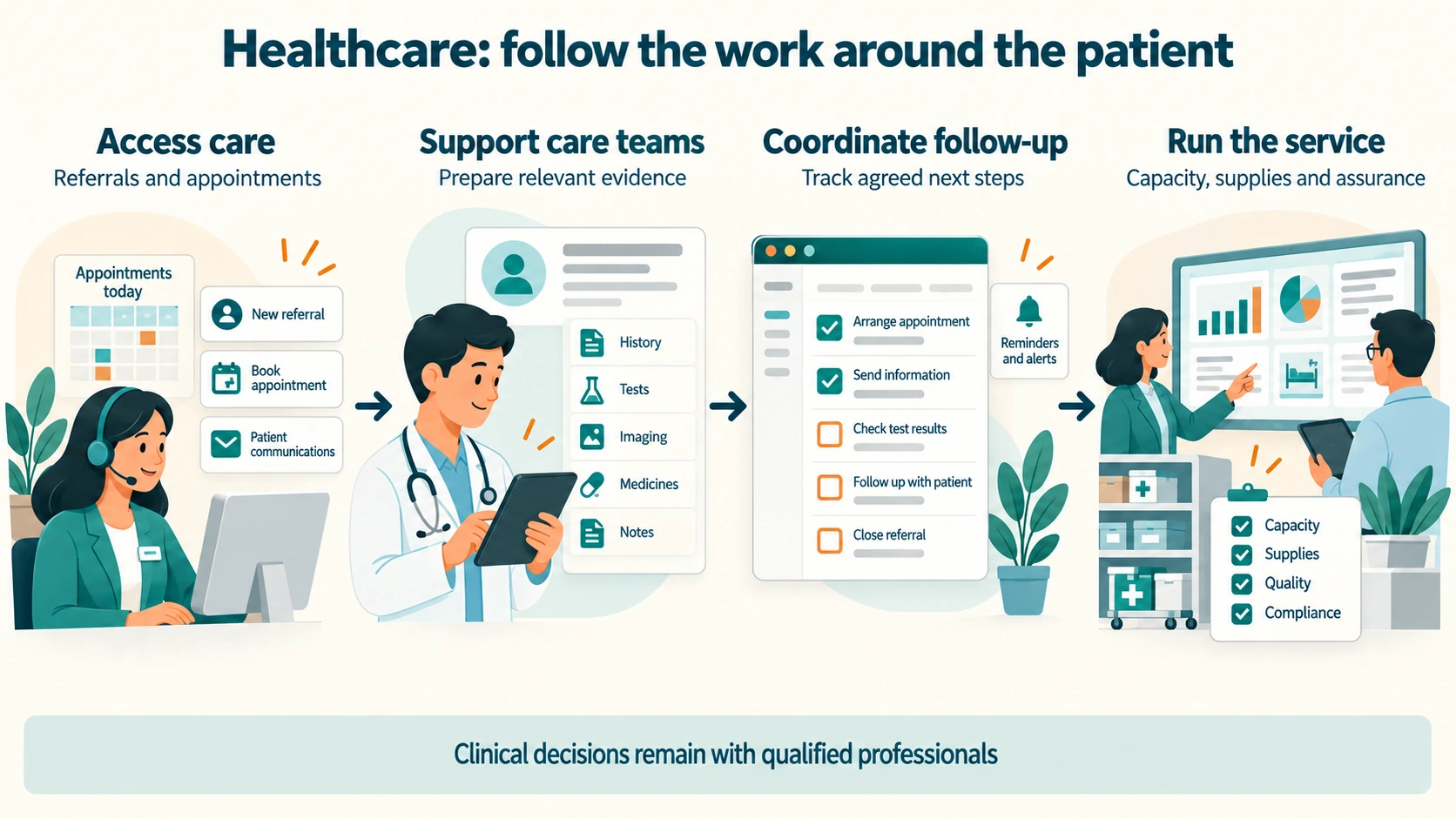
From referral to appointment
Keep agreed follow-up from getting lost
Prepare the evidence before a consult or MDT
Collect and check compliance evidence
The rules that bind the work
Clinical decisions stay with clinicians. The Australian Commission on Safety and Quality in Health Care published its AI Clinical Use Guide in August 2025. Clinicians stay accountable for AI output that enters the record. The Commission's ambient scribe scenario adds a warning. A tool that suggests a diagnosis or treatment may need listing with the Therapeutic Goods Administration (TGA). So no agent on these pages sets urgency, reads a result, or recommends treatment.
The rule for decisions about people. A named person decides any significant decision about a person, and health is one of them. Here that covers clinical triage, declining a referral, booking out of order, and sending a patient back to the GP. The rule sits beside the deterministic zones.
Consent and privacy. The Privacy Act 1988 and state health records laws apply in Australia. The Health Information Privacy Code 2020 applies in New Zealand. Contact preferences and consent are recorded, and an agent checks them before any message. Two sets of data sovereignty principles also shape what data may be used. They are Te Mana Raraunga for Maori data, and Maiam nayri Wingara for Aboriginal and Torres Strait Islander data.
My Health Record. Since 1 July 2026, pathology and imaging reports go to My Health Record by default. They must be uploaded within 24 hours of release. The rule covers written reports, not the images (Australian Digital Health Agency, accessed 15 October 2026). An agent may use these documents only where the service's access policy and the patient's own controls allow.
Patient identifiers. In Australia, the Individual Healthcare Identifier (IHI) comes from the Healthcare Identifiers Service. The service is called with the organisation's NASH certificate. Check its rules before a vendor hosts an agent that looks up identifiers. In New Zealand, the National Health Index (NHI) has a live FHIR interface (Health New Zealand, accessed 15 October 2026).
Accreditation. Australian hospitals are assessed against the eight National Safety and Quality Health Service (NSQHS) Standards. Since 1 July 2023, assessments come at short notice, with at least 24 hours' warning (the Commission). A service can exclude up to 20 business days per cycle, according to a search summary of the Commission's page. A secondary summary says hospitals are reaccredited at least every three years. In New Zealand, services are audited against Nga Paerewa, NZS 8134:2021.
What runs in Australia and New Zealand today
Results are as reported by the party named. None is independently audited.
- Ambient scribes are live. Health New Zealand bought 1,000 Heidi scribe licences for every public emergency department (HINZ, 26 November 2025 [vendor]). It added 100 for mental health crisis teams. The minister later put use at about 1,250 staff, so the reports conflict. Metro South Health announced Heidi across five hospitals on 31 August 2026. In its trial, 92 percent of clinicians reported less admin time (Heidi Health [vendor]).
- Referral triage is at validation. At Logan, a model called ReferralAI suggests an urgency category for ENT referrals. Clinicians decide. A national study of AI-assisted colonoscopy triage invited sites in July 2026. A pelvic pain triage pilot runs at the Austin in Melbourne (undated).
- Public symptom triage is live. Healthdirect's virtual triage handled about 1.55 million encounters from April 2023 to March 2025 (Medical Republic, 2025).
- Vendor agents are arriving in primary care first. Heidi II launched on 28 September 2026. Its agents prepare charts and draft referrals, follow-ups and recalls. A clinician reviews before anything is sent. No Australian public hospital site was found (Medical Republic, 30 September 2026 [vendor]).
- One statewide EMR is coming. NSW is moving every district to one Epic record. The first go-live was in March 2026 (NSW Health, 27 March 2026). All districts are due by the end of 2028. It is not an agent. It brings a platform with vendor agents into Australian public health.
- Nothing found on follow-up or accreditation. No Australian or New Zealand public health service was found using an agent to check that follow-up was done. None was found collecting accreditation evidence with an agent.
- Not confirmed here. Epic's agents are not confirmed in Australia. Microsoft Dragon Copilot is not offered in Australia or New Zealand. Oracle's clinical agent has no Australian listing. All three were checked on 15 October 2026.
Evidence and limits
The estate is a composite. No Australian or New Zealand health service publishes its full system estate. The table is industry knowledge, not a survey.
Most deployment figures come from vendors or their releases. Four sources refused the fetch during research, so their status lines come from search summaries. Scribe numbers for New Zealand conflict between sources.
The four agent designs are proposals. Two of them have no published precedent in Australia or New Zealand: checking follow-up completion and collecting accreditation evidence.
Three accreditation facts were not verified. They are the current NSQHS version, its number of actions, and the period to fix a Not Met action. The Commission's site timed out during research. Check them before relying on them.
Next step
Start with referral to appointment, the fullest worked example. The healthcare blueprint sets out the four agents as one design.
Explore this topic
Research for this page was done on 15 October 2026. The estate is a composite of a public hospital network in Australia or New Zealand.
Where the work sits in established frameworks. WHO's 2023 classification of digital interventions gives common names, including referral coordination and scheduling (WHO listing). APQC's Healthcare Provider process framework offers a process view. This page uses its own patient-service journey, not a formal mapping to either.
Vendor agents, status on 15 October 2026.
- Vendor and agent
- Epic Art
- What it does
- Clinician agent: notes, chart summaries, incidental findings follow-up
- Status
- Live in US outpatient specialties from early 2026 [vendor]
- In Australia or New Zealand
- Not confirmed. NSW, the ACT and Parkville run Epic.
- Vendor and agent
- Epic Emmie
- What it does
- Patient agent inside MyChart
- Status
- First live at Sutter Health, March 2026 [vendor]
- In Australia or New Zealand
- Not confirmed
- Vendor and agent
- Epic Agent Factory
- What it does
- Build and run custom agents
- Status
- Previewed March 2026
- In Australia or New Zealand
- No
- Vendor and agent
- Oracle Health Clinical AI Agent
- What it does
- Notes, orders, coding, chart review. Nursing version from September 2026.
- Status
- US commercial. UK note agent from February 2026 [vendor]
- In Australia or New Zealand
- No Australian listing found
- Vendor and agent
- Microsoft Dragon Copilot
- What it does
- Ambient notes with plug-ins and agents
- Status
- Available in the US, Canada, UK, Ireland and parts of Europe [vendor]
- In Australia or New Zealand
- No
- Vendor and agent
- Microsoft Healthcare Agent Orchestrator
- What it does
- Agents for tumour board preparation
- Status
- Launched May 2025. Research partners exploring [vendor]
- In Australia or New Zealand
- No deployment found
- Vendor and agent
- Heidi II
- What it does
- Chart preparation, referrals, follow-ups, recalls
- Status
- Launched 28 September 2026 [vendor]
- In Australia or New Zealand
- Yes, primary care first
- Vendor and agent
- Hyro
- What it does
- Voice and chat agents for scheduling
- Status
- Live at more than 45 US health systems [vendor]
- In Australia or New Zealand
- No site found
Sources.
- Australian Digital Health Agency, My Health Record sharing by default, in force 1 July 2026, accessed 15 October 2026.
- Australian Digital Health Agency, National Healthcare Interoperability Plan 2023-2028, published 11 July 2023. 33 of 44 actions were complete in the January to March 2026 report.
- ACSQHC, short notice assessments, from 1 July 2023.
- ACSQHC, AI Clinical Use Guide and ambient scribe scenario, August 2025.
- ACSQHC, NSQHS Standards. The site timed out on 15 October 2026. The eight standard names were checked against a secondary summary.
- Victorian Department of Health, ambient AI scribes advisory, June 2026.
- HL7 Australia, AU Core and AU eRequesting, accessed 15 October 2026.
- Health New Zealand, NHI FHIR API and NZ FHIR Registry, accessed 15 October 2026.
- NSW Health, Single Digital Patient Record now live, 27 March 2026. TechPartner News reported Hunter New England live on 3 June 2026.
- HINZ, Heidi scribe in New Zealand emergency departments, 26 November 2025 [vendor release].
- Heidi Health, Metro South rollout, 31 August 2026 [vendor].
- The Medical Republic, Heidi II agents, 30 September 2026.
- The Medical Republic, Healthdirect virtual triage, 2025.
- HIT Consultant, Epic at HIMSS 2026, 10 March 2026.
- HLTH, Oracle Clinical AI Agent for nursing, 15 September 2026.
- Microsoft, Dragon Copilot availability, accessed 15 October 2026.
- NZSG, national validation study of AI-assisted colonoscopy triage, July 2026.
- University of Melbourne, AI in the gynaecology waitlist, undated.
Cite this page
Written by Murali Sid, Founder and AI Systems Architect, last updated 15 October 2026. Licensed CC BY-SA 4.0, so quote it freely with attribution.
Murali Sid (2026). Healthcare: follow the work around the patient. Agentic Architecture Skills. https://www.agenticarchitectureskills.com/use-cases/healthcareMachine-readable version of this page: /use-cases/healthcare.md
Explore business opportunities
Pick an industry and see its estate and use cases. Then follow one worked example from today's process to the process with agents.
Energy and resources: the estate and where agents fit
The systems a generator, an oil and gas operator and a miner run, layer by layer. The rule that keeps agents off the control path. The use cases and named deployments placed on that estate.