Public sector
A proposed workflow for public sector. Revised 17 September 2026. The roles below are design options, not claims that these agents are deployed or that multiple agents are necessary.
The business opportunity
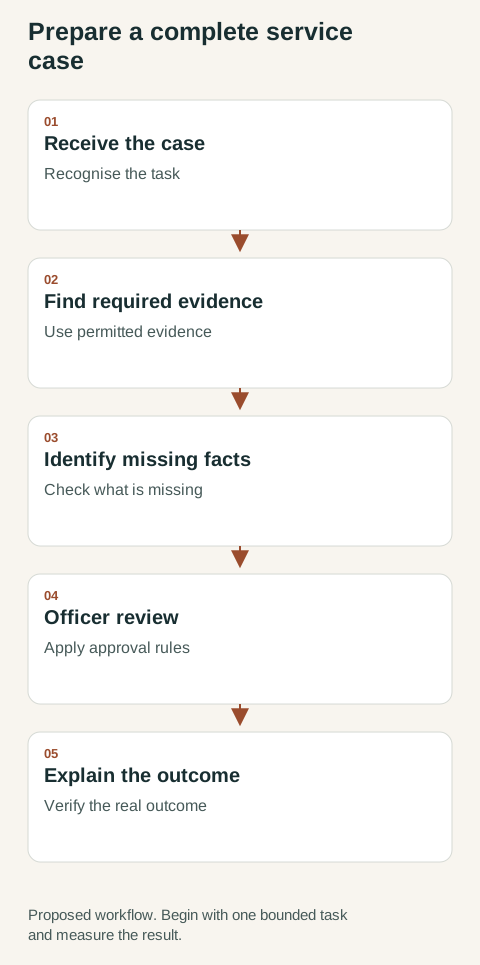
A public body needs to assemble the records for a permit or benefits case. Staff must identify missing evidence, apply the correct policy version, and provide an understandable explanation.
Start with the simplest useful solution
Compare the agent with structured forms, document checklists, and case-management rules. Use the same representative cases and count human review, errors, integration, and ongoing operation. Add an agent only where choosing what to investigate or handling varied evidence improves the result.
Proposed responsibilities
- Agent
- Case preparation agent
- What it does
- Assembles the file, checks completeness, flags missing evidence, drafts the summary
- Autonomy and learning position
- A3, L2
- Notes
- The strongest case in the vertical. Prepares; the officer decides
- Agent
- Citizen enquiry agent
- What it does
- Answers process and status questions from a governed corpus
- Autonomy and learning position
- A3, L2
- Notes
- Full customer-facing control set, plus accessibility duties
- Agent
- Records and retention agent
- What it does
- Classifies, applies retention schedules, prepares disclosure responses
- Autonomy and learning position
- A3, L1
- Notes
- Statutory retention is deterministic
- Agent
- Translation and plain-language agent
- What it does
- Adapts official communication for language and reading level
- Autonomy and learning position
- A2, L1
- Notes
- High value, low risk, consistently underused
- Agent
- Eligibility decision agent
- What it does
- Decides entitlement
- Autonomy and learning position
- Not recommended at any autonomy level
- Notes
- Assess applicable law and preserve an effective route to human review
Start with one agent and ordinary tools. Separate a responsibility only when it needs different permissions, independent review, or its own operating schedule. The autonomy and learning positions are starting choices to test, not certification levels.
How the architecture supports the task
Identity and policy (direct), observability and audit trail (direct: appealability makes the audit trail load-bearing), runtime (direct: sovereignty routing), knowledge and memory (direct), human oversight (direct), tool gateway and evaluation and release (supporting).
Controls and human decisions
Keep consequential decisions with authorised officers under applicable policy. Provide a way to correct records and challenge an outcome.
Give every tool call a task identity, a limited permission scope, and a recorded result. Before a write, check that the source record has not changed. Stop when required evidence is unavailable, the task budget is reached, or a proposal exceeds the authorised scope.
A useful investigation loop
Observe the exception, identify the missing fact, request that evidence, and check whether it changes the proposed action. Repeat only while there is a concrete unanswered question. End with a reviewed proposal, a confirmed result, or an explicit request for human help.
Economics and measures
Measure time to a complete case, repeat requests, decision corrections, accessibility, and the effort required from the applicant.
Agree the baseline with the process owner. Count value only after the outcome is confirmed. Compare the value of recovered time and improved outcomes with the full cost of tools, models, evidence preparation, supervision, and correction.
Limits to test
Test cases involving missing records, language differences, and unusual circumstances. An incomplete digital record must not be treated as proof that a claim is false.
Evaluate ordinary cases, uncommon failures, conflicting evidence, and recovery after an interrupted action before expanding authority.
External reading
The workflow above is the guide's proposal. These sources support the general investigation and risk-management methods; they do not validate the proposed business result.
- ReAct: reasoning and acting with language models, 2022. Research basis for alternating reasoning and tool use.
- NIST AI Risk Management Framework, 2023. General framework for managing AI risks.
Sources reviewed 17 September 2026.
Cite this page
Written by Murali Sid, Founder and AI Systems Architect, last updated 15 October 2026. Licensed CC BY-SA 4.0, so quote it freely with attribution.
Murali Sid (2026). Public sector. Agentic Architecture Skills. https://www.agenticarchitectureskills.com/library/blueprints/verticals/public-sectorMachine-readable version of this page: /library/blueprints/verticals/public-sector.md
Banking and financial services
A proposed workflow for banking and financial services. Revised 17 September 2026. The roles below are design options, not claims that these agents are deployed or that multiple agents are necessary.
Glossary
Canonical definitions used across the guide. Terms are defined once here and used consistently everywhere. Additions and corrections via PR.