Manufacturing and supply chain
A proposed workflow for manufacturing and supply chain. Revised 17 September 2026. The roles below are design options, not claims that these agents are deployed or that multiple agents are necessary.
The business opportunity
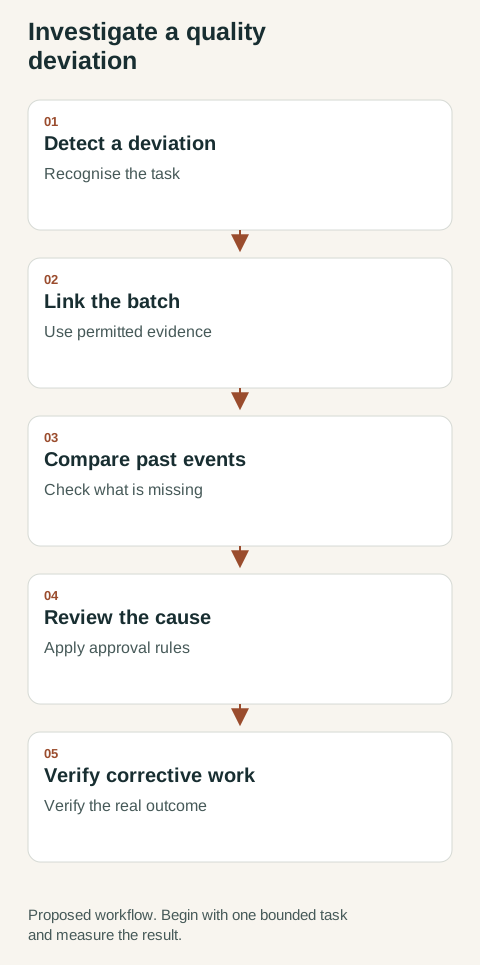
A production line produces an unexpected defect. A quality engineer needs inspection images, batch records, machine readings, and the approved process specification.
Start with the simplest useful solution
Compare the agent with statistical process control, inspection rules, and established maintenance analysis. Use the same representative cases and count human review, errors, integration, and ongoing operation. Add an agent only where choosing what to investigate or handling varied evidence improves the result.
Proposed responsibilities
- Agent
- Maintenance planning agent
- What it does
- Correlates condition data, history and work backlog; proposes and schedules maintenance
- Autonomy and learning position
- A3, L2
- Notes
- The best internal case. Failures cost a rescheduled job
- Agent
- Quality investigation agent
- What it does
- Assembles process, batch and inspection evidence for a deviation; proposes root cause
- Autonomy and learning position
- A2 to A3, L2
- Notes
- Proposes. Quality releases
- Agent
- Changeover assistance agent
- What it does
- Retrieves the procedure, the last changeover's issues and the current line state
- Autonomy and learning position
- A2, L1
- Notes
- Directly the residual work the metaphor describes
- Agent
- Supply exception agent
- What it does
- The supply-chain department blueprint, applied to production materials
- Autonomy and learning position
- A3, L2
- Notes
- See the department blueprint
- Agent
- Production control agent
- What it does
- Takes autonomous production action
- Autonomy and learning position
- Not recommended
- Notes
- No named-factory case with measured outcomes exists. See limits
Start with one agent and ordinary tools. Separate a responsibility only when it needs different permissions, independent review, or its own operating schedule. The autonomy and learning positions are starting choices to test, not certification levels.
How the architecture supports the task
Knowledge and memory (direct: historian, asset register, procedures, batch records), human oversight (direct: the floor crew is the point), tool gateway (direct on the information path), evaluation and release (direct), observability and audit trail, identity and policy, runtime (supporting, with the OT boundary from the line of business and OT layer (R05)).
Controls and human decisions
Keep equipment control and product release in their approved systems. Use the agent to assemble evidence and suggest investigations.
Give every tool call a task identity, a limited permission scope, and a recorded result. Before a write, check that the source record has not changed. Stop when required evidence is unavailable, the task budget is reached, or a proposal exceeds the authorised scope.
A useful investigation loop
Observe the exception, identify the missing fact, request that evidence, and check whether it changes the proposed action. Repeat only while there is a concrete unanswered question. End with a reviewed proposal, a confirmed result, or an explicit request for human help.
Economics and measures
Measure first-pass yield, investigation time, recurrence, false alarms, review effort, and recovery after an incorrect suggestion.
Agree the baseline with the process owner. Count value only after the outcome is confirmed. Compare the value of recovered time and improved outcomes with the full cost of tools, models, evidence preparation, supervision, and correction.
Limits to test
Similarity to an earlier event does not establish the cause. Test competing explanations and validate the corrective action.
Evaluate ordinary cases, uncommon failures, conflicting evidence, and recovery after an interrupted action before expanding authority.
External reading
The workflow above is the guide's proposal. These sources support the general investigation and risk-management methods; they do not validate the proposed business result.
- ReAct: reasoning and acting with language models, 2022. Research basis for alternating reasoning and tool use.
- NIST AI Risk Management Framework, 2023. General framework for managing AI risks.
Sources reviewed 17 September 2026.
- Government guidance on integrating AI in operational technology, December 2025. Additional reading for deployments that interact with industrial systems.
Cite this page
Written by Murali Sid, Founder and AI Systems Architect, last updated 15 October 2026. Licensed CC BY-SA 4.0, so quote it freely with attribution.
Murali Sid (2026). Manufacturing and supply chain. Agentic Architecture Skills. https://www.agenticarchitectureskills.com/library/blueprints/verticals/manufacturing-and-supply-chainMachine-readable version of this page: /library/blueprints/verticals/manufacturing-and-supply-chain.md
Mining and resources
Start with a bounded investigation or evidence task. Mining examples in this guide build on safety, production, and audit work described by the author. The complete agent extensions remain proposals.
Banking and financial services
A proposed workflow for banking and financial services. Revised 17 September 2026. The roles below are design options, not claims that these agents are deployed or that multiple agents are necessary.