Workflow, one agent, or several?
Choose coordination that helps the task rather than adding unnecessary moving parts.
An enterprise needs work completed, whether that means preparing an inspection request or investigating repeated audit findings. Which decisions should be fixed in software, which should one agent make, and which genuinely need separate investigators?
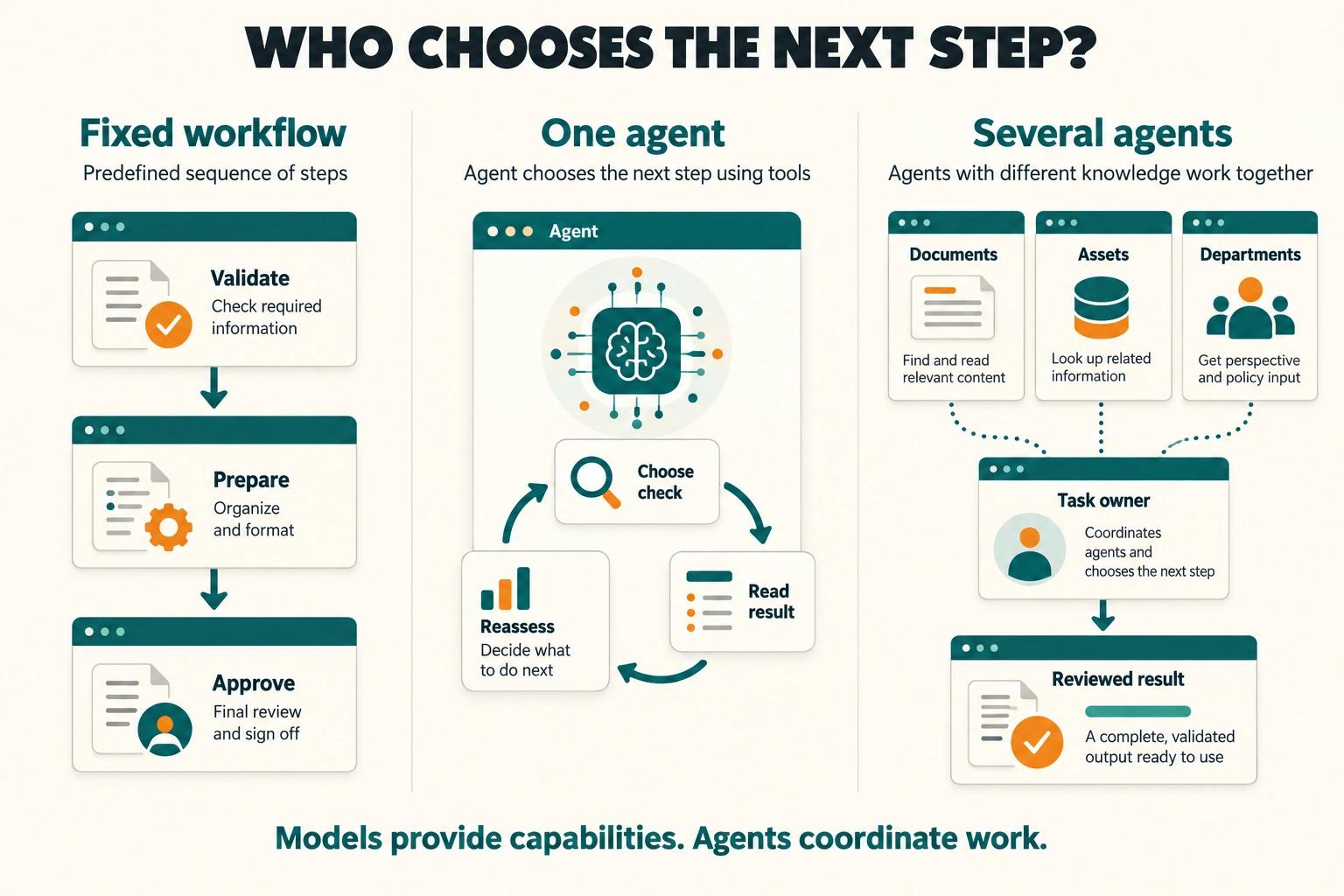
Adding agents can create more work
A natural design is to assign an agent to every role: planner, researcher, critic, writer, and reviewer. But who owns an unanswered question? What happens when two agents use different versions of the same standard? Who notices that both created the same inspection request?
Before separating the work, make the responsibility for the complete result clear. Extra agents should solve a specific problem that a simpler arrangement could not handle well enough.
A workflow when the sequence is known
Consider an inspection request with established rules: validate the asset identifier, check required fields, prepare the request, and obtain approval. Keep these steps explicit in software. A model can interpret the free-text description within that workflow without choosing the entire process.
This gives the business a predictable route through known work. Test exceptions such as missing fields and existing requests. Add a separate investigation only where the fixed route cannot resolve the case.
One agent for a bounded investigation
Now consider an audit finding whose supporting records disagree. The useful next check depends on what the agent finds. It might inspect the source report, compare its dates with the completion record, then request missing evidence.
Give one agent a clear question, permitted tools, and time and cost limits. Define when the evidence is sufficient, when to stop, and when to ask a person. A repeated unproductive lookup should not become an endless loop. Tools and the loop explains how the loop is stopped.
Several agents when separation helps
A mining compliance investigation may need separate checks of standards, equipment records, and departmental evidence. Separation is a candidate when the investigations have distinct scopes or can make useful progress independently.
Keep one owner for the final result. A document specialist might identify a requirement while an asset specialist checks relevant inspection records. The owner must reconcile both against the same site, period, and version of the standard. Several agents agreeing is not independent verification if they all rely on the same wrong source.
Make the handoff explicit
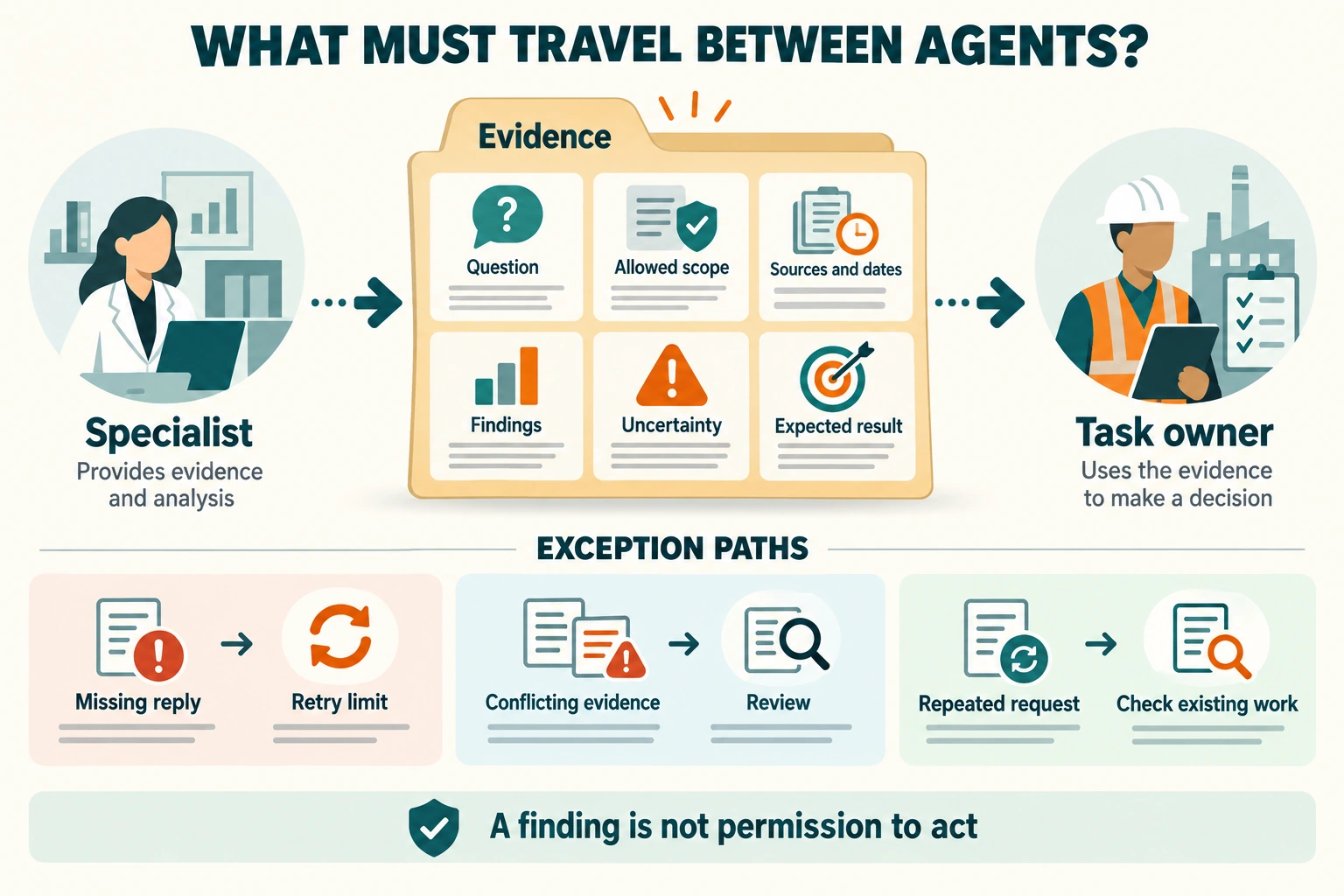
Pass the question, permitted scope, source references, findings, unresolved issues, and expected result. Identify the asset, site, time period, and source version. Assign ownership of shared state so two agents cannot silently overwrite each other's work.
For a missing reply, set a retry limit and a route to the owner. For conflicting evidence, preserve the disagreement for review. For repeated requests, check the recorded operation before sending another. The autonomy contract sets the allowed actions independently of how agents are arranged.
Evaluate the complete result
Compare the simplest credible workflow, one capable agent, and the proposed team on representative tasks. Count duplicated work, coordination calls, expert review, elapsed time, failures, and full cost. Do not select a team solely because individual specialists produce impressive answers.
Test missing responses, conflicting records, changed permissions, and repeated requests. Keep the team only when its contribution justifies the additional coordination. Explore systemic audit investigation. The decision on several agents versus one good loop gives the verdict. It sits with the agent platform layer (R07). That layer runs the loop and its limits.
Evidence and limits
Anthropic's Building effective agents separates predefined workflows from model-directed work and describes coordination patterns (19 December 2024). ReAct studies an agent that alternates reasoning and action (2022). Both were reviewed on 18 September 2026. The industrial arrangements here are design proposals to test, not vendor-validated deployments.
Next step
Give specialist models clear jobs on combine models around a useful task.
Cite this page
Written by Murali Sid, Founder and AI Systems Architect, last updated 15 October 2026. Licensed CC BY-SA 4.0, so quote it freely with attribution.
Murali Sid (2026). Workflow, one agent, or several?. Agentic Architecture Skills. https://www.agenticarchitectureskills.com/ladder/single-and-multiple-agentsMachine-readable version of this page: /ladder/single-and-multiple-agents.md