Choose how to store memory
Compare six implementation choices after deciding what the memory is for.
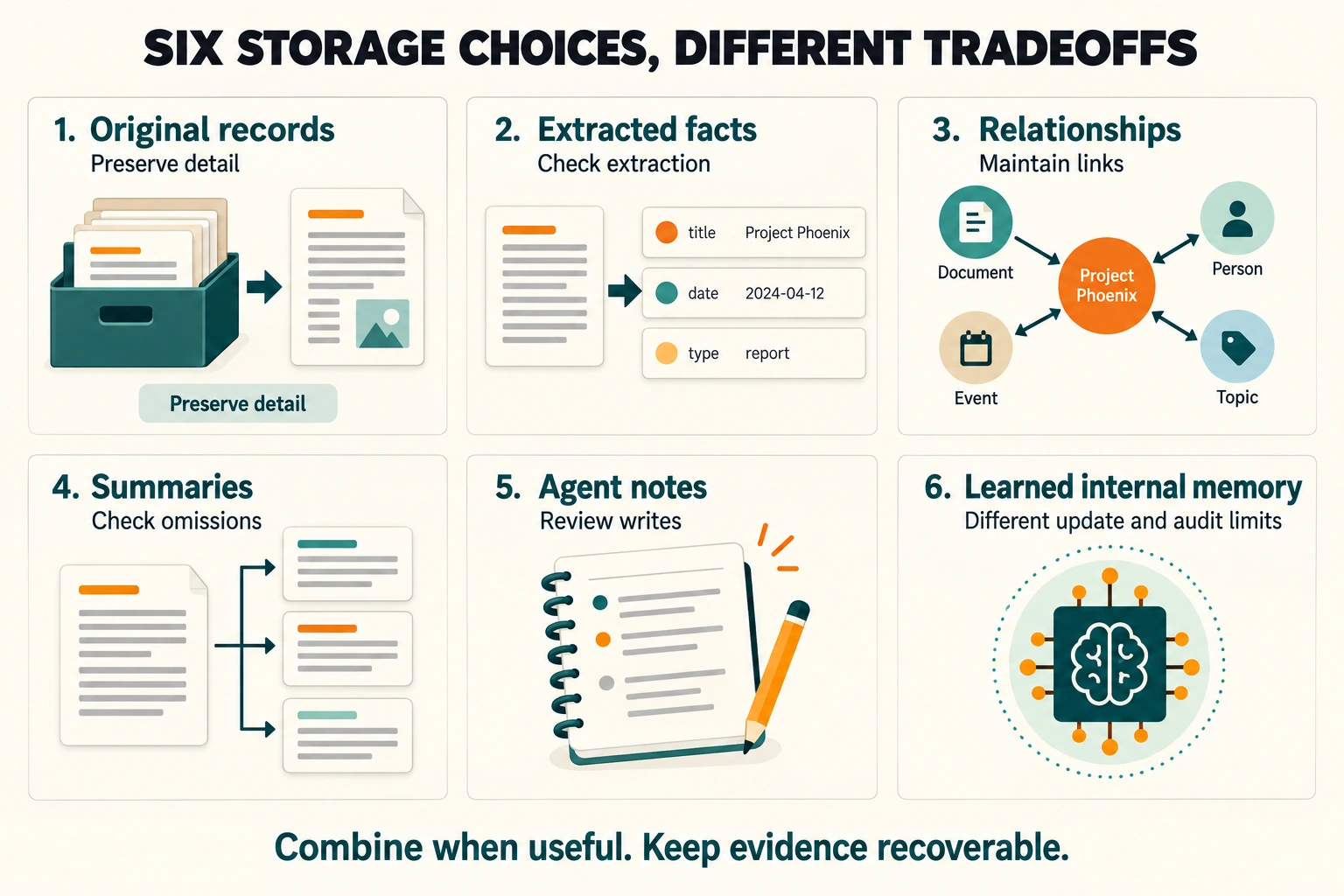
You know which facts, experiences, and methods should be retained. The next question is how to keep them usable. Saving only a summary is compact, but can omit a detail needed later. Saving every source preserves detail, but still needs a way to find and check it.
Keep memory purpose separate from implementation
Episodic memory describes the role of a past experience. It might be stored as an original case record with a summary and a search index. Long-term describes reuse across tasks. It does not specify a database or require embeddings.
The choices below can be combined. Start with source preservation and the simplest retrieval that meets the task, then justify each additional representation.
Original records: preserve the detail
Retain the source text or media under its lifecycle policy. Use exact lookup, keywords, and suitable indexes to find it. This keeps omitted details available for reinspection, but duplicates, parsing, search quality, storage, and access still need engineering. Embedding an index is model work even if there is no generative extraction.
Extracted facts: make repeated facts easy to use
A small record can hold a site's owner, a case status, or an explicit preference. Require source references, validity information, and a correction path. Extraction can omit qualifications or attach a fact to the wrong entity. Keeping the source lets a later task inspect what was lost in the derivative.
Relationships: answer questions about connections
Links between sites, standards, controls, and evidence can help trace dependencies. Begin with reliable keys and joins. A graph may help more complex relationship questions, but its edges need provenance and maintenance. A link inferred by a model is still a claim to check.
Summaries: navigate large bodies of information
Summaries can help locate themes or choose which source sections to read. They should point back to the supporting material. A summary that is not refreshed after corrections can mislead. RAPTOR, 2024, explores tree-organized summaries for retrieval; it is one approach, not a required architecture. Reviewed 18 September 2026.
Agent notes: make selected memory inspectable
An agent can propose notes or update a structured memory file through tools. Enforce scope, source links, versioning, and review rules. The fact that a note is readable does not make its contents true. MemGPT, 2023, explores management of information across memory levels. Reviewed 18 September 2026.
Learned internal memory: assess different limits
Model weights, learned memory modules, and runtime caches are different mechanisms with different update behavior. Do not treat them as one interchangeable persistent store. Ask how a specific fact can be corrected, removed, scoped, and connected to evidence. Titans, first submitted December 2024, studies neural memory updated at test time. Reviewed 18 September 2026. A research result does not establish an enterprise audit or deletion mechanism.
Managed memory services, as of October 2026
The three largest clouds now sell managed long-term memory for agents:
- AWS Bedrock AgentCore, including its memory, became generally available on 13 October 2025 (AWS) [vendor].
- Google Vertex AI Memory Bank became generally available on 17 December 2025 (Google release notes) [vendor].
- Microsoft Foundry Agent Service memory is still in preview (Microsoft Learn) [vendor].
All three split memory for one session from memory kept across sessions. The choices on this page still apply inside them. You still decide what to extract, how to keep the source, and when to expire it. Published scores for these services do not always survive a rerun. See test memory against the work.
Gartner wrote in July and August 2026 that production agents need governed memory, not ad hoc builds (Gartner abstract). Only the abstracts were read. No survey measures how many enterprises organise memory on purpose. Treat a managed service as one option to test against the simplest baseline. Sources read 14 October 2026.
Decide when to do the work
Extraction during ingestion pays before questions arrive. Retrieval and interpretation at query time pay as the memory is used. Background consolidation adds another update process. Measure write cost, read cost, freshness, omissions, and recovery together. No storage choice eliminates the need for ownership and lifecycle controls.
Continue the story: Understand the role of long context.
Cite this page
Written by Murali Sid, Founder and AI Systems Architect, last updated 15 October 2026. Licensed CC BY-SA 4.0, so quote it freely with attribution.
Murali Sid (2026). Choose how to store memory. Agentic Architecture Skills. https://www.agenticarchitectureskills.com/memory/six-architecturesMachine-readable version of this page: /memory/six-architectures.md